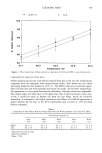
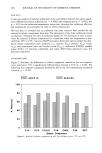
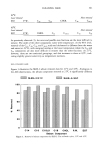
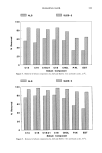
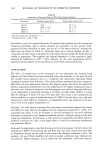
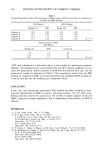
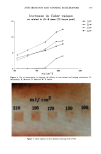
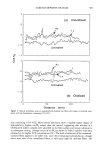
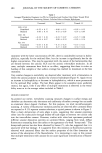
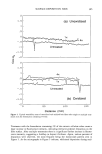
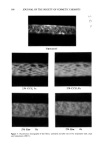
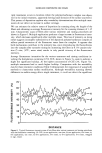
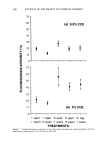
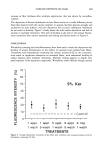
390 JOURNAL OF THE SOCIETY OF COSMETIC CHEMISTS adsorption but cannot detect the buildup observed with microfluorometry. Wettability measurements show that oxidized fibers have a stronger tendency to adsorb and retain surface deposits, reflecting the higher affinity between the cationic polymer and nega- tive charges formed on the fiber surface during oxidation. We have not done micro- fluorometric scanning of oxidized fibers, since uranine proved not to be a suitable fiuo- rochrome for such specimens. The formulation containing 5 % keratin hydrolysate appears to deposit on the scale faces of the fiber surface and not to build up in multiple applications. Deposition of Ker on oxidized fibers results in a considerable increase in surface hydrophilicity after a single treatment, with only a slight further increase after multiple treatments. These results possibly reflect a more uniform distribution of the surface deposits on oxidized hair. REFERENCES (1) Y. K. Kamath, C. J. Dansizer, S. Hornby, and H.-D. Weigmann, Surface wettability scanning of long filaments by a liquid membrane method, Textile Res. J., 57, 205-213 (1987). (2) j. Garcia-Dominguez, M. R. Julia, A. de la Maza, J. M. Pujol, and J. Sanchez, A method for determining the distribution of cationic shrink-resistant resins on wool, J. $oc. Dyers Color., 92, 433-439 (1976). (3) F. R. Rothery and M. A. White, Determination of the presence and distribution of polymers on wool, J. Soc. Dyers Color., 99, 11 (1983). (4) U. Meyer, Selektive Markierung von Filzfreiausrfistungen auf Wolle mit fluoreszierenden Verbin- dungen, Textilveredl., 17, 440-446 (1982). (5) H. Gottschalk, G. Hohm, and H. Kaminski, Verteilung von haarfestigenden Polymeren auf Hu- manhaar, Proc. Internat. Wool Text. Res. Conf., Aachen, 1975, Vol. III, pp. 349-358. (6) Y. K. Kamath, C. J. Dansizer, and H.-D. Weigmann, Wetting behavior of human hair fibers, J. Appl. Polym. Sci., 22, 2295-2306 (1978). (7) I. H. Leavet, CSIRO, Melbourne, Australia, personal communication.

j. Soc. Cosmet. Chem., 41, 391 (November/December 1990) Book Review SOAP TECHNOLOGY FOR THE 1990's, edited by Luis Spitz. American Oil Chemists' Society, Champaign, IL, 1990. Price: $95.00 ($75.00 for AOCS members). This 320-page volume describes the proceedings of a seminar or "AOCS short course" that took place in Cincinnati, Ohio, May 1-2, 1989, among "major soap companies and experts." The title, Soap Technology for the 1990's is somewhat misleading, because this book is actually a description of soap technology, history, and marketing of the past and the present, more than it is of soap technology for the future. Although there a few pages of trends and predictions, this book is more a description of the state of the art. Nevertheless, all considered, this book is a good primer to introduce technolo- gists or marketers to a general under- standing of the history and introductory technology of bar cleaning products in- cluding soaps, combars, and syndets. This primer begins by describing the ancient history of soap and then moves to the history of soap companies and the his- tory and the positioning of soap brands of the past and the present. The deodorancy and skin care segmentation that occurred after World War II is then described. Tile book also summarizes the chemistry and physical properties of soap raw materials and the more important processing steps in the manufacture of soap, including sa- ponification and neutralization washing, refining, bleaching, deodorization, and hydrogenation and drying and finin- ishing. The final chapter describes soap packaging, including a discussion of bar shapes, wrapping, and cartoning. Other chapters briefly describe syndets and soap/syndet formulations and spe- cialty soaps, including floating, marbel- ized, translucent, and transparent bars. Perfuming and coloring is described with regard to the perception of soap bars. The book also contains a brief section summar- izing the regulatory status of soaps as cos- metics, as OTC drugs, and the soap "ex- emption" status. A chapter is also in- cluded on the separation and purification of glycerine, a by-product of soap manu- facture. The primary focus of this book is on soap bar products, with an adequate intro- duction into syndet and syndet/combar formulations, but with virtually no dis- cussion of liquid soaps, which have re- cently become a significant factor in the marketplace. Soap Technology for the I990's can be a valuable addition to our libraries if it is viewed as an introductory guide into the history, the marketing, and the tech- nology of soap bar products.--CLAR- ENCE R. ROBBINS--Colgate Palm- olive Co. 391
Purchased for the exclusive use of nofirst nolast (unknown)
From: SCC Media Library & Resource Center (library.scconline.org)