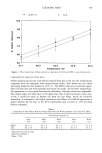
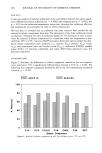
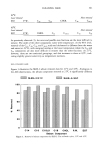
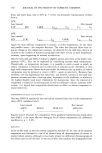
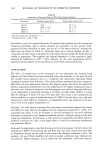
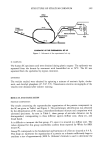
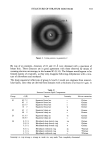
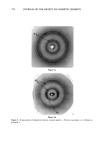
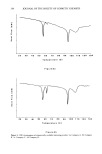
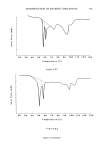
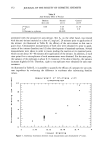
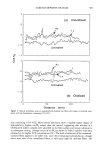
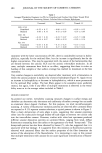
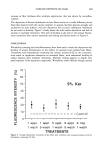
342 JOURNAL OF THE SOCIETY OF COSMETIC CHEMISTS from, and lower than, that at 43øC (p = 0.05). An alternative representation of these data is: 21øC Least removed ?dost removed P.W. EST CHOL C 18:21 C 16 C 14 C 18 43øC Least removed ?dost removed EST P.W. C 18:21 C 14 CHOL C 18 C 16 Again the most difficult components to remove, at either temperature, are the esters and paraffin waxes--the nonpolar fractions. The other five fractions show some se- quence change as the temperature increases. As observed for the ALS data, there is an increase in the number of statistical groupings from three to four as wash temperature increases, again suggesting an increase in selectivity. Data for both ALS and SLES-2 indicate a slightly greater selectivity at the higher tem- perature (43øC). This can be explained by considering extreme wash temperatures. Theoretically, as temperature decreases, it is possible to reach a point at which no sebum component is removed and no selectivity of removal occurs. Similarly, at very high wash temperatures (above those practicable for washing hair on heads), all sebum components may be removed at close to 100%--again no selectivity. Between these extremes, one may hypothesize that selectivity, and removal, increase as the wash tem- perature increases and that a limiting value, dependent on the surfactant, is reached at the highest feasible wash water temperature for shampooing. Since the removal of a component is related to its melting point as well as surfactant-sebum-substrate inter- actions, it is logical that temperature should have an effect on sebum component re- moval selectivity. COMPARISON OF DATA: ALS AND SLES-2 One-way ANOVA analysis for the total sebum removed from hair at both temperatures shows (95% confidence level): Least removed ?dost removed ALS/21 ALS/43 SLES- 2/21 SLES-2/43 Figures 4 and 5 illustrate the comparisons. These graphical representations clearly show that SLES-2 is the more effective detergent for all sebum components (all differences significant at p = 0.05). SQUALENE In the earlier work on selective sebum component removal (1), the issue of the squalene component was discussed in view of its absence from all chromatograms of control or washed sebum extracts, although it was clearly present in calibration chromatograms of the sebum used to soil the hair. It was not evident why squalene had disappeared from

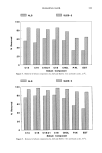
CLEANING HAIR 343 • ALS • SLES-2 100 8O 6O 4O 2O 0 C14 C16 C18:21 Cl 8 CHOL P.W. EST Sebum Component Figure 4. Removal of sebum components by ALS and SLES-2: Ten soil/wash cycles, 2 IøC. • ALS • SLES-2 o E lOO 8o 6o 4o 2o C14 C16 C18:21 C18 CHOL P.W. EST Sebum Component Figure 5. Removal of sebum components by ALS and SLES-2: Ten soil/wash cycles, 43øC.
Purchased for the exclusive use of nofirst nolast (unknown)
From: SCC Media Library & Resource Center (library.scconline.org)