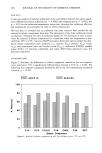
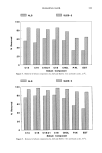
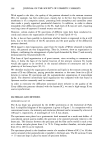
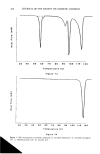
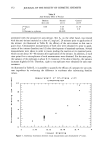
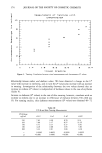
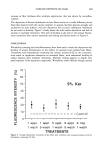
340 JOURNAL OF THE SOCIETY OF COSMETIC CHEMISTS HAIR DATA A two-way analysis of variance performed on the total sebum removal data shows signif- icant differences between surfactants (p = 0.0002) and temperatures (p = 0.002), but p = 0.93 for the surfactant/temperature interaction, showing that surfactant effects at one temperature are essentially the same at other temperatures. Previous data (1) revealed that no surfactant was more selective than another for the removal of sebum components from hair. The detergency of the three surfactants tested in reference 1 followed the rules of surfactant theory (4). To determine if there is selec- tivity for removal of sebum components by a surfactant when the temperature is low- ered from 43øC to 2 IøC, one-way ANOVA statistics have been used to analyze the data. Seven sebum components were analyzed, i.e., myristic (C•4), palmitic (C•6), stearic (C•8), and unsaturated (oleic and linoleic) acids (C•8:2•) cholesterol (CHOL) paraffin waxes (P.W.) (11 fractions combined) and esters (EST) (from spermaceti wax five fractions combined). ALS-WASHED HAIR Figure 2 illustrates the differences in sebum component removal at the two tempera- tures removal at 2 IøC is significantly different from removal at 43øC (p = 0.05). The following also compares component removal by ALS at the two temperatures (statistical criterion, p = 0.05): • ALS/21C • ALS/43C 100 80 60 40 20 0 C14 C16 C18:21 C18 CHOL P.W. EST Sebum Component Figure 2. Removal of sebum components by ALS: Ten soil/wash cycles, 2 IøC and 43øC.

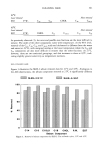
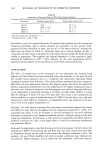
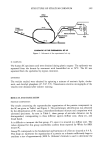
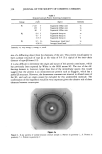
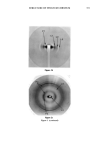
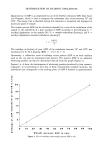
CLEANING HAIR 341 21øC Least removed Most removed EST P.W. C 16 C 14 CHOL C 18 C 18:21 43øC Least removed Most removed EST P.W. CHOL C 14 C 18:21 C 16 C 18 As previously observed (1), the ester and paraffin wax fractions are the most difficult to remove. The order of the other components varies with temperature. At the 95 % level, removal of the C14, C16, C18, and C18:21 acids and cholesterol is different from the waxes and esters (at 43øC), with marginal overlap at the lower temperature where the C16 and C14 components are also more difficult to remove than the other fractions. At 2 IøC, however, there are two statistical groupings, and this increases to three at 43øC, indi- cating slightly greater selectivity as temperature increases. SLES-2-WASHED HAIR Figure 3 illustrates the SLES-2 sebum removal data for 2 iøC and 43øC. Analogous to the ALS observations, the sebum component removal at 2 IøC is significantly different • SLES-2/21C • SLES-2/43C 100 80 ß 60 o E • 40 20 0 C 14 C 16 C 18:21 C 18 CHOL P.W. EST $ebum Component Figure 3. Removal of sebum components by SLES-2: Ten soil/wash cycles, 2 IøC and 43øC.
Purchased for the exclusive use of nofirst nolast (unknown)
From: SCC Media Library & Resource Center (library.scconline.org)