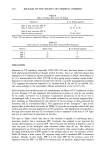
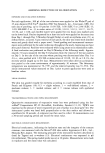
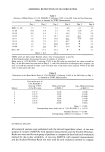
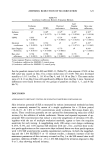
ASSESSING REDUCTION OF SLS IRRITATION 317 Table I Selection of Molar Ratios of 1.0% SLS:SLEC-5 Inducing •50% of the SLS Value for One Particular Subject as Assessed by TEWL Measurements Day 1 Day 2 Day 3 Day 4 Day 5 Day 8 SLEC-5 1.6% 1.3 1.7 3.4 6.8 6.3 1.5 1:1.00 0.8 1.8 3.5 7.8 11.8 2.7 1:0.50 0.9 2.4 5.1 14.9 17.6 2.9 1:0.25 1.5 3.5 10.1 22.6 26.7 4.6 1:0.17 1.6 4.4 15.8 39.1 41.0 14.0 1:0.13 1.8 7.6 21.5 46.7 • 2.3 1:0.10 1.2 5.0 27.8 48.9 • 2.2 1:0.08 1.2 5.6 26.3 53.4 • 3.5 -- SLS 1.0% 2.1 17.5 52.2 • • 3.1 SLS/2 = 8.8 26.1 TEWL values are daily values-Baseline values. Unit of measurement is g/m2/hr. • Patching procedure discontinued because of evidence of irritation. Molar ratios of 1.0% SLS:SLEC-5 inducing •50% of the SLS value are underlined the value recorded on Day 3 at the SLS-treated site was used on Days 4, 5, and 8 for calculation of subsequent days' response the ratio of 1:0.08 was selected on Days 2 and 8 because none of the molar ratios induced •50% of the SLS value on these particular days. Table II Derivation of the Mean Molar Ratio of 1.0% SLS:SLEC-5 Inducing •50% of the SLS Value on Day 3 as Assessed by TEWL Measurements First molar ratio of 1.0% SLS:SLEC-5 inducing • 50% Molar percentage log •o Molar percentage Subject of the SLS value of SLEC-5 of SLEC-5 1 1:0.17 14.29 1.1549 2 1:0.17 14.29 1. 1549 3 1:0.10 9.09 0.9586 4 1:0.17 14.29 1. 1549 5 1:0.17 14.29 1. 1549 6 1:0.25 20.00 1.3010 Mean = 1.1465 Corresponding mean molar ratio of 1.0% SLS:SLEC-5 = 1:0.16 Standard deviation = 0.1091 Corresponding coefficient of variation = 29% STATISTICAL ANALYSIS All statistical analyses were performed with the derived logarithmic values. A one-way analysis of variance (ANOVA) with repeated measurements and the Student-Newman- Keuls test were used for each group of panelists to compare the data from each evaluation method for day-to-day variability. A two-way ANOVA with repeated measurements and the Student-Newman-Keuls test were used for each evaluation method to compare

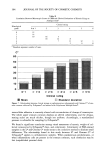
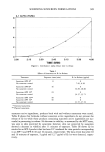
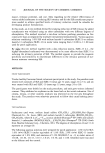
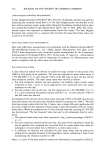
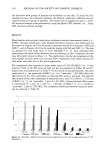
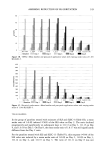
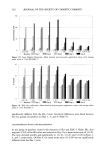
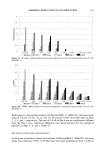
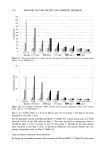
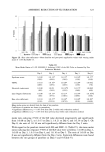
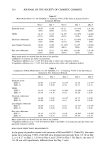
318 JOURNAL OF THE SOCIETY OF COSMETIC CHEMISTS the data from both groups of panelists for variability on each day. To study the rela- tionship between two evaluation methods, the Pearson correlation coefficient was cal- culated within each group of panelists. The chosen level of significance was p 0.05. All statistical analyses were performed by using the Quick CSS © (StatSoft, Inc., Tulsa, OK) statistical software package. RESULTS Mean baseline and post-patch application erythema scores and instrumental values (i. e., TEWL, electrical conductance, laser Doppler flowmetry and skin color reflectance) are illustrated in Figures 1A-E for the group of panelists treated with mixtures of SLS and SLEC-5, and in Figures 2A-E for the panelists treated with SLS and SLEC-13. The data are grouped for each molar ratio of 1.0% SLS:SLEC-5 or -13, with individual bars representing the mean values obtained prior to patching on Day ! (baseline) and one hour after patch removal on Days 1-5. The graphs show a day-by-day progression of the skin response for each molar ratio and also allow comparison of the values obtained for each molar ratio after one to five patch applications. The transformed data expressed as mean molar ratios of 1.0% SLS:SLEC-5 or -13 that induced •50% of the SLS value on each test day are presented in Tables III and IV, respectively, and summarized in Table V. In this system of data presentation, the mean molar ratio (i.e., the proportion of SLEC-5 or -13 to "neutralize" 1.0% SLS) reflects the effectiveness of the ether carboxylate in reducing SLS irritancy potential. The greatest effectiveness of the ether carboxylate is represented by a ratio of 1:0.08 (i.e., 0.08 part of SLEC-5 or -13 can "neutralize" ! part of !.0% SLS), whereas the least effectiveness is represented by a ratio of 1:!.00 (i.e., !.00 part of SLEC-5 or -!3 is needed to "neutralize" ! part of !.0% SLS). The correlation coefficients between evaluation meth- ods are reported in Table VI. 2.5 • 2 0.5 o SLS1.0% 1:0.08 1'010 1:0.13 1:0.17 1:0.25 1'050 1'1.00 SLEC-51.6% • Baseline • Day 1 • Day 2 • Day 3 • Day 4 • Day 5 Figure 1A. Erythema--Mean baseline and post-patch application scores with varying molar ratios of 1.0% SLS:SLEC-5.
Purchased for the exclusive use of nofirst nolast (unknown)
From: SCC Media Library & Resource Center (library.scconline.org)