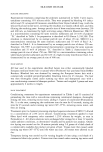
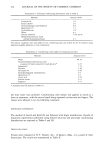
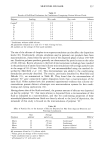
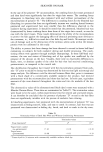
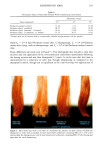
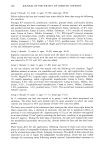
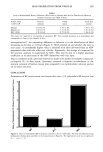
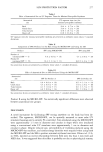
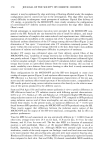
SILICONES ON HAIR 241 Table V Tristimulus Values of Dyed Hair Treated With Conditioning Color Sealant Tristimulus values Tress (treatment) a L* a* b* Piedmont (undyed control) Piedmont (dyed, unwashed) Piedmont (dyed, untreated, 12 washes) Piedmont {dyed, 2 treatments, 12 washes) 74.10 2.37 27.68 28.97 23.92 10.40 38.93 23.96 14.04 34.25 26.13 12.82 Tresses dyed for 40 minutes with a commercially available semipermanent red dye product. where Lf = L* of dyed Piedmont tresses after 12 shampooings, L i = L* of Piedmont tresses after dying, with no shampooings, and L o = L* of the Piedmont undyed control tress. These differences are easily seen in Figure 3. This photograph also includes a tress that received only one application of the color-protectant conditioner immediately following the dyeing process and was then shampooed 12 times. It can be seen that this tress is characterized by a reduction in color loss through shampooing as compared to the shampooed control, though not as significant as the tress receiving two applications of RED DYE UNTREATED TREATED 1X TREATED 2X TREATED W/•M2115 WISM2115 .............. AFTER 12 SHAMPOOS .................. Figure 3. Hair tresses dyed with a red shade of a temporary dye product: (a) dyed control, (b) dyed hair shampooed 12 times with a standard, (c) hair treated with conditioner containing SM2115 (1.25% active silicone) after the dyeing process, and (d) hair treated with conditioner containing SM2115 after dyeing and again after the sixth shampooing.

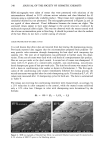
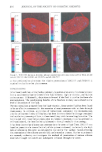
242 JOURNAL OF THE SOCIETY OF COSMETIC CHEMISTS the color-protectant conditioner. Similar results have been reported in studies compar- ing the benefits derived from this microemulsion to those of a cationic emulsion con- taining amodimethicone (14). A second series of tresses was prepared as described above, in this case with a shorter dyeing time. These tresses were analyzed by thin-section light microscopy. It was found that at short exposure times (less than or equal to 10 minutes), the dye does not penetrate to the medulla. Longer exposure times (greater than or equal to 30 minutes) resulted in deeper penetration and color level. During the shampooing process, for tresses untreated with the microemulsion prepared from polymer "D," some color is removed while the dye becomes more uniformly distributed throughout the fiber. The same dye diffusion is observed in tresses treated with the color-protectant conditioner, although the color loss is noticeably diminished. It can be concluded that the application of the silicone microemulsion retards the removal of direct dyes associated with sham- pooing but does not interfere with the diffusion of the remaining dye throughout the fiber. The reduction in color loss observed in these experiments was for shampoo removal of a semipermanent dye and should not be extrapolated to assume color protection for hair dyed with oxidative products, as fading of oxidative dyes is primarily chemically or photo initiated unless the hair is very badly damaged. The color loss of oxidatively dyed hair through shampooing is minimal for the hair type employed in these experiments. SILICONE PENETRATION INTO THE HAIR FIBER Though consumer perception of damaged hair is based upon macroscopic attributes, much damage also takes place within the interior of the fibers. On an atomic level, bleaching of hair results in oxidation of cystine, with formation of cysteic acid (4), while exposure to UV irradiation results in degradation of a number of amino acids within the keratin structure (15). Silicones are known to spread uniformly over the surface of hair fibers due to their high coefficients of spreading (9). Until recently, it was believed that silicone deposition was confined to the surface of the hair fiber. Experimental results of dynamic electrokinetic and permeability analyses recently published, however, suggest that the amino functional microemulsion of polymer "D" is capable of penetrating into the interior of a hair fiber (14). To determine whether silicone actually penetrates through the cuticle, a series of TOF- SIMS experiments was conducted comparing SM2115, the microemulsion based on polymer "D" and SM2101, a macroemulsion based on polymer "A." The level of silicone on the exterior of hair fibers was compared to that just below the surface of the cuticle. This was accomplished by polishing a small section of the fiber to remove the cuticle and then comparing the silicone levels of the cuticle surface and the freshly exposed hair cortex. Mapping of total ion concentration across the observed surfaces was performed to determine any surface feature effects that might affect relative ion intensities. In the case of the hair fiber treated with a macroemulsion of polymer "A," the level of silicone in the interior of the fiber was roughly 10% of that found on the exterior surface. In marked contrast, for hair treated with SM2115, the level of silicone on the interior was over 40% of that on the exterior. These results are clearly shown in Figures 4a-d. Figures 4a and 4c are dot maps of the partially polished hair fibers, showing siloxane concentration at the surface and in the cortex. Figures 4b and 4d indicate siloxane peak
Purchased for the exclusive use of nofirst nolast (unknown)
From: SCC Media Library & Resource Center (library.scconline.org)