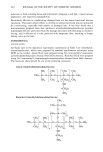
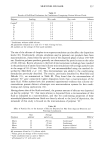
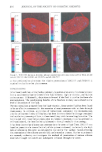
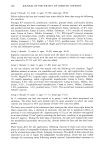
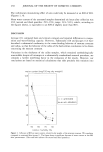
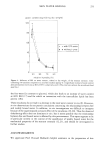
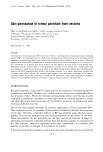
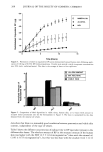
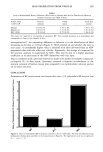
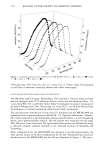
250 JOURNAL OF THE SOCIETY OF COSMETIC CHEMISTS The well-known moisturizing effect of urea could only be measured at an RH of 90% (Figures 3, 4). Mean water content of the untreated samples determined six hours after collection was 33% (second and third quartiles: 29%-35% range: 23%-53%), which, according to the figures shown, is equivalent to an RH of slightly more than 80%. DISCUSSION Leveque (11) compared hairs and stratum corneum and reported differences in compo- sition and water-binding capacity. However, Takenouchi (10) and Jacques (12) have described a substantial conformity in the water-binding behavior of stratum corneum and callus, so that the behavior of the callus of the heels allows conclusions to be drawn concerning the stratum corneum. Variations in the thickness of the callus samples, which remained methodologically unavoidable despite all attempts at a substantially standardized removal procedure, are certainly a further interfering factor in the evaluation of the results. However, our conclusions are based on statistical calculations that take precisely this variation into water content (mg/100 mg dry weight) 105 85 65 45 25 o- -o untreated •- -- w/o-emulsion 90 8,0 70 60 retative humidity (%) Figure 1. Influence of RH on water content, related to dry weight, of the stratum corneum. W/o emulsion compared to untreated skin (group 1). The figure shows a significant decrease of water content at low RH after pretreatment. (The error bars indicate the second and third quartiles.)

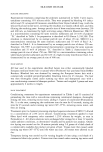
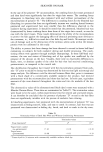
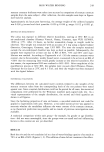
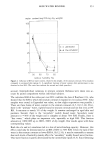
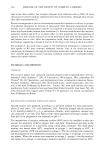
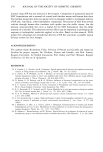
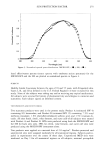
SKIN WATER BINDING 251 water content (mg/100 mg dry weight) 105 $5 .................................... 65 • ........................ 45 ...... v' '- .............. 5 90 80 70 60 reK]tive humidity (%) o- -o untreated _• •_ o/w-emulsion Figure 2. Influence of RH on water content, related to dry weight, of the stratum corneum. O/w emulsion compared to untreated skin (group 3). A significant decrease of water content after pretreatment is also observed at low RH. (The error bars indicate the second and third quartiles.) account. Interindividual variations in stratum corneum thickness were taken into ac- count by paired comparisons within individual subjects. The calculated RH of the callus just over 80% confirms the data of Buethner (13), who showed that the RH to which the stratum corneum is exposed in vivo is about 85%. (Our samples were stored in Eppendorf test tubes, so that slight evaporation was possible.) There are three forms of water content in the stratum corneum (4,5,10,12,14). First, there is the "primary" water, tightly bound to stratum corneum and not lost even at 0% RH. It amounts to nearly 5% of dry weight. It remains unchanged in aged skin and psoriasis. Second, there is the "secondary" weakly bound water. Secondary water amounts to =30% of dry weight and is complete at about 70% RH. Finally, there is "free water," which plays an important role, especially at high RH. This fraction amounts at 100% RH up to 200%-500% of dry weight. Our results agree with these corresponding values. Both the o/w and w/o emulsions led to a loss of water-binding capacity. However, this effect could only be demonstrated at an RH of 60% to 70% RH. Given the lack of free water in the stratum corneum at lower RH (4, 10, 12, 14), it may be reasonable to assume that such levels of humidity mainly affect the "secondary" weakly bound water fraction. This water fraction is partly determined by the intercellular lipids (4,5). Since Downing
Purchased for the exclusive use of nofirst nolast (unknown)
From: SCC Media Library & Resource Center (library.scconline.org)