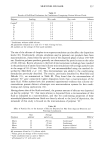
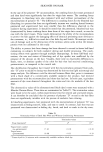
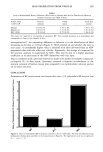
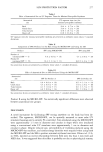
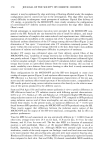
SILICONES ON HAIR 237 Table II Results of Half-Head Evaluations for Conditioners Comprising Various Silicone Fluids Polymer Snarling Wet comb Dry comb Softness Control a 2.0 2.0 2.5 2.5 A 2.5 3.5 3.0 3.0 B 1.5 2.5 3.0 3.0 C 3.5 3.5 4.0 3.0 D 3.5 4.0 3.5 4.0 E 2.5 3.0 3.5 3.5 F 2.5 3.0 3.0 3.5 G 2.5 3.0 3.0 3.0 a Conditioner without added silicone. All parameters evaluated on a scale of 1-5 with 5 being the best. All numbers are the average of three panel members. The size of the silicone oil droplets in an aqueous emulsion can also affect the deposition levels (10). Traditionally, silicone emulsions used in personal care products have been macroemulsions, characterized by particle sizes of the dispersed phase of about 250-400 nm. Emulsion polymer products generally are characterized by particle sizes on the order of 100-200 nm. Recent advances in the field ofmicroemulsion technology have resulted in the production ofamino functional silicone microemulsions with average particle sizes in the range of 10-30 nm. Polymer "D" was microemulsified using the method de- scribed by Merrifield eta/. (12). This microemulsion was added to the conditioning formulation previously described. The results, previously described by Merrifield and DeLuke (13), are summarized in Table III. They found that the microemulsion of polymer "D" gave consistently higher deposition levels than a macroemulsion of the same fluid. Other authors have also presented experimental evidence that silicone mi- croemulsions possess distinct advantages over macroemulsion systems for hair condi- tioning and dyeing applications (14). Having shown that of the fluids evaluated, the greatest amount of silicone was deposited on hair by polymer "D," that more silicone is deposited from a microemulsion of this fluid as compared to a macroemulsion, and that the conditioning properties of these trimethylsilylamodimethicone fluids are directly related to the level of deposition, the remainder of this study is focused on the microemulsion of polymer "D." Table III Effect of Particle Size on the Amount of Silicone Deposited on Hair from Aqueous Dilutions and Prototype Conditioners Base Average Emulsion polymer particle size Carrier PPM Si a Macro D 250 nm Conditioner b 25 Micro D 20 nm Conditioner 32 Macro D 250 nm Aqueous dilution • 61 Micro D 20 nm Aqueous dilution 66 All treatments diluted to 1% silicone solids. a Values given are average of five treated tresses. b Same conditioner base as used in Table I. c pH adjusted to 5.5 with acetic acid.

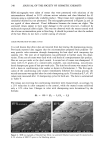
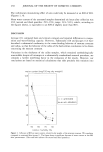
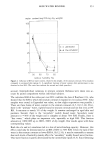
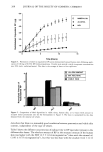
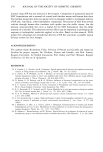
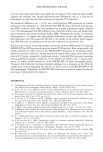
238 JOURNAL OF THE SOCIETY OF COSMETIC CHEMISTS CONDITIONING AND CHEMICAL PROCESSING A major drawback to chemical processing of hair with such processes as oxidative dyeing, bleaching, or double processing is the unappealing aesthetic properties of the hair following these procedures. After processing, consumers may describe their hair as being straw-like in feel, dull, lifeless, brittle, haM-to-comb, flyaway, and easily broken during grooming. It is desirable, therefore, to provide a material that will prevent such damage. In half-head evaluations, the hair treated with the microemulsion prepared from polymer "D" prior to chemical processing was characterized by the panelists as feeling soft and silky, and being easier to comb in both the wet and dry states. The results of combing studies described below confirm the reduction in combing forces. On unprocessed hair, polymer "D" provided the maximum conditioning benefits of all the materials examined, as previously shown in Table II. To determine whether the same trend would be observed in conditioning pretreatment applications, wet combing ex- periments were performed on oxidatively dyed tresses pretreated with a microemulsion of this fluid as well as with emulsions prepared from polymers "E" and "G." These results are summarized in Figure 1. Polymers "E" and "G" were chosen because al- though half-head studies indicated that these conditioned almost as well as polymer "D," atomic absorption analysis showed that "E" and "G" were not deposited on the hair to the same extent as polymer "D." All the pretreated hair fibers were characterized by lower combing forces in the wet state than those tresses that received no pretreatment prior to oxidative dyeing. In this application, the level of silicone deposited on the hair prior to dyeing or bleaching appears to have a significant effect on the subsequent combing forces after processing. !""• 0.631 untreatecL c•yed ? pretreatec•, polymer G, dyec• pretreated, polymer E, dyed pretreated, polymer D. dyec• untreatec•, bleached pretreated, poylmer D, bleached i.• ' 0.032 -•.' 0.0591 . . .• 0.0'197 •., 0.044 •::. untreated ß 0.0 •:3 0.17 . ß .. ?' 0.2'13 .. 0.2 0.4 0.6 0.8 COMBING FORCES (joules) Figure 1. Combing forces for oxidatively processed hair, with and without pretreatment by polymers "D," "E," and "G."
Purchased for the exclusive use of nofirst nolast (unknown)
From: SCC Media Library & Resource Center (library.scconline.org)