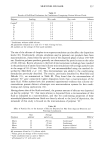
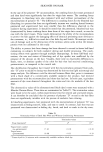
SILICONES ON HAIR 233 SILICONE EMULSIONS Experimental emulsions comprising the polymers summarized in Table I were macro- emulsions containing 35% silicone solids. They were prepared by blending 4% isolau- reth-6 and 2% octoxynol-40 (nonionic emulsifiers from Union Carbide Corp.) with the silicone fluid and initial water, inverting the emulsion in a Gaulin colloid mill, and then diluting the resulting paste. Average particle sizes of these emulsions were between 250 and 400 nm, as determined by light scattering using a Malvern Mastersizer. SM2115 is a microemulsion containing the same nonionic surfactants and 20 wt% of polymer "D," described in Table I. Its preparation is described in US Patent 5,244,598. This emulsion is characterized by an average particle size of about 20 nm. SM2101 is a macroemulsion containing the same nonionic surfactants and 35 wt% of fluid "A," described in Table I. It is characterized by an average particle size of about 250 nm. Emulsion 124-7987 is an experimental macroemulsion containing the same nonionic emulsifiers and 35 wt% of polymer "D," described in Table I, characterized by an average particle size of about 250 nm. SM2169 is a macroemulsion containing ethox- ylated lauryl alcohol surfactants and 60 wt% of a high-viscosity dimethicone fluid. It is characterized by an average particle size of 400 nm. HAIR SAMPLES All hair used in the experiments described herein was either commercially blended European medium brown hair or natural white (Piedmont) hair purchased from DeMeo Brothers. Bleached hair was obtained by treating the European brown hair with a commercially available peroxide/persulfate bleaching lotion for 45 minutes. The hair was then thoroughly rinsed under running tap water and shampooed once with a non-conditioning commercial shampoo product. Tresses used weighed 2 grams and were approximately 6 inches in length. HAIR TREATMENT Conditioning treatments for experiments summarized in Tables I and II consisted of prewashing the tress with a non-silicone-containing commercial shampoo, thoroughly rinsing the tress, removing excess water, adding 1.0 gram of conditioner (Formulation No. 1) to the tress, massaging the conditioner into the tress for 45 seconds, rinsing the tress for 45 seconds under running tap water (30ø-35øC), removing excess water, and then air drying. Treatments prior to chemical processing employed aqueous solutions of SM2115 diluted to a concentration of 2.0% active silicone. Conditioning treatments applied to hair fibers dyed with temporary color contained 1.25% silicone by weight, as seen in Formulation 2. All dilute solutions were unchanged after storage for at least 12 months under ambient conditions, as determined visually and by particle size analysis. Oxida- tive dyeing was carried out for 30-minute periods using 5.0 grams of a black shade of a commercially available dye product per gram of hair. Tresses were then rinsed under running tap water (30ø-35øC) until the water ran clear. All tresses were allowed to air dry. Temporary dyeing was carried out for varying lengths of time using a red shade of a commercial direct-dye product. Tresses were then rinsed under running tap water until

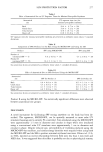
234 JOURNAL OF THE SOCIETY OF COSMETIC CHEMISTS Formulation 1: Prototype conditioning formulation used in Table I: Material Amount (wt%) Ceteareth~20 1.0 Stearyl alcohol 2.0 Stearamidopropyl dimethylamine 0.8 Quaternium- 18 1.4 Cyclomethicone 3.0 Water q.s. Silicone emulsion 1.0% active Methylisothiazolinone (and) methylchloroisothiazolinone 0.1 The silicone emulsions were post-added to the conditioning base and stirred for 20-30 minutes using moderate propeller agitation at room temperature. Formulation 2: Conditioning color sealant for temporary hair dyes Material Amount (wt%) Water 88.10 Trimethylsilylamodimethicone (and) octoxynol-40 (and) isolaureth-6 (and) glycerin* 6.25 Isolaureth-6 1.19 Glycerin 1.09 Octoxynol-40 0.85 Stearylamidopropyl dimethylamine 0.5 Quaternium- 15 0.2 Acetic acid 0.19 Sodium acetate 0.11 Fragrance 0.75 * Available from GE Silicones as SM2115. the rinse water was uncolored. Conditioning color sealant was applied in excess as a leave-in treatment, with the excess liquid being squeezed out between the fingers. The tresses were allowed to air dry following treatment. DEPOSITION EXPERIMENTS The method of Gooch and Kohl (8) was followed with slight modification. Results of deposition experiments performed using diluted solutions and prototype conditioning formulations are reported in Tables I and III. TRESS EVALUATION Tresses were evaluated at H.V. Shuster, Inc., of Quincy, Mass., by a panel of three beauticians. The results are summarized in Table II.
Purchased for the exclusive use of nofirst nolast (unknown)
From: SCC Media Library & Resource Center (library.scconline.org)