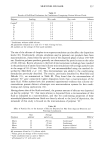
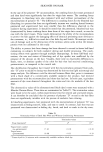
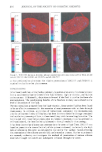
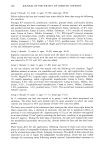
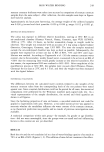
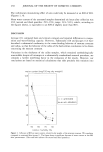
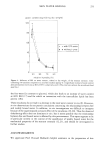
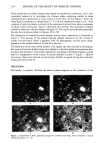
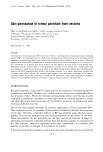
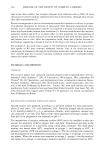
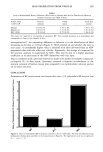
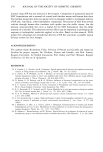
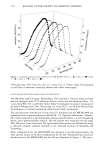
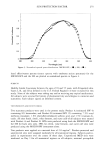
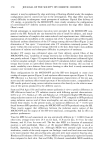
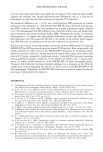
SILICONES ON HAIR 24:5 Li•'•e Sca• Width = lO Pixels 1.4,:• _ _ __ F_', __ _ .4r• _ [ LI d " b kl 10 ^ LEIq6TH (k,m'• INTERIOR EXTERIOR 14 Line Scan Width : 15 Pixels 1 [1[ [ L•' •- U _ 10 15 20 ß ,, • •, •... B LENGTH (•.m) A EXTERIOR iNTERIOR Figure 4. a,c: TOF-SIMS dot maps depicting siloxane concentration of hair trcatcd with (a) SM2 lOl and (c) SM2115. Regions where cuticle has becn polished away are indicated. b,d: Siloxane concentration with respect to location, comparing cuticle surface to polished regions for hair treated with (b) SM2 lOl and (d) SM2115. Areas scanned indicated in Figures 4a and 4c. intensity with respect to position while scanning from points "A" to "B" as shown in Figures 4a and 4c. Note that absolute intensities should not be compared. It is possible that in the preparation of the TOF-SIMS samples, silicone from the cuticle surface was "smeared" onto the exposed fiber cortex during sectioning. In order to rule out this possibility, several monolayers of the surface of the cross section were removed from the fiber shown in Figure 4c by etching with the ion beam for two- and four- minute periods. The fiber was then reanalyzed after each etching. In each follow-up etching, the relative levels of silicone between the exterior and the interior were identical to those observed prior to etching. The penetration of the fluids may be related to several properties: amine content, polymer structure, particle size of the emulsion, or concentration and type of the emulsifiers. Cross sections of hair fibers treated with different silicone emulsions were examined using TOF-SIMS. The results are depicted in Figures 5a•ct. These figures are cross sections of hair fibers treated with a macroemulsion of a high-viscosity dimethicone fluid (Sa), a macroemulsion of polymer "A" (Sb), a microemulsion of polymer "D" (5c), and a macroemulsion of polymer "D" (Sd), respectively. Relative ion intensities between these cannot be compared. All the silicones examined appeared to have penetrated significantly into the interior of the hair in this preliminary study. Further work such

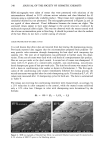
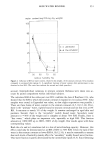
244 JOURNAL OF THE SOCIETY OF COSMETIC CHEMISTS -1.5 4.0 o0 :-t.5 :-t.0 •.5 1.5 Figure 5. TOF-SIMS dot maps depicting silicone concentration over cross sections of hair fibers treated with (a) SM2169, (b) SM2101, (c) SM2115, and (d) 124-7987. as that performed to determine the relative penetration of SM2115 and SM2101 is required to elucidate this phenomenon. CONCLUSIONS It has been found that, of the fluids examined, deposition of an amino functional silicone from a conditioning base is favored if the fluid is linear, high in viscosity, and high in amine content. Additionally, deposition is favored if the fluid is used in the form of a microemulsion. The conditioning benefits of the fluid are in many cases related to the level of deposition of the fluid. The microemulsion prepared from this high-viscosity, linear amine fluid has been found to be an effective treatment for the retention of semipermanent color on hair through shampooing. In addition, application of formulations containing this microemulsion prior to permanent dyeing or bleaching has been shown to limit the damage associated with oxidative processing of hair, without interfering with the resulting hair color. The hair treated with these formulations prior to chemical processing was characterized as well-conditioned, the benefits being substantive through multiple shampooings. It has been shown that silicones can penetrate into the cortex of hair fibers. SM2115 was found to penetrate the most effectively of the systems evaluated, as shown by the high ratio of silicone in the cortex as compared to that on the fiber surface. Factors effecting the penetration of the silicone are not fully understood at present. Further experiments are currently underway to investigate the method of penetration of various silicone materials through the cuticle and subsequent diffusion through the cortex.
Purchased for the exclusive use of nofirst nolast (unknown)
From: SCC Media Library & Resource Center (library.scconline.org)