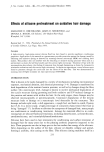
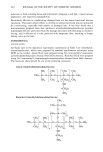
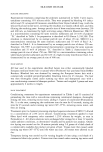
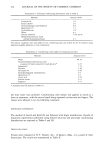
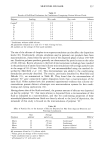
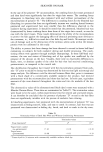
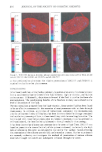
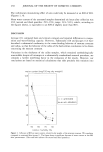
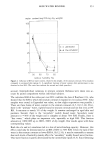
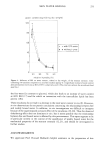
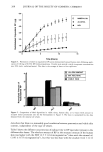
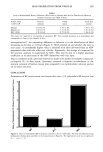
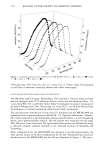
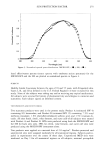
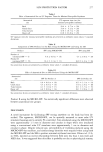
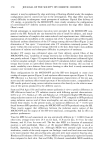
276 JOURNAL OF THE SOCIETY OF COSMETIC CHEMISTS 1 0.7 •.4 •.2 •.1 • WayclenCh (urn) Figure 4. Normalized eryrhemal effectiveness spectra. MICRO-SPF, (-•-) SSS, (-ffi-). erythema (MPE) was determined by visual grading 22 -+ 2 hours after irradiation. Irradiation for unprotected and product-protected sites was administered on Day 2. On Day 3, MPE for product-protected sites and for unprotected sites was determined by visual grading 22 -+ 2 hours after Day 2 irradiation. DATA CALCULATION AND ANALYSIS SPF was calculated as the ratio of time for MPE for protected skin to time for MPE for unprotected skin. Log-transformed SPFs and log-transformed MEDs were analyzed by two-factor analysis of variance with anatomical site and subject as factors. Fisher's least significant difference (or -- 0.05) was used for pairwise anatomical site comparisons. RESULTS The effect of anatomical site on UV exposure times for minimal perceptible erythema is shown in Table I. UV exposure time for each anatomical site group was significantly different (p 0.0001) from exposure times for all other site groups. Comparison of SPFs produced on the back for Product A and Product B using the MICRO-SPF and using the SSS are shown in Table II. There was no statistically significant difference between SPFs produced on the back using the MICRO-SPF and SPFs produced using the SSS for Product A or for Product B. Table III shows the effect of anatomical site on SPFs produced for Product A and for

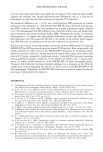
SUN PROTECTION FACTOR 277 Table I Effect of Anatomical Site on UV Exposure Times for Minimal Perceptible Erythema Anatomical site UV exposure time (sec) for minimal perceptible erythema Back Cheek (face) Volar forearm Outer calf 29.4 --- 9.7 (n = 20) 33.8 + 6.2(n = 20) 47.8 + 18.7 (n = 20) 61.8 --- 23.8 (n = 20) UV exposure times for minimal perceptible erythema are presented as arithmetic mean values + standard deviations. Table II Comparison of SPFs Produced on the Back Using the MICRO-SPF and Using the SSS Product SPF using MICRO-SPF SPF using SSS Product A (estimated SPF = 4) Product B (estimated SPF = 15) 4.0 + 0.8 (n = 16) 16.3 + 3.1 (n = 11) 4.5 + 0.9 (n = 19) 16.0 + 4.2 (n = 16) Sun protection factors are presented as arithmetic mean values + standard deviations. Table III Effect of Anatomical Site on SPFs Produced Using the MICRO-SPF Anatomical site SPF for Product A SPF for Product B Back 4.0 --- 0.8 (n = 16) 16.3 +-- 3.1(n = 11) Cheek (face) 4.4 --- 0.8 (n = 16) 17.0 --- 2.9 (n = 18) Volar forearm 4.1 + 1.0 (n = 17) 16.1 + 3.7 (n = 15) Outer calf 4.6 + 0.8 (n = 14) 18.1 + 2.0 (n = 12) Sun protection factors are presented as arithmetic mean values + standard deviations. Product B using the MICRO-SPF. No statistically significant differences were observed between anatomical site groups. DISCUSSION A novel instrument for facilitating SPF testing anywhere on the body has been de- scribed. The apparatus, MICRO-SPF, can be optically mounted to most solar UV simulator housings and is entirely PC-controlled. Sites irradiated using the MICRO-SPF were approximately 1.5 mm in diameter and circular in shape while sites irradiated using a conventional solar UV simulator were approximately 1 cm in diameter and circular in shape. Despite reduced size, perceptibility of erythema produced using the MICRO-SPF was excellent, and similar energy densities were required when using both the MICRO-SPF and the SSS to produce minimal erythemal reactions. Olson eta/. (14), in 1966, reported an inverse relationship between field sizes less than 2 mm wide and MED dose. It was suggested that this effect is probably not due to physiological reasons
Purchased for the exclusive use of nofirst nolast (unknown)
From: SCC Media Library & Resource Center (library.scconline.org)