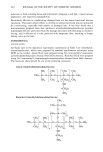
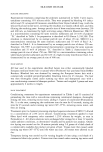
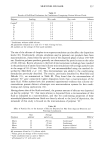
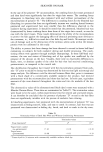
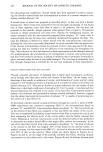
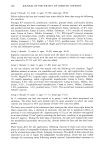
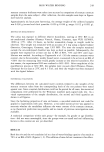
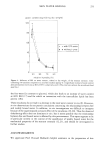
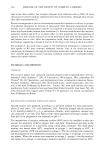
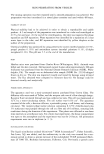
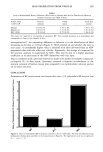
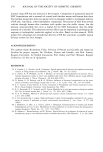
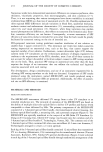
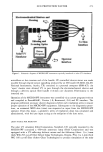
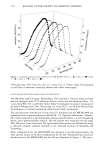
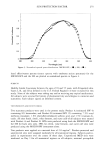
274 JOURNAL OF THE SOCIETY OF COSMETIC CHEMISTS 0.4 Figure 2. Normalized spectral power distribution for MICRO-SPF. Fiber 1, (-A-) fiber 2, (-I-) fiber 3, (-'-) fiber 4, (-V-) fiber 5, (-O-). UVB spectrum (290-320 nm) and 3) a 1-mm UG 11 (Schott Glass Technologies) cut-off filter to attenuate remaining infrared and visible wavelengths. LIGHT SOURCE FOR STAND-ALONE SOLAR UV SIMULATOR The SSS (Solar Light Company, Philadelphia, PA) contained a 150-watt xenon-arc lamp and was equipped with a UV-refiecting dichroic mirror and the following filters: 1) a 1-mm thick WG 320 cut-off filter (Schott Glass Technologies) to produce simulation of the solar UVB spectrum (290-320 nm) and 2) a 1-mm UG 11 cut-off filter (Schott Glass Technologies) to attenuate remaining infrared and visible wavelengths. The spectral power distribution of each solar UV simulator and the MICRO-SPF was determined with a spectroradiometer (Model OL 752 Optronic Laboratories, Orlando, FL), which consisted of a dual holographic grating monochromator, a 4-inch integrating sphere, and a photomultiplier detector. Spectral outputs were measured over the range 280-400 nm at 2-nm increments. The spectroradiometer system was calibrated by using a 200-watt tungsten standard traceable to the National Institute of Standards and Technology. Filter configuration for the MICRO-SPF was designed to provide approximately the same spectral output as the filter configuration for the SSS. Normalized spectral power distributions for the MICRO-SPF and the SSS are illustrated in Figure 3. The convo-

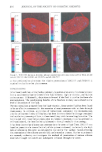
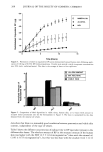
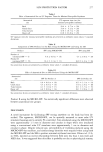
SUN PROTECTION FACTOR 275 1 0ø8 0ø6 0ø4 0ø2 0 ----------'"•---- I I •0 300 320 340 360 3gO Wavelen• (n•) Figure 3. Normalized spectral power distributions. MICRO-SPF, (-•-) SSS, (-•-). luted effectiveness spectra (source spectra with erythema action spectrum) for the MICRO-SPF and the SSS are plotted as normalized spectra in Figure 4. SUBJECTS Healthy female Caucasians between the ages of 18 and 55 years, with Fitzpatrick skin Types I, II, and III as defined in the U.S. Federal Register (1) were recruited for this study. None of the subjects were taking any oral or receiving any topical medications. All subjects were screened for history of photosensitivity and allergies to cosmetics and sunscreens. Each subject signed an informed consent. TEST PRODUCTS AND STUDY DESIGN Two sunscreen products were used in the present study: Product A (estimated SPF 4) containing 8% homosalate and Product B (estimated SPF 15) containing 7.5% octyl methoxy cinnamate, 1.8% phenylbenzimidazole sulfonic acid, and 1.5% titanium di- oxide. All sites (back, cheek, volar forearm, and outer calf) of all subjects were treated with Product A and Product B. SPFs were produced using both the MICRO-SPF and the SSS for back sites only. SPFs for cheek, volar forearm, and outer calf sites were produced using the MICRO-SPF instrument alone. Test products were applied at a material dose of 2.0 mg/cm 2. Product-protected and unprotected sites were assigned randomly for all anatomical regions. Subjects partici- pated in experiments over the course of three days. Unprotected MED sites were irradiated on Day 1 for all anatomical regions on all subjects minimal perceptible
Purchased for the exclusive use of nofirst nolast (unknown)
From: SCC Media Library & Resource Center (library.scconline.org)