264 JOURNAL OF THE SOCIETY OF COSMETIC CHEMISTS had been established using acetone as a quenching agent, and the integrated software converted the counted CPM into DPM using the H number. SKIN ANALYSIS At the end of the experiment, the donor cell was washed with a buffer solution and the skin was removed. The initial washings (two rinses) were done with a solution of ethanol/water (50/50 v/v), rather than with the phosphate buffer (five to ten rinses) used to manufacture the vesicles. Visual inspection of the inside of the cell was used as a way to monitor complete removal of the preparation (the NS¾ preparation is white). Vali- dation experiments were performed at time t = 0 and showed that this procedure provided a complete removal of the preparation. The remaining preparation was re- moved from the donor compartment, and the skin was blotted with a square of cotton gauze. The washing fraction and the cotton gauze were counted together. The skin was then positioned on a support with dissection needles and stripped with Magic-Tape 800. The stripping was considered complete when the surface of the skin glistened to the eye. The tape with the stratum corneum and the skin were introduced in two separate vials with 1 ml of water and 2 ml of digesting liquid (Protosol ©, National Diagnostic, Atlanta, GA). The vials were closed, and the samples were digested at 55øC for 48 hours. After digestion, 2 ml of glacial acetic acid were added to neutralize the solution, and liquid scintillation fluid was added for counting. SURFACTANT TESTING The effect on the skin of surfactant solutions used as receptor phases was investigated using the flux of water as an indicator of damage. Briefly, freshly excised hairless mouse skin was mounted on the cell, and receptor solutions were pumped through the cell at 32øC for a 12-hour period. Then 200 •1 of deionized water spiked with 3H water were applied onto the skin, and the permeation was monitored for three hours. CHROMATOGRAPHIC METHOD Retinyl palmitate was analyzed for degradation by normal phase high-performance liquid chromatography (HPLC) (7). The assay resolved retinyl palmitate and its pre- dominant cis-trans isomers (13-cis, all-trans, 9-cis and 9, 13-dicis). The chromatographic equipment consisted of a solvent delivery pump with pressure monitor (Rabbit TM HP, Rainin Instrument), silica column (•Porasil TM , 125•, 10 •m, 3.9 X 300 mm, Waters, Milford, MA), a U¾ variable wavelength detector set at 313 nm (SpectroMonitor © 3100, Milton Roy ©, Rainin Inst.), and an integrator (Shimadzu C-R3A, Rainin Inst.). The mobile phase was 99% hexane and 1% methyl-tert butyl ether. The internal standard used in this assay was a solution of fluoranthene in the mobile phase. All chemicals were HPLC grade. Because of the possible multiple derivative compounds, the receptor phase was analyzed by HPLC, and RP could not be found in detectable quantity. The linearity of the U¾ detector's response was established between concentrations of RP ranging from 0.1 mg/ml to 100 •g/ml, but concentrations of retinyl palmitate as low as 0.05 •g/ml were

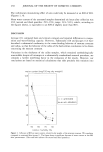
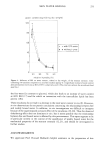
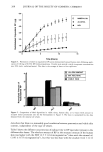
SKIN PERMEATION FROM VESICLES 265 detectable in the receptor phase. Therefore, the compounds permeated are metabolites or other derivatives of RP and are represented in terms of equivalent RP based on the observed radioactivity. This observation is consistent with a recent publication on the activity of esterase and alcohol dehydrogenase on the metabolism of RP in the hairless guinea pig skin (8). Retinol was the only detectable metabolite of RP. RESULTS AND DISCUSSION ENTRAPMENT OF RP AND STABILITY OF NSV The RP concentration used in the following experiments was in a range of 0.05% to 1%. At this concentration, RP was completely entrapped in the vesicles under these condi- tions of manufacture. The stability of the system was tested by centrifugation as de- scribed in Materials and Methods. DEVELOPMENT OF RECEPTOR PHASE RP is an insoluble compound in water, but the solubility of lipophilic materials in the receptor compartment could be increased by adding surfactants or other substances. Three-percent solutions of solubility enhancers were evaluated as receptor phase: the permeation of 100 I•l of RP in mineral oil (50% w/w) was monitored across Silastic © for a period of 12 hours (Figure 1). The use of either surfactant tested allowed the highest amount of radiolabeled compound to permeate, while hydroxypropyl beta cyclodextrin did not perform as well. 20- 15 lO 0 i o 14 A Polysorbate 80 (HLB = 15) ß Isoceteth 20 (HLB = 15.7) [] Beta-Cyclodextrin [] [] [] [] [] [] [] ß i i i i i i 2 4 6 8 10 12 Time (Hours) Figure 1. Permeation of radiolabeled RP from a 50% (w/w) solution in mineral oil across a medical grade sheeting of polydimethylsiloxane (Silastic ©, 0.005-inch thick), into three receptor phases (n = 3).
Purchased for the exclusive use of nofirst nolast (unknown)
From: SCC Media Library & Resource Center (library.scconline.org)