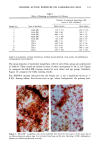
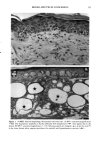
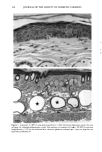
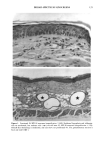
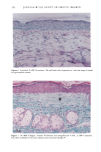
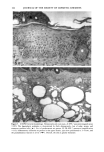
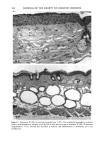
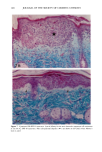
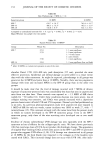
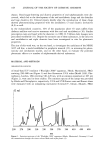
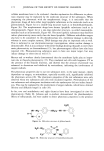
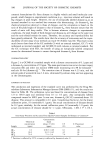
120 JOURNAL OF THE SOCIETY OF COSMETIC CHEMISTS ENUMERATION Enumeration of Langerhans cells was performed by light microscopy with the aid of a calibrated eyepiece grid that defined a 250 x 250qxm field using a x40 objective and a x 10 ocular. As Langerhans cells are the only cells expressing CDIa or HLA-DR marker in the epidermis, all of the stained cells with dendritic morphology were counted. The number of cells per square millimeter was then calculated. Ten fields from each spec- imen were randomly chosen for enumeration, and the mean value was used as the density (cells/mm 2) of HLA-DR- or CDla-positive epidermal Langerhans cells. SKIN COLOR MEASUREMENT Skin color was measured with a tristimulus colorimeter (Model CR-200) Chromame- ter TM , Minolta Camera Co., Japan) to provide an indication of chronic sun exposure as expressed by the difference between the outer forearm and inner upper arm sites in both ethnic groups. Mean chromameter values for each subject were calculated from mea- surements taken at three randomly chosen sites from the outer forearm area and from the upper inner arm area. The L*a*b* system of measurement (CIE 1976) was used. The L* value measures brightness, and positive a* and b* values indicate redness and yellow- ness, respectively. STATISTICAL ANALYSIS For the validation of the bleaching method, a paired Student's t-test was used. The mean difference was considered significant when the p-value was less than 0.05. A four-way analysis of variance (ANOVA) incorporating factorial effects up to two-factor interac- tions was used for the chronic actinic exposure study. The factors were age, ethnic background, biopsy site (chronic actinic exposure), and primary antibody used for staining. Factors were considered significant when the p-value was less than 0.05. INSTITUTIONAL REVIEW BOARD APPROVAL Institutional Review Board approval was obtained prior to initiation of the study. RESULTS VALIDATION OF THE BLEACHING METHOD The bleaching method was validated by comparing the numbers of HLA-DR- and CDla-positive cells of nonpigmented skin before and after bleaching (Table I). There was no statistically significant difference between the numbers of cells before and after bleaching. Thus, the bleaching method did not affect the staining. Figures la and lb show HLA-DR-positive Langerhans cells in the epidermal sheet of an African-American subject before and after bleaching.

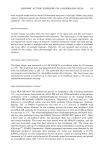
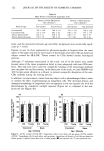
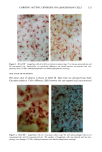
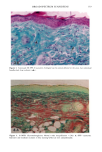
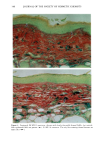
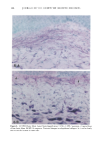
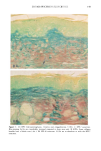
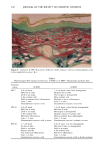
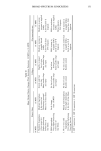
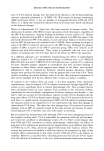
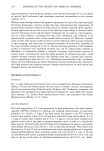
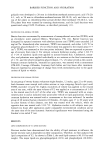
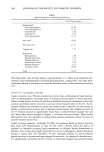
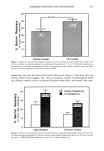
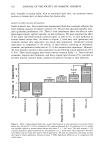
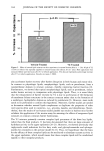
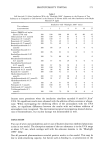
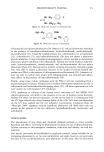
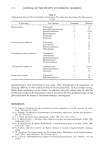
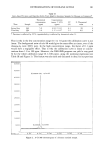
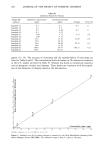
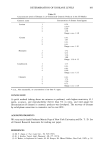
CHRONIC ACTINIC EXPOSURE ON LANGERHANS CELLS 12 l Table l Effect of Bleaching on Langerhans Cell Density Sample Number of epidermal Langerhans cells (mean + SD cells/mm 2) no. Type of antibody Before bleach After bleach ! HLA-DR 776 + 151 832 -+ 155 2 HLA-DR 590 + 80 595 + 57 3 HLA-DR 600 + 69 586 + 65 4 HLA-DR 733 + 106 701 + 49 5 HLA-DR 718 + 90 696 + 87 6 CDla 686 + 61 683 + 71 7 CDla 638 + 68 613 + 46 8 CDla 653 + 69 683 + 76 9 CDla 922 + 96 885 +-- 166 10 CDla 618 + 106 621 + 90 EFFECT OF CHRONIC ACTINIC EXPOSURE, ETHNIC BACKGROUND, AND AGING ON EPIDERMAL LANGERHANS CELL DENSITY The mean densities of epidermal Langerhans cells for each ethnic group are summarized in Table II. These results are similar to those of other investigators (5,10,13,19). Figure 2a compares the HLA-DR staining results for each ethnic and age group. Similarly, Figure 2b compares the CDIa staining results. The ANOVA analysis indicated that the biopsy site is not a significant factor (p) 0.05). Among others, four factors such as age, ethnic background, the primary anti- Figure 1. HLA-DR + Langerhans cells in the epidermal sheet from the inner aspect of the upper arm of an African-American subject (age 23), (a) before bleaching and (b) after bleaching (x200, alkalinephos- phatase anti-alkalinephosphatase staining).
Purchased for the exclusive use of nofirst nolast (unknown)
From: SCC Media Library & Resource Center (library.scconline.org)