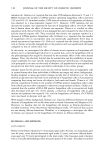
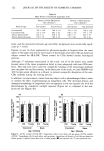
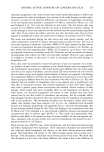
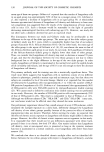
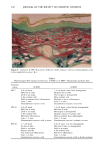
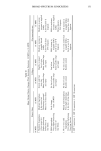
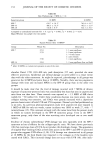
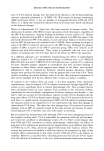
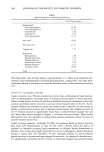
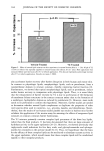
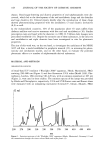
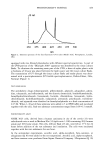
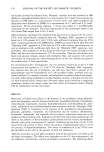
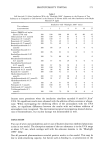
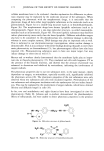
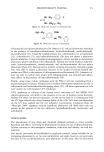
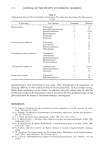
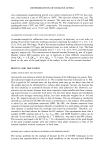
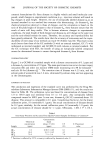
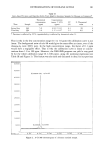
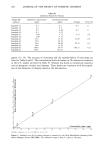
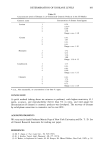
182 JOURNAL OF THE SOCIETY OF COSMETIC CHEMISTS Table III Calibration Results for Dioxane Sample ID/ Calibration concentration Concentration found replicate (ppm) (ppm) Average Error (%) Standard-1/1 0.1 0.1 0.1 0 Standard-1/2 0.1 0.1 Standard-2/1 0.5 0.48 0.5 0 Standard-2/2 0.5 0.52 Standard-3/1 5.00 5.12 5.12 2.4 Standard-3/2 5.00 5.12 Standard-4/1 25.0 23.26 24.90 0.4 Standard-4/2 25.0 26.54 Standard-5/1 50.0 48.80 50.15 0.3 Standard-5/2 50.0 51.49 Standard-6/1 100.0 99.41 100.21 0.21 Standard-6/2 100.0 101.01 papers (12-14). The accuracy of intra-assay and the reproducibility of inter-assay are listed in Tables I and II. The concentration levels ofdioxane in 20 commercial cosmetics in the U.S. market are listed in Table IV. Dioxane was found in commercial cosmetics such as shampoos, lotions, and cleansers. These results are consistent with the hypoth- esis of the formation of dioxane stated in the introduction. 3- 2- 1- S6 • Concentration ( ppm: •g/g) 0 , S2 0 1'0 2'0 3'0 4'0 5'0 6'0 7•0 8'0 9•0 1 • 0 DMLIMS+ Version 4.3.1a [14-MAY-96 10:33:30] Figure 3. Standard curve fit for analyte dioxane in cosmetics by the Drug Metabolism Laboratory Infor- mation Manager System (DM-LIMS). The calibration range is from 0. ! ppm to !00 ppm.

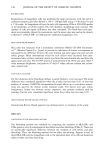
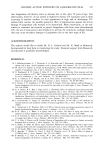
DETERMINATION OF DIOXANE LEVELS 183 Table IV Concentration Levels of Dioxane in 20 Commercial Cosmetic Products in the US Market Cosmetic name Concentration of dioxane found (ppm) Lotions i 0.54 2 n.m.* 3 0.69 4 1.38 Range: n.m.-1.38 Creams Shampoos Conditioners Cleansers 2 1.01 3 n.m. 4 n.m. Range: n.m.- 1.01 1 1.72 2 4.12 3 1.16 4 1.88 Range: 1.16-4.12 1 1.13 2 n.m. 3 n.m. 4 O.6O Range: n.m.-1.13 2 1.74 3 2.26 4 O.73 Range: n.m.-2.26 * n.m., Not measurable, or concentration is less than 0.1 ppm. CONCLUSION A quick method (taking about six minutes to perform), with higher sensitivity (0.1 ppm), accuracy, and reproducibility (better than 5% in intra- and inter-assay) for determination of dioxane in cosmetic products was developed. The recovery of dioxane- by solid-phase extraction in cosmetics can be over 80%. ACKNOWLEDGMENTS We very much thank Professor Martin Pope of New York University and Dr. T. D. Lee of Clinical Research Associates for reading our paper. REFERENCES (1) M. F. Argus. J. Nat. Cancer Inst., 35, 949 (1965). (2) R. J. Kociba, Toxicol. Appl. Pharmacol., 30, 275 (1974). (3) G. Barker, in Surfactants in Cosmetics, M. M. Rierger, Ed. (Marcel Dekker, New York, 1985), p. 18.
Purchased for the exclusive use of nofirst nolast (unknown)
From: SCC Media Library & Resource Center (library.scconline.org)