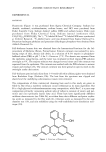
102 JOURNAL OF COSMETIC SCIENCE common ingredient in detergents and toothpaste (4). SLS is known to be incompatible in acids (pH 2.5), where the SLS is in a non-ionized form, which is highly inactive in solution. Cetyl pyridinium chloride, a quaternary ammonium compound, is a cationic surfactant, with the following formula: /NCH2(CHz) 14CH3CL CPC1 is not a very effective detergent, although it is popularly used as a preservative (5). The third surfactant, decyl glucoside, is a nonionic surfactant that does not dissociate into ions when in solution. Decyl glucoside is an alkyl polyglycoside, a surfactant consisting of numerous alkyl chains lengths. Decyl glucoside is a hydrocarbon with an average chain length of 12 carbon atoms (6) and is an effective cleanser because it contains polar glucose groups, with a typical molecule containing an average of two polar glucose groups. By providing powerful cleansing ability with little or no irritation to the skin and mucous membranes, alkyl polyglycosides have become an exciting alternative in surfactant technology. The three sodium chloride solutions were tested against surfactants that represent three of the main classes of surfactants. Each of the surfactants was tested at various concen- trations around the critical micelle concentration. EXPERIMENTAL MATERIALS The SLS was obtained from the Stepan Company, Northfield, Illinois CPC1 from Penta Manufacturing, Fairfield, New Jersey and decyl glucoside (Plantaren 2000 ©) from Henkel Corporation, Hoboken, New Jersey. The douche solution with sodium chloride was Summer's Eve Extra Cleansing Vinegar and Water ©, supplied by C. B. Fleet Co. Inc., Lynchburg, Virginia. All materials were used without further purification. CLEANSING PROCEDURE All blood samples were collected in Vacutainer © tubes with EDTA as an anticoagulant. The plasma was removed, and the cells were rinsed and adjusted to a 40% hematocrit with the 0.9% sodium chloride and stored at 4øC. Three-inch-diameter Veratec Flexilon (70% rayon/30% polyester) cloth pads were cut into eight pie-shaped pieces along the diagonal. A 50-•fi aliquot of blood was expelled onto the tip of the cloth using an Eppendorf pipettor. After one minute, the cloth was picked up with forceps and placed into an 80-ml beaker containing 8 ml of the solution under study, and placed on a Fisher clinical rotator at 100 rpm. After swirling for 15 seconds, the rotator was stopped and the cloth removed. Excess liquid was drained by gently touching the cloth along the inside wall of the beaker. Potassium cyanide reagent was added to the beaker as necessary. The reagent bound to the hemoglobin, changing the osmotic pressure around the cell, which caused the red

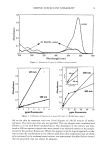
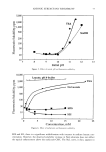
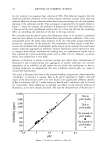
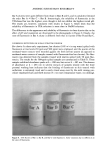
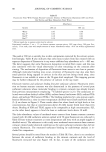
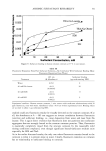
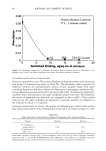
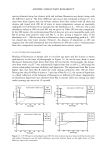
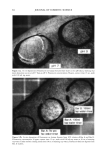
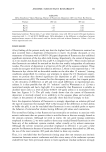
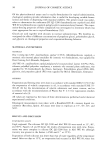
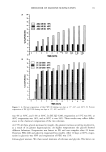
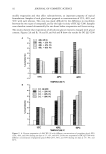
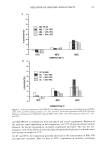
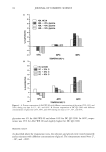
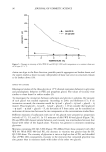
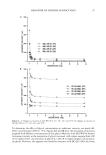
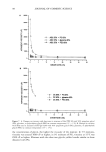
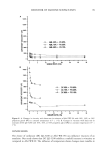
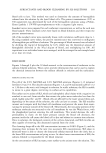
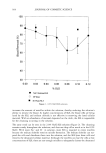
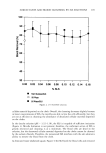
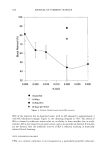
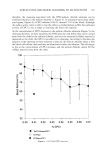
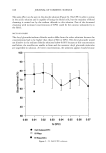
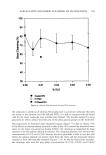
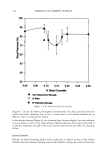
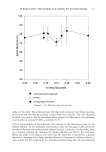
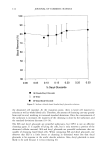
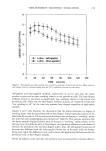
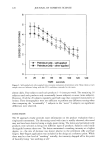
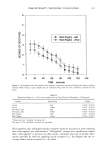
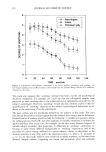
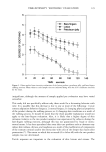
SURFACTANTS AND BLOOD CLEANSING BY SLS SOLUTIONS 103 blood cells to lyse. This method was used to determine the amount of hemoglobin released into the solution by the lysed blood cells. The percent transmittance (%T) at 550 nanometers was determined for each of the hemoglobin solutions using a Perkin- Elmer Lambda 3 UV/VIS spectrophotometer with a tungsten light source. Standard curves were prepared for each surfactant concentration, as well as for each new blood sample. These standard curves were based on blood dilutions and their respective percent transmittances. All of the standard curves were essentially linear, with correlation coefficients close to 1. By using standard curve values, the percent transmittance was converted to milligrams of hemoglobin per milliliter of solution. The percentage of blood removed was calculated by dividing the mg/ml of hemoglobin by 6.25, which was the theoretical amount of hemoglobin delivered in the 50-pl aliquot of blood, and multiplying by 100. All repetitions in an individual series were averaged, with the averages for each sample based on at least ten trials. DISCUSSION Figures 1 through 9 plot the % blood removal vs the concentration of surfactant in the sodium chloride solutions. These curves provide information that can be used to explain the chemical interaction between the sodium chloride in solution and the surfactants. SODIUM LAURYL SULFATE The pH of the 0.9% NaCI/SLS and 2.0% NaCI/SLS solutions (Figures 1, 2) remained between 6.0 and 7.0. The douche solutions (Figures 3, 6, and 9) maintained a pH of 3.32 to 3.38 due to the acetic acid (vinegar) in solution. In acidic solutions, the SLS is unable to ionize to a great degree, restricting its surface-active capabilities. The surface-active anions of SLS, which are hydrophobic alkyl chains with a negative ion attached to one end, form micelles that attract the polar water molecules less than the small, highly polar Na + and C1-. Blood cells are affected by the water around them and, depending on the nature of the solution, the cells can lyse or crenate. The SLS micelies interact and compete with the blood cell membrane and prevent the water from main- taining the pressure outside of the blood cell. Theoretically, the non-polar portions of the surfactant molecules are attracted to the cell membrane by van der Waals forces, with the phospholipid portion entering the cell membrane. This would decrease the cell's permeability to water. As the water pressure outside the blood cell decreases, the pressure inside the cell causes the blood cell to lyse and release its contents into solution. Once in solution, the biological contents of the cell are denatured, and SLS micelles are then capable of removing this denatured material from the cloth. The cleansing drops off as the SLS concentration increases to 0.08% (Figure 1), and the cleansing then increases for the next two successive SLS concentrations. SLS alone in aleionized water is able to cleanse the denatured cellular material from the cloth, but at the lower SLS concentrations no lysing occurs. At these lower concentrations of SLS, the sodium chloride is responsible for the blood removal. As the concentration of SLS increases, more surface-active artions enter the solution. This
Purchased for the exclusive use of nofirst nolast (unknown)
From: SCC Media Library & Resource Center (library.scconline.org)