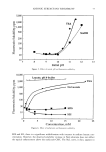
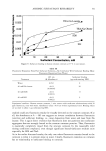
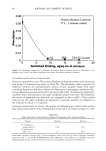
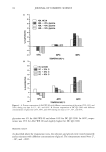
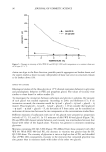
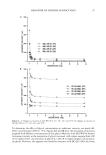
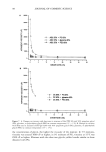
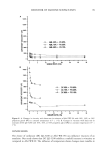
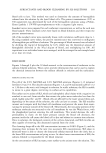
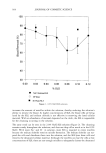
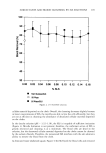
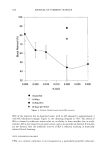
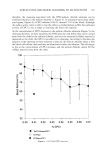
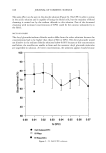
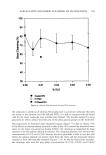
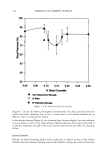
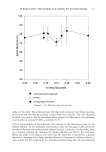
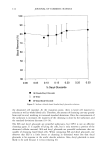
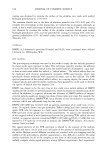
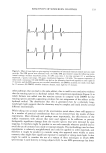
112 JOURNAL OF COSMETIC SCIENCE lOO o o o 90• 80 i ( 70 60-- 50- 40 -' 3O 0.00 0.05 0.10 0.15 0.20 0.25 0.30 % Decyl Glucoside ß SE Douche/Decyl Glucoside ¸ DI Water ß DI Water/Decyl Glucoside Figure 9. Sodium chloride-based douche/decyl glucoside solutions. the denatured cell material. At the transition point, there is lysed cell material in solution as well as whole blood cells. Therefore, the amount of cleansing can vary greatly from trial to trial, resulting in increased standard deviations. Once the concentration of the surfactant is increased, the majority of the cleansing is done by the surfactant, and the standard deviations decrease (10-14). The SLS and decyl glucoside are powerful surfactants, but CPC1 is not an effective cleansing agent. It is capable of lysing the cells, but it only removes a portion of the denatured cellular material. SLS and decyl glucoside are powerful surfactants that are capable of cleansing lysed blood cells. When comparing SLS and decyl glucoside, one observes that SLS is a little better at cleansing in deionized water but that decyl glucoside is far superior in the acidic douche solution. Also, decyl glucoside is more likely to be used because it is less irritating (6).

SURFACTANTS AND BLOOD CLEANSING BY SLS SOLUTIONS 113 Surfactants inhibit the cleansing of sodium chloride solutions. Ionic interactions, van der Waals forces, and the ability to lyse blood cells all influence the solutions' ability to cleanse blood from the surface of the cloth. The results indicate that surfactants can inhibit the cleansing of blood by sodium chloride solutions by lysing the cells and allowing the denatured cellular material to deposit onto the surface of the cloth. Once such material is on the surface of the cloth, the sodium chloride solutions cannot remove it. ACKNOWLEDGMENTS We would like to thank C. B. Fleet Co., Inc., for supporting the research, and Dinner Bell Meat Products and Packers for providing bovine blood. REFERENCES (1) A. N. Martin, J. Swarbrick, and A. Cammarata, Physical Pharmacy, 2nd ed., 1969, pp. 251-252. (2) M. M. Rieger, Surfactants and Cosmetics (Marcel Dekker, New York, 1985), pp. 2-3. (3) L. Afro, The use of quaternary ammonium compounds as preservatives in poliovirus vaccine. Prelimi- nary report, State Bacteriol. Lab., Stockholm. Acta Pathol. Microbiol, Scand., 61(1), 106-108 (1964). (4) The Merck Index, 12th ed. (Merck Research Laboratories, Division of Merck & Co., Inc., Whitehouse Station, NJ), pp. 1478-1479, 2068. (5) I. Cohen and A. Libackyj, Coacervating soap-electrolyte solutions. I. Charge properties. II. Generalized treatment of coacervating soap-electrolyte systems. J. Colloid Sci., 19(6), 560-570 (1964). (6) K. Hill, W. yon Rybinski, and G. Stoll, Alkyl Polyglycosides (Weinheim, New York, 1997). (7) M. M. Rieger, Surfactant Encyclopedia, 2nd ed. (Allured Publishing Corp., Carol Stream, IL, 1996). (8) J. Falbe, Surfactants in Consumer Products (Heidelberg, New York, 1987). (9) Th. F/3rster, H. Hensen, R. Hoffman, and B. Salka, Using alkyl polyglycosides in personal-care products, Cosmet. Toilerr., 110 (April 1995). (10) V. L. Snoeyink and D. Jenkins, Water Chemist• (John Wiley & Sons, New York, 1980), pp. 16-17. (11) J. S. Fruton and S. Simmonds, General BiochemiJtry, 2nd ed. (John Wiley & Sons, New York, 1958). (12) Y. Marcus, Ion Solvation (John Wiley & Sons, New York, 1985), pp. 87-92. (13) J. Burgess, Ions in Solution (John Wiley & Sons, New York, 1988), p. 15. (14) D. Myers, Surfaces, Interfaces, and Colloids (VCH Publishers, New York, 1991), pp. 25-37.
Purchased for the exclusive use of nofirst nolast (unknown)
From: SCC Media Library & Resource Center (library.scconline.org)