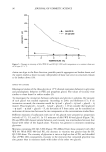
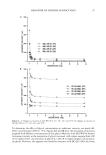
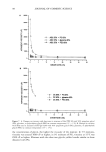
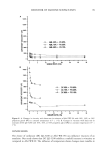
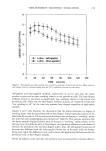
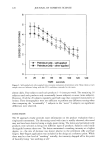
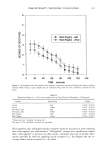
j. Cosmet. Sci., 49, 115-124 (March/April 1998) Evaluation of the "soothing" intensity of a lotion product and petroleum jelly usino time-intensity sensory techniques WILLIAM E. LEE III and M. SUZANNE MITCHELL, Department of Chemical Engineering, University of South Florida, Tampa, FL 33620. Accepted for publication April 1, 1998. Synopsis Time-intensity (TI) sensory techniques were applied to the assessment of the "soothing" intensity of two skin-care products: a commercially available moisturizing lotion and petroleum jelly. Subjects rated the soothing quality of a product every ten seconds for a total of 120 seconds while product samples were either self-applied or applied by another person ("other-applied"), using the middle three fingers in both cases. Bare-fingers rubbing (both self- and other-applied) was also included as a reference condition. The main objectives of this study were: 1) to demonstrate the nature of the information provided by the TI technique (as compared to single-point evaluations) and 2) to determine if "soothing" ratings were higher when the product was self-applied versus other-applied. The results indicated that significant differences were present between the products in terms of both the soothing intensities and the rate of soothing decrease with time, with the latter clearly indicated by the TI "fingerprints." Also, "soothing" ratings were higher when the product was self-applied versus other-applied. This suggests that consumers use tactile information from both the applying surface (fingers) and receiving surface (skin) in the assessment of skin-care products. INTRODUCTION A wide variety of skin-care products are currently available to the consumer. Many of these are provided to address real or perceived skin problems such as dryness, flaking, and chapping. These problems may be due to prolonged environmental exposures such as exposure to sun and dry air or attributable to other processes such as excessive skin cleaner usage or dermatological conditions. Skin-care products may also be employed to avoid the onset of such problems, often seeking to maintain skin moisture and proper biomechanical properties (1). In the evaluation of skin-care products such as creams and lotions, a variety of sensory attributes are employed. These may involve tactile attributes such as greasiness, oiliness, and waxiness, and hedonic descriptions such as "like/dislike" and "soothing" (2,3). Other modalities may also play a role, such as vision (color, luster) and olfactory re- sponses (odor character and intensity). As described in ASTM method E 1490 (4), the evaluation of tactile cream/lotion attributes can be accomplished by using a "rub-out" 115

116 JOURNAL OF COSMETIC SCIENCE procedure where the subject's index or middle finger applies a sample of the product onto the subject's skin using a circular "rubbing" motion. Indeed, it is likely that most consumers base much of their evaluation of creams/lotions during self-application using their fingers. Most sensory methods require subjects to evaluate specific attributes at a single specific time. This assessment time is often after a sample has been applied or otherwise ma- nipulated. For example, a subject might evaluate "greasiness" or "creaminess" of a lotion product soon after a sample quantity was applied. In effect, the subject is requested to time-average his or her response, arriving at a single value to represent what may in reality be a dynamic situation. Skin-care products may spread, dissolve, melt, thin, penetrate, evaporate, etc., during (and after) the initial application. These are dynamic events the expectation that the associated sensory evaluation is "static" (or can be characterized by a single time-averaged value) may be inappropriate. In general, poten- tial information regarding the temporal behavior of the response is not provided by single-point sensory perception protocols. So-called time-intensity (TI) sensory techniques are designed to capture responses in real time. TI techniques, therefore, provide information on the dynamic nature of the re- sponse. It has been shown (5) that TI techniques provide significantly more information than single-point techniques. TI techniques have been employed in food product de- velopment and other areas such as fragrances and perfumes to provide quantitative information on the temporal behavior of sensory parameters of interest (usually olfactory or gustatory). Food evaluations also include tactile attributes (for example, see reference 6). ASTM Committee E-18 is currently developing a standard document on TI tech- niques that includes computerized data acquisition techniques and data analysis. Applications of TI techniques to the sensory evaluation of creams and lotions appears to be limited. ASTM method E 1490 does describe a procedure to obtain temporal data on skin feel attributes during the application process. More specifically, the ASTM rub-out procedure rates parameters such as spreadability, denseness, and wetness after 3, 6, 9, 12, and 15 rubs. The main objective of this research was to apply TI techniques to the evaluation of the attribute as "soothing" while skin-care products were applied. More specifically, the soothing intensity was evaluated every ten seconds while a skin-care product (lotion or petroleum jelly) was applied during a two-minute rub-out. The utility of the TI ap- proach would be demonstrated by the identification of time-related behavior in the responses. In addition, the following hypothesis was tested: a subject's evaluation of "soothing" is a function of who is applying the product. In other words, the same product will be perceived as less soothing when the product is applied by another person as opposed to self-application. MATERIALS AND METHODS SUBJECTS Twenty female students in the age group 19 to 26 participated in the study. All subjects were not informed of the purpose of the study. Subjects were screened for existing skin-related problems. In addition, no stringed musical instrument players or others
Purchased for the exclusive use of nofirst nolast (unknown)
From: SCC Media Library & Resource Center (library.scconline.org)