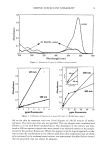
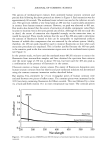
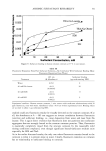
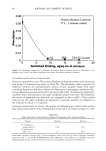
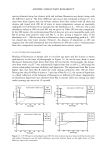
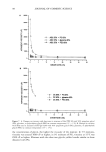
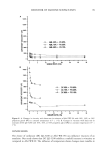
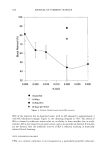
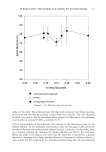
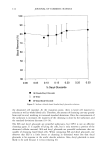
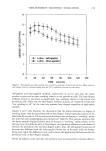
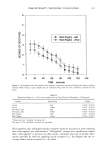
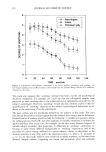
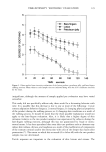
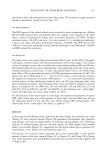
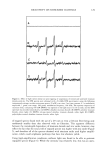
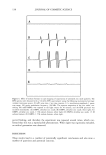
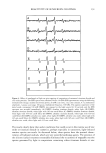
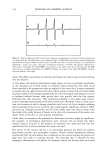
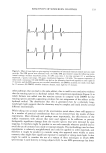
TIME-INTENSITY "SOOTHING" EVALUATION 123 m (.9 m 0 0 --•-- Bare fingers • Lotion :••. ••.• --•-- Petroleum jelly 20 40 60 80 100 120 140 TIME seconds Figure 5. Other-applied time-intensity evaluations of the lotion product, petroleum jelly, and bare-fingers rubbing motions. Mean values at each sample time are indicated along with the 95% confidence intervals for the mean. insignificant, although the amount of sample applied per evaluation may have varied somewhat. This study did not specifically address why there would be a decreasing behavior with time. It is possible that this decrease is due to one or more of the following: 1) pure sensory adaptation behavior (fatigue) 2) mental fatigue 3) changing physical properties of the product during the rubbing process or 4) changing skin conditions as a result of the rubbing process. It should be noted that the third possible explanation would not apply to the bare-fingers evaluation. Also, it is likely that a higher degree of skin irritation (relative to the two product samples) was experienced by subjects during the bare-fingers rubbing motions, although this was not quantitated by visual or instru- mental means. It has been speculated that some skin-care products such as cleansers may induce skin redness, dryness, and roughness as a result of the modification of components of the stratum corneum and/or the interaction with cells of the deeper skin layers after penetration (7). The extent to which this occurred (if it did at all) with the two product samples was not determined. Tactile responses are important to the evaluation of skin lotions and creams. The

124 JOURNAL OF COSMETIC SCIENCE manufacturers of other products recognize the importance of the tactile sense in product evaluation. For example, moisturizers are incorporated into facial tissue and toilet paper products (8,9). This study demonstrates the potential information that one can obtain from applying TI techniques to the study of lotion/cream products. REFERENCES (1) J. D. Middleton, Development of a skin cream designed to reduce dry and flaky skin, J. Soc. Cosmet. Chem., 25, 519-523 (1974). (2) L. B. Aust, L. P. Oddo, J. E. Wild, O. H. Mills, and J. S. Deupree, Descriptive analysis of skin care products by a trained panel of judges,J. Soc. Cosmet. Chon. 38, 443-449 (1997). (3) R. Naidoo, Sensory characteristics of skin care preparations: It makes sense, Pharm. Cosmet. Rev., 21, 19, 21 (1994). (4) American Society for Testing and Materials, Standardpractice for descriptive skinfee/ analysis of creams and lotions, ASTM Designation E 1490-92 (1992). (5) W. E. Lee III, Single-point versus time-intensity sensory measurements: An informational entropy analysis,J. Sensory Studies, 4, 19-30 (1989). (6) W. E. Lee III, and R. M. Pangborn, Time-intensity: The temporal aspects of sensory perception. Food Technol., 40(11), 71-78, 82 (1986). (7) T. M. Kajs and V. Garstein, Review of instrumental assessment of skin: Effects of cleaning products, J. Soc. Cosmet. Chem., 42, 249-271 (1991). (8) Disposable Paper Products Market (report), Packaged Facts, Inc., New York (1990). (9) Tissue maker's new tactics, New York Times, p. 29 (October 24, 1984).
Purchased for the exclusive use of nofirst nolast (unknown)
From: SCC Media Library & Resource Center (library.scconline.org)