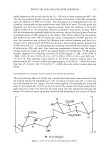
j. Cosmet. Sci., 50, 133-146 (May/June 1999) Mechanism of polyethylene Dlycol-8/SMDI copolymer in controlled delivery of topically applied druDs H. M. FARES* and J. L. ZATZ, Rutgers University College of Pharmacy, Piscataway, NJ 08855-0789 Accepted jSr publication April 30, 1999. Synopsis The effect of polyethylene glycol-8/SMDI copolymer (PP-15) in controlling the delivery of salicylic acid (SA) and lactic acid (LA) from topical preparations was studied. The effect of PP-15 on permeation was measured in vitro using flow-through diffusion cells and dermatomed pig skin. Skin uptake was also evaluated over time using tape-stripping and tissue analysis. The polymer decreased the flux of SA through pig skin but did not affect the delivery of LA. The polymer increased the overall deposition of SA in the SC but did not change the levels of SA in the viable skin significantly. Skin uptake of LA was not affected by the presence of the polymer. Based on dialysis and cloud point measurements it was found that PP-15 reduced the activity of SA in the vehicle via binding, leading to a decrease in permeation. The binding mechanism accounts for the effect (or lack of effect) of PP-15 on the solutes investigated. INTRODUCTION The use of polymers to control the delivery of actives from semisolid preparations has numerous advantages. Acrylic, cellulosic, and block copolymers are among the polymers that received the most attention from investigators (1-3). Typically in semisolid prepa- rations, these polymers increase the viscosity of the system (2,4) without changing the rate of delivery of actives (5). Other polymeric systems studied used polymer micropar- ticles that contained the drug and were capable of releasing it over an extended period of time. Won (6) introduced porous solid microspheres into which the drug could be incorporated. Mathiowitz eta/. (7) presented non-bioerodable and erodable microspheres that were capable of reducing the release rate of actives. In this study the effect of a newly introduced copolymer, namely, polyethylene glycol- 8/SMDI (Polyolprepolymer-15©), in reducing the rate of permeation of salicylic acid and lactic acid was studied. Polyolprepolymer-15 © is a hydroxyl-terminated block copoly- mer of 1,1"-methylene-bis-[4,isocyanatocyclohexane] and eight moles of ethylene oxide, which makes the polymer soluble in water. The average molecular weight of the polymer * H. M. Fares' current address is SmithKline Beecham Consumer Healthcare, 1500 Littleton Road, Par- sippany, NJ 07054. 133

134 JOURNAL OF COSMETIC SCIENCE is 1,800. The mechanism by which the polymer reduced the rates of permeation of actives to the skin is presented. Some factors that could influence the efficacy of the polymer were studied, and the results are reported. EXPERIMENTAL MATERIALS Materials included salicylic acid (SA), dibasic sodium phosphate, monobasic potassium phosphate, sodium chloride, potassium chloride, sodium hydroxide, tetramethylammo- nium hydroxide pentahydrate, acetonitrile HPLC, methanol HPLC grade, scintillation fluid, and glacial acetic acid (Fisher Scientific, Fair Lawn, NJ) lactic acid (LA) (Sigma, Saint Louis, MO) polyethylene glycol-8/SMDI copolymer (Polyolprepolymer-15, Pene- derm Inc., Foster City, CA) hydroxyethyl cellulose (Natrosol 250 HR, Aqualon Com- pany, Wilmington, DE) cellulose acetate dialysis tubing (Spectrum, Houston, TX) poloxamer 105 (Pluronic L-35, BASF, Parsippany, NJ) polyoxyethylene (20) sorbitan monooleate (Tween 80, ICI, Wilmington, DE) diazolidinyl urea, methylparaben, and propylparaben (Sutton Laboratories, Chatham, NJ) [•4C]SA-56.1 mCi/mmol, [•4C]LA- 108.3 mCi/mmol, and [3H]water-108.3 mCi/mmol (NEN Products, Boston, MA) skin-digesting fluid (Solvable, Packard Instrument Company, Inc., Meriden, CT) and aqueous detergent (Palmolive dishwashing liquid, Colgate Palmolive, New York, NY). FORMULATIONS Solutions and suspensions. Buffered aqueous preparations (pH = 2.4) containing various concentrations of SA ranging from 0.1% to 2% w/w were formulated. Formulations containing SA at a concentration higher than 0.2% w/w were suspensions. All formu- lations contained a preservative (0.2% w/w diazolidinyl urea) and a dispersing agent (0.1% w/w polyoxyethylene (20) sorbitan monooelate). When polyethylene glycol-8/ SMDI copolymer (PP-15) was added to the formula, its concentration ranged from 0.3 % to 6% w/w. Water was displaced to accommodate the addition of PP-15. Lactic acid (LA) was formulated in buffered aqueous solutions (pH = 2.0). Its concen- tration in the formulations ranged from 5% to 10% w/w. All formulations contained a preservative (0.2% w/w diazolidinyl urea) and a dispersing agent (0.1% w/w polyoxy- ethylene (20) sorbitan monooleate). In some formulations, 3% w/w PP-15 was added to the formula and water was displaced to accommodate the addition. Aqueous solutions of 0.25 % w/w methylparaben (MP)and 0.004% w/w propylparaben (PP) contained a surface-active agent (0.1% w/w polyoxyethylene (20) sorbitan mono- oleate). When PP-15 was added to the formula, 3% w/w of the water was displaced. Formulations containing 0.5% w/w SA and 5.0% w/w LA were used in most of the experiments unless otherwise stated. IN VITRO PERMEATION Preparation of the skin. Fresh, excised, micro-Yucatan pig skin was supplied by Charles River Laboratories (Wilmington, MA). Upon receipt, the skin was washed gently with
Purchased for the exclusive use of nofirst nolast (unknown)
From: SCC Media Library & Resource Center (library.scconline.org)