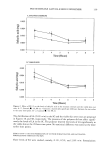
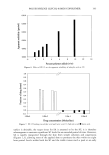
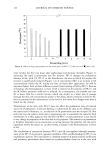
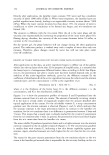
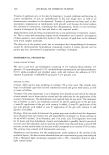
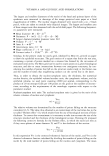
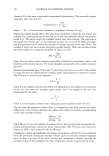
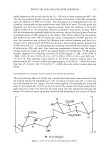
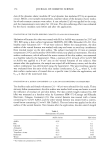
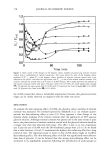
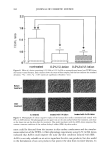
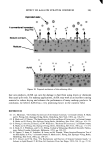
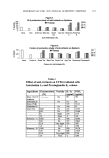
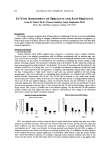
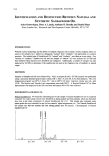
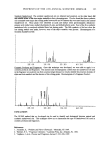
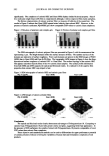
198 JOURNAL OF COSMETIC SCIENCE FATIGUE ANALYSIS OF HAIR Y.K. Kamath, S.B. Hornby, H.D. Weigmann and S.Ruetsch TRI/Princeton, Princeton, NJ 08542 INTRODUCTION: All materials suffer fatigue failure when subjected to low levels of strain repeatedly over long periods of time. This is especially true of fibers, which are materials of high aspect ratio. Human hair being a fiber of biological origin is no exception. Heterogeneity of its stoicrare makes it more prone to fatigue failure than its synthetic analogs. Stress concenlrafions at weak points can generate cracks which propagate to critical size on repeated strain cycling, leading to catastrophic failure. Human hair is subjected to low levels of tensile strain during various grooming processes. This can be considered as subjecting the fiber to tensile fatigue in the Hookian region. Since stress concenlrations develop preferentially in the regions of flaws, the method can be used as a diagnostic method to evaluate hair damage. In the same way, if there are trealments which reinforce the fiber stmcau•, their efficacy can also be evaluated. In this work we have presented evidence which indicates that both fiber damage and the amelioration of its effect on fiber failure by certain treatments can be achieved by tensile fatigue measurements. Effects of various parameters on failure probabilities and the fundamental processes which lead to fiber failure have been worked out extensively by Prevorsek and Lyons EXPERIMENTAL: Hair samples used in this study was obtained from DeMeo Bros. of New York. Chemicals used in this work were obtained from Aldrich or from the suppliers to the haircare imluslxy, meeting L-'I•A requirements, and were used as received. Reductive treatments were carried out with thiogiycolic acid (TGA, 10%, pH 9.8), glycerol monothioglycolate (GMTG, 10ø/0, pH 7.8) and Cysteamine (Cys, 10ø/0, pH 7.8). Treatment sequence was 20 min reduction followed by 10 min neutralization with 4.6% H202 at pH 2.6. Bleaching was done with 6% H20• at pH 7 for lh. A 4 hour bleach treatment consisted of 4 one hour treatments. Conditioner treatments involved dip coating in a solution of 0.5% for 10 min followed by 5 one minute rinses to remove the excess conditioner. Ten treaanents involved 10 of the above treatments in sequence with blow drying at low temperature in between each of the treatments. Fatigue life measurements were made on 3 cm long fibers. Cross sectional area of the fibers were determined by the laser micrometer and fibers from the middle of the distribution were selected. The apparatus used for this measurement, shown schematically in Fig. 1, was built at TRI, and was designed for constant load fatiguing. It consisted of two platens. Fibers were mounted on the upper platen and were loaded with a sufiable weight. The lower platen was moved up and down with a motor at a suitable f•equency, ranging from 0.7 -2.3 Hz. Each fiber was connected to an electrical circuit through a micro- switch to count the number of cycles survived by the fiber. The apparatus could accommodate 40 fibers per rim. RESULTS AND DISCUSSION: Characteristic Life: The fatigue life dam were treated by Weibull statistics [2]. Assuming that the lower bound of lifetime is 0, i.e., that the weakest fiber breaks when it is loaded for the first time, the cumulative probability of failure F(x) is given by • F(x) = 1- e o) Equation (1) can be linearized by taking 1ogaritluns of both sides to give, 1- F(x) (2)

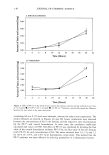
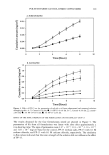
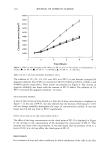
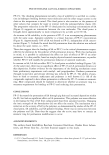
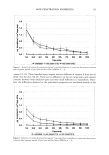
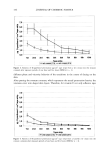
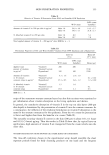
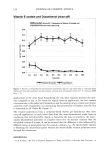
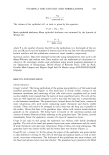
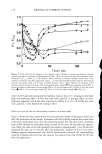
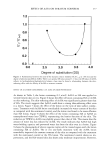
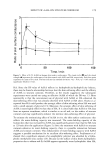
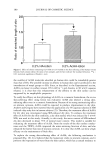
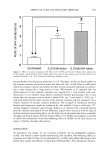
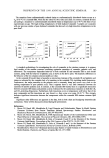
PREPRINTS OF THE 1999 ANNUAL SCIENTIFIC SEMINAR 199 A plot of In (x) Vs the led• hand side of equalion (2) gives a straight line with a slope b and an intercept - bin0, from which 0 can be calculated. Characteristic life can be evaluated from this plot by extrapolation of the number of cycles, which correspond to the failure of 63.2% of the specimens. This can be determined mathematically. Characteristic life has been used in this work as a measure of fiber damage and its alleviation. Effect of Chemical Treatments on Damage: Reduction: Characteristic life data on reduced fibers in Fig. 2 shows that TGA at high pH does the most damage to the fiber. Treatments involving GMTG and Cys are significantly less damaging. They are also less effective in curling. The cause seem to be the mixed disulfide which formed in the process and corresponds to the disulfide bonds that are not reformed. Bleaching (Oxidation): Nonlinear nature of fiber damage in oxidation can be seen from the dntn of Fig. 3. Although the difference between 1 and 2h treatments is not significantly different, 4h treatment leads to a drastic decrease in characteristic life. Conditioner Effects: Figure 4 shows that both low and high molecular weight conditioners reverse the damaging effect of the bleaching treatment. We propose that these effects are a result of cuticle reinforcement by the conditioner molecules in the intercuticular regio• Cross-linking by salt linkages and hydrophobic bonding seem to be possible. In the case of a low molecular weight conditioner this may occur both in the cuticle and the cortex because of penetration and diffusion. REFERENCES: 1. Prevorsek, D.C. and Lyons, J. W., Textile Res. J. 34, 1040 (1964) 2. Charles, L and Sheth, N.J., Statistical Design and Analysis of Engineering Experiments, McGmw-I-lill Book Company, New York, NY, 1973 ACKNOWLEDGEMENTS: Author is thankful to Ms. S. Homby and Ms. I. Bradford for their contribution to the experimental work and data trealmcnt. This work was supported by a group of TRI corporate participants.
Purchased for the exclusive use of nofirst nolast (unknown)
From: SCC Media Library & Resource Center (library.scconline.org)