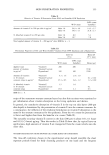
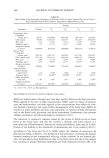
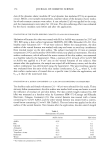
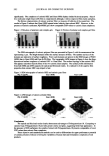
168 JOURNAL OF COSMETIC SCIENCE Table III Mean Values of the Stereologic Parameters of Epidermal Cells of Control Guinea Pigs and of Guinea Pigs Topically Treated With Cosmetic Preparations (Mann-Whitney test) Groups Parameter Control T• T•n T•v T v Germinative layer Cytoplasm volume (m •) 620.33 1010.08' 1016.69' 764.14'* 1323.44' Cell volume 718.94 1220.32' 1164.57' 951.41' 1476.18' N/C ratio 0.16 0.21' 0.15 ns 0.25* 0.12'* Thickness (l•m 3) 7.32 11.51' 11.11' 16.56' 16.26' Numerical density (nø/mm 3) 1438348 825519* 869289* 1059321 * 712823' Spinous layer Cytoplasm volume (l•m •) 1067.43 1901.33' 2144.54' 1473.18' 2552.61' Cell volume (l•m 3) 1157.09 2119.41' 2294.59* 1648.15' 2709.33* N/C ratio 0.08 0.11 * 0.07 ns 0.14 "• 0.06* Thickness (lam 3) 9.36 16.95' 23.71' 29.43* 37.78* Numerical density (nø/mm 3) 876950 476206* 471392' 665843* 374095* Total thickness Surface density (mm2/mm 3 ) 4.76 2.58* 2.38* 1.52' 1.40* Thickness (lam 3) 22.72 34.98** 39.90** 59.59 64.57* Outer layer/basal layer ratio 1.04 1.04 n• 1.01 •s 1.00 • 1.00 '• Numerical density (nø/mm 3) 1011357 487789* 526503' 620644* 401681 * * p 0.01 **p 0.05 ns, Nonsignificant. MECHANISMS OF ACTION OF ALPHA-HYDROXY ACIDS (AHAs) AHAs are widely used in therapy since they have specific effects on the skin structures. When applied to the skin in high concentrations, AHAs cause the release of keratino- cytes and epidermolysis, and when applied at low concentrations they reduce the cohe- sion between corneocytes and cause evident desquamation of the horny layer. AHAs are involved in many metabolic processes: they participate in essential cellular mechanisms such as the Krebs cycle, glycolysis, and serine biosynthesis. Furthermore, they promote collagen maturation and glycosaminoglycan formation (10,11). The reduction in corneocyte cohesion caused by the action of AHAs occurs at lower levels in the horny layer, and this fact involves a dynamic and active process in a particular step of keratinization. Among the various possibilities, there may be a modi- fication of ion binding or the dissolution of desmosomes due to the reduced pH (11). According to Van Scott and Yu (12), AHAs reduce the cohesion of corneocytes by affecting ion bonds, as follows: 1) by hydration of the horny layer, increasing the distance between corneocytes and consequently reducing cellular cohesion. In our material gly- colic acid provoked a deep hydration not only in the horny layer, but also in the spinous one, resulting in greatly thickened epithelium and wide separation between cells 2) by

VITAMIN A AND GLYCOLIC ACID FORMULATIONS 169 reduction of electron-negative sulfate and phosphate groups of the outer wall of the corneocytes due to the enzymatic inhibition of transferases and kinases, a fact that would provoke the loss of cohesive strength. The hydration effect obtained in our experiments is very important when the cosmetic products containing glycolic acid are used, because there is a great interest in the research of the active substance with hydration properties. The moisturizing products are some of the most important types of cosmetics, because these act to prevent atopic xeroxis and cutaneous early aging and are used to support the treatment of several alterations. There are several moisturizing agents used in cosmetic products--for example, aminoacids, urea, latic acid, silicones, vegetable and mineral oils, liposomes, polymers, and ceramides, which act by different mechanisms, such as occlusive mechanism or carrying water into the skin surface (13,14). In our paper, the glycolic acid and vitamin A provoked the hydration effect by intra- and extracellular edema. This effect is very interesting and beneficial because it can improve cutaneous hydration, and it is not limited to the upper cells layers but is also present in the deeper ones. AHAs provoke a reduction in pH even in the deep layers of the horny layer (11), and the reduced pH contributes to desmosome dissolution. A reduced pH provokes maximum activity of certain enzymes, resulting in increased cell proliferation and differentiation. AHAs also stimulate epidermal proliferation by acting on keratinocytes. The changes observed in normal skin treated with AHAs (15) are similar to those observed in wound cicatrization (16) during the period of reaction after steroid-induced atrophy (17) and in treatment of the skin with retinoic acid (18). Increased total epidermal thickness, as well as increased numbers of granular layers, suggest that AHAs may stimulate changes in the epidermis. In the present study, glycolic acid stimulated an increase in the thickness of the granu- lose layer in the guinea pig skin, with cells filled with rough and fused keratin-hyalin granules. The epidermal thickening observed was due to the intra- and extracellular hydration (beneficial edema, in this case) and the nuclear volume increase. In the basal layer it may be suggested that the increase in nuclear activity occurred in the group treated with the formulation containing glycolic acid and vitamin A palmirate, due to alterations observed in the eccentricity, form coefficient e outline index (p 0.01), which indicates variations in the nuclear function. In this way, the effects observed (cell renewal and hydration) are very important in the products used to prevent and to improve cutaneous aging. In our studies, both the formulations containing vitamin A palmirate or glycolic acid caused increased epidermal thickness, but these alterations were even more evident with the use of the formulation containing a combination of vitamin A palmitate and glycolic acid. This is probably due to the presence of the glycolic acid in the gel formulation studied, increasing the behavior of skin penetration by vitamin A palmirate and poten- tiating its effects (20). Finally, we speculate that AHAs may promote collagen synthesis in human skin (18). It should be remembered that ascorbic acid (an AHA in the lactone form) stimulates procollagen synthesis in fibroblasts in culture (21).
Purchased for the exclusive use of nofirst nolast (unknown)
From: SCC Media Library & Resource Center (library.scconline.org)