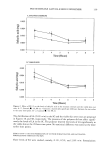
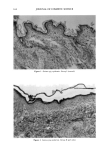
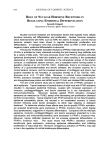
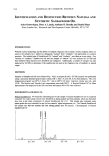
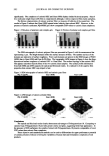
194 JOURNAL OF COSMETIC SCIENCE IDENTIFICATION AND DISTINCTION BETWEEN NATURAL AND SYNTHETIC SANDALWOOD OIL Asira Ostrovskaya, Peter A. Landa, Anthony D. Rosalia and Daniel Maes Estee Lauder Inc., Research and Development Center, Melville, NY 11747 INTRODUCTION: With the current technology and the ability of synthetic fragrance oils to mimic sensory response, there is a need in the industry for a method to distinguish "natural" from "synthetic" oils particularly in cosmetic products. The isolated case of Sandalwood Oil, "natural" and "synthetic", was taken as a case study. Five varieties of "synthetic" Sandalwood oils and one sample of "natural" oil were analyzed by GC/MS and their different Mass Spectra were identified and compared. Additionally, a sample of cologne was also analyzed by GC/MS to determine if the sandalwood oil used in the fragrance was of synthetic or natural origin. METHODS: Samples of Sandalwood oils were diluted 0.4g / 10mL in reagent alcohol. GC/MS analysis was performed using a non-polar dimethyl polysiloxane column, DB-1, 30m x 0.32cm ID, 0.25u film thickness. The oven temperature program was 60øC (5 ram), 4øC /mm to 280øC (20 ram). Injection volume was luL, split 1/100. The Injector and Transfer Line temperatures were both 280øC. A Hewlett Packard 5971A Mass Spectrometer was employed in the full scan mode and masses 40 to 550 were collected. EXPERI3,1YNTS AND RESULTS: Natural Sandalwood: We found the chromatogram for the sample of natural Sandalwood oil we analyzed contained two major peaks which were identified as alpha-santalol'and beta-santalol, which the literature also cites as the main constituents of natural Sandalwood Oil (1-3). This sample also contained some minor peaks that were identified as epi-cis-beta santalol, alpha bergamotene, etc. The Natural Sandalwood Oil sample also did not contain any late eluting peaks after 40 minutes. Chromatogram of Natural Sandalwood Oil: i i i 25.00 30.00 , 35.00 ' I ' 40.00

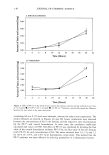
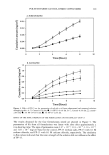
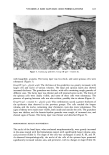
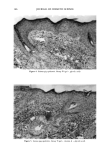
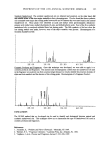
PREPRINTS OF THE 1999 ANNUAL SCIENTIFIC SEMINAR 195 Synthetic Sandalwood: The synthetic sandalwood oils we obtained and analyzed, on the other hand, did not exhibit either of the two major santalois in their chromatograms. We also found that these synthetic oils contained some major late eluting peaks between 40 and 45 minutes that were not found in the natural Sandalwood oil. These peaks were identified as acids and methyl esters (predominantly dihyctroiso- pirnaxic acid methyl ester, methyl-18-pimaren-18-oate, and dehyctroabiefic acid). Four of the five synthetic sandalwood oils we analyzed exhibited these late eluting peaks. The fifth synthetic oil did not show the late eluting methyl ester peaks, however, none of the major santalois were present. Chromatogram of a Synthetic Sandalwood Oil: 25 O0 30.00 35.00 40.00 Cosmetic Products and Fragrances: Once this technique was developed, we were able to apply it to cosmetic products and fragrances. The analysis and chromatograms confn-rn that the sandalwood oil used in the fragrance we analyzed was from a natural origin because we clearly identify the presence of peaks of alpha and beta santalois and the absence of late elutmg peaks. Chromatogram of a Fragrance Product: 25.00 30 O0 35.00 40.00 CONCLUSION: The GC/MS method that we developed can be used to identify and distinguish between natural and synthetic sandalwood oils. This technique allows us to characterize the type of Sandalwood Oil used in cosmetic products and fragrances. References: 1. Arctander, S., "Perfume and Flavor Chemicals, "Montclair, NJ. 1969. 2. Theimer, E.T., "Fragrance Chemistry, "Academic Press, Inc., Orlando, FL. 1982. 3. Verghese, J., et. al., Flavour and Fragrance Journal, 5: 223-226, 1990.
Purchased for the exclusive use of nofirst nolast (unknown)
From: SCC Media Library & Resource Center (library.scconline.org)