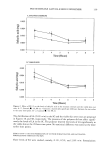
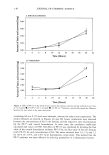
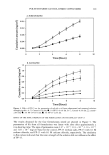
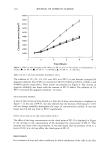
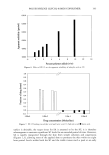
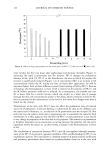
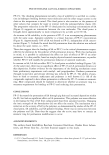
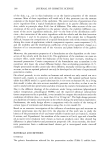
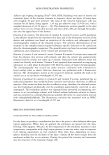
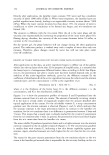
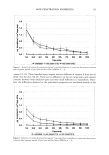
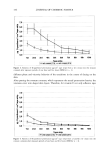
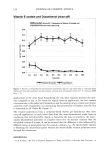
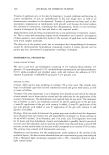
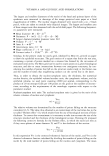
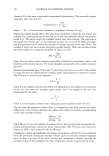
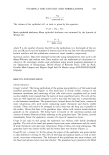
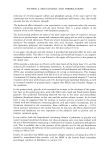
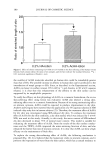
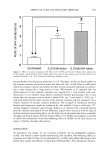
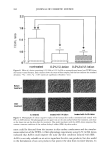
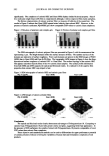
182 JOURNAL OF COSMETIC SCIENCE 2.2 iii 1.8 1.4 1.0 T" ..... .... '-'1' nontreated 0.2%HA-lotion 0.2%AcHA-Iotion Figure 8. Effect of a lotion containing 0.2% HA or 0.2% AcHA on transepidermal water loss (TEWL) from the human ventral forearm. Each column shows the mean of four samples, and the bars indicate the standard deviation. **p 0.01 *p 0.05 statistical significance (Student t-test). Before treatment After .• - - treatment . :• .* . n ontreated treated with HA-lotion -•..•....•_ , . _.. -..: •- .. .•..*•..• '• treated with AcHA-I orion Figure 9. Photographs of silicon negative replica of the human skin surface nontreated and treated with HA- or AcHA-lotion. The photographs on the upper row are the skin surface before the treatment, and those on the lower row are the skin after the treatment. One-week treatment with the AcHA lotion improved the stratum comeurn condition of the sodium dodecyl sulfate (SDS) dry-skin surface. ment could be detected from the increase in skin surface conductance and the simulta- neous reduction of the TEWL. (c) Skin physiology experiments using 0.2% AcHA lotion indicated that AcHA could improve the scaly dry-skin condition induced with SDS. AcHA is not only valuable as an active ingredient for skin care products, but also useful in the formulation of sun care products that protect the skin from excessive dryness. In

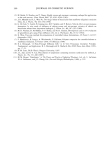
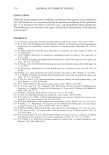
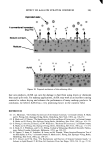
EFFECT OF AcHA ON STRATUM CORNEUM 183 o o 0 o Stratumcørneum%c::•i•••'•'......':i"•i•'= o 0 0 0 0 0 0 0 o o o o AcHA Figure 10. Proposed mechanism of skin-softening effect. hair care products, AcHA can cure the damage to hair from using dryers or chemicals that cause split ends. For makeup applications, AcHA may work as an excellent coating material to reduce drying and enhance the performance of many makeup products. In conclusion, we believe AcHA has a very promising future in the cosmetic field. REFERENCES (1) I. C. Mackenzie, "The Cellular Architecture of the Stratum Corneum," in Stratum Corneum, R. Marks and G. Piewig, Eds. (Springer-Verlag, Berlin, Heidelberg, New York, 1983), pp. 146-152. (2) R. Marks and S. P. Barton, "The Significance of the Size and Shape of Corneocytes," in Stratum Corneum, R. Marks and G. Piewig, Eds. (Springer-Verlag Berlin, Heidelberg, New York, 1983), pp. 161-170. (3) G. Piewig, E. Scheuber, B. Reuter, and W. Waidelich, "Thickness of Corneocytes," in Stratum Corneum, R. Marks and G. Piewig, Eds. (Springer-Verlag, Berlin, Heidelberg, New York, 1983), pp. 171-174. (4) A. Rook, D. S. Wilkikson, and F.J.G. Ebling, Textbook of Dermatology (Blackwell Scientific Publica- tions, Oxford, London, Edinburgh, Melbourne, 1972), pp. 249-255. (5) H. Tagami, Y. lwase, K. Yoshikuni, K. Inoue, and M. Yamada, "Water Sorption-Desorption Test of the Skin Surface In Vivo," in Stratum Corneum, R. Marks and G. Piewig, Eds. (Springer-Verlag, Berlin, Heidelberg, New York, 1983), pp. 248-251. (6) N.Y. Schurer and P.M. Elias, "The Biochemistry and Function of Stratum Corneum Lipids," in Advances in Lipid Research, P.M. Elias, Ed. (Academic Press, San Diego, 1991), Vol. 24, pp. 27-56.
Purchased for the exclusive use of nofirst nolast (unknown)
From: SCC Media Library & Resource Center (library.scconline.org)