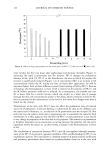
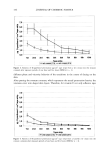
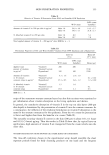
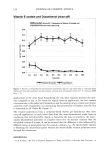
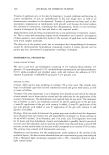
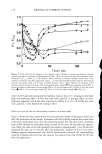
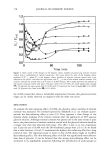
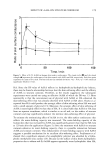
176 JOURNAL OF COSMETIC SCIENCE 1.2 1.0 0.8 0.6 0.4 0.2 0.0 ' 0 50 100 Time / min ! Figure 2. Time course of the changes in the dynamic elastic modulus of guinea pig stratum corneum treated with water or sodium acetylhyaluronate (AcHA). The y-axis shows the ratio of the dynamic elastic modulus, E't/E't_o, where E't is the dynamic elastic modulus of stratum corneum treated with a test solution at a specific time after application, and E't_ o is that of non-treated stratum corneum. The stratum corneum was treated with 2 pl of water or AcHA solution. The x marks represent the modulus of the stratum corneum treated with water. The closed upside-down triangle (¾) shows treatment with AcHA, of which the degree of substitution of acetyl group (DS) is 2.6. For the open circle (O), DS is 3.0 for the closed circle (0), DS is 3.5 for the open square ([•), DS is 3.7 for the closed triangle ('), DS is 3.8. with 5 w/w% glycerol maintained the modulus value at about 0.7, showing its relatively high skin-softening effect. If HA was used with glycerol, a synergic effect on skin- softening appeared, which has been reported by Ozawa eta/, (13). If AcHA was used with glycerol, it also showed the synergic effect. EFFECT OF AcHA ON THE WATER-HOLDING CAPACITY OF HUMAN SKIN Figure 5 shows the time course of the ratio of human skin surface conductance before and after the application of the sample. Treatment with HA slightly lowered the initial value of the skin conductance ratio over the measuring period. On the other hand, treatment with AcHA showed an immediate sharp increase of the ratio 10 min after the applica- tion. Then, the value of the ratio gradually decreased to approximately 1.4 at 60 min and remained the same up to 120 min after the application. Analysis of the in vivo water- holding capacity demonstrated that AcHA significantly increased the water-holding capacity of human skin and that the capacity was greater than that of HA for 60 min after the application.

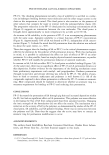
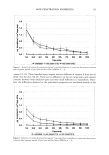
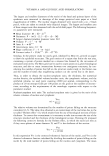
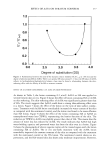
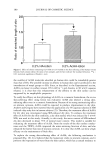
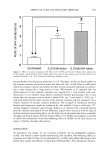
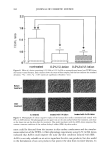
EFFECT OF AcHA ON STRATUM CORNEUM 177 1.2 II 1.0 0.8 0.6 0.4 0.2 0.0 2.5 3.0 3.5 4.0 Degree of substitution (DS) Figure 3. Relationship between the ratio of the dynamic elastic modulus (E'•/E'•= o) at 100 min and the degree of substitution (DS) of AcHA. There is an optimal DS value around 3.3. Since the DS value of AcHA reflects its hydrophobicity/hydrophilicity balance, there may be found a relationship between the skin- softening effect and the affinity of AcHA to stratum corneum. EFFECT OF A LOTION CONTAINING 0.2% AcHA ON SKIN PHYSIOLOGY As shown in Table I, the lotion containing 0.2 w/w% AcHA or HA was applied to ventral forearm skin in vivo. Figure 6 shows the effect of lotion containing HA or AcHA on skin softening. The skin-softening effect of AcHA was significantly greater than that of HA. The result suggests that AcHA could show a strong skin-softening effect even in a lotion. Figure 7 shows the effect of the lotion on the ratio of skin surface conduc- tance. Treatment with AcHA lotion considerably increased the water content of the skin as compared with the nontreated control, and the lotion was found to be more effective than HA lotion. Figure 8 shows the effect of the lotion containing HA or AcHA on transepidermal water loss (TEWL), representing the barrier function of the skin. The reduction in TEWL by AcHA was slightly greater than that of HA. This means that the amount of water loss was reduced by AcHA. The result indicates that AcHA had high water-holding capacity and prevented water loss from the skin even in a lotion. Figure 9 shows the photographs of silicon negative replica of the treated region with the lotion containing HA or AcHA. The in vivo one-week treatment with the AcHA lotion remarkably improved the stratum corneum of dry skin as compared with the treatment with the nontreated control or the HA lotion. The nontreated control shows no im- provement, and the HA-treated skin also shows only moderate improvement. However,
Purchased for the exclusive use of nofirst nolast (unknown)
From: SCC Media Library & Resource Center (library.scconline.org)