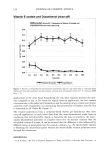
170 JOURNAL OF COSMETIC SCIENCE CONCLUSIONS Under the present experimental conditions, we observed that glycolic acid, combined or not with vitamin A, acts on guinea pig skin by provoking thickening of the epithelium due to an increased cell volume caused by intra- and extracellular edema (hydration). This thickening is not limited to the upper cell layers but is also present in the basal and spinous layers. REFERENCES (1) R. Hermitre, Aging skin, retinoids and alpha hydroxy acids, Cosmet. Toilerr., 107, 63-67 (1992). (2) W. A. Metz, Die streckenmessung und gerichteten strukfuren im mikroskop und ihre anwendung zur bestimmung yon oberfl•chen--volumen relationen im knochengewebe, Mikroskopie, 22, 132-142 (1968). (3) M. Delesse, Proc•d• m&anique pour d&erminer la compasiton des rotes, Annales de Mines, 13, 379-388 (1847). (4) H. W. Chalkley, Method for the quantitative morphologic analysis of tissues, J. Nat. Cancer Inst., 4, 47-53 (1943). (5) E. R. Weibel, Principles and methods for the morphometric study of the lung and other organs, Lab. Invest., 12, 131-155 (1963). (6) A. Hennig, Feher der oberflachenbestimmung yon kerner bei endlicher schimittdicke, Mikroskopie, 12, 7-11 (1957). (7) M. Abercrombie, Stimulations of nuclear populations from microforme sections, Ant. Rec., 94, 239 (1946). (8) H. Elias, et al., Some methods for the study of kidneys structures, Z. Wiss. Mikrosk., 5, 70 (1961). (9) E. R. Weibel, Principles and methods for the morphometric study of the lung and other organs, Lab. Invest., 12, 131-155 (1963). (10) E. Van Scott and R. J. Yu, Hyperkeratinization, corneocyte cohesion and alpha hydroxy acids,J. Am. Acad. DermatoL, 11,867-879 (1984). (11) W. P. Smith, Hydroxy acids and skin aging, Cosmet. Toiletr., 109, 41-44 (1994). (12) E. Van Scott and R.J. Yu, "Substances That Modify the Stratum Corneum by Modulating Its Formation," in Principles of Cosmetics for the Dermatologist, P. Frost and S.N. Horwitz, Eds. (Mosby, St. Louis, 1982), pp. 70-74. (13) M. Rieger, Ceramides: Their promise in skin care, 111, 33-45 (1996). (14) B. Idson, Dry skin: Moisturizing and emolliency, Cosmet. Toilerr., 107, 69 (1992). (15) R. M. Lavker, et aL, Effects of topical ammonium lactate on cutaneous atrophy from a potent corti- costeroid, J. Am. Acad. DermatoL, 26, 535-544 (1992). H. Pinkus, Examination of the epidermis by strip method, J. Invest. DematoL, 19, 431-447 (1952). P. Zheng, et aL, Morphologic investigations on the rebound phenomenon after corticoid4nduced atrophy in human skin, J. Invest. Dermatol., 82, 345-352 (1984). P.M. Elias and M. L. Williams, Retinoids, cancer and the skin, Arch. DermatoL, 117, 160-180 (1981). E. Van Scott and R.J. Yu, Alpha hydroxy acids: Procedures for use in clinical practice, Cutis, 43, 222-228 (1989). G. R. Leonardi and P.M. B. G. Maia Campos, Influence of glycolic acid as a component of different formulations on skin penetration by vitamin A palmitate, J. Cosmet. Sci., 49, 23-32 (1998). S. R. Pinnell, et al. Induction of collagen synthesis by ascotbit acid: A possible mechanism, Arch. DermatoL, 123, 1684-1686 (1987). (16) (17) (18) (19) (20) (21)

j. Cosmet. Sci., 50, 171-184 (May/June 1999) Skin-softening effect of acetylhyaluronate on stratum corneum T. OKA, M. UEMURA, N. UENO, and T. YANAKI, Shiseido Research Center, 1050 Nippa-cho, Kohoku-ku, Yokohama, Kanagawa, 223-8553Japan. Accepted for publication April 30, 1999. Presented in part at the Third Scientific Conj•rence of the Asian Societies of Cosmetic Scientists, Taipei, Taiwan, May 24, 1997. Synopsis Sodium hyaluronate (HA), which is made from safe biological sources, has a very high moisturizing effect. To endow HA with precious functions, we synthesized varieties of HA derivatives and evaluated their usefulness for cosmetic products. After numerous investigations for seeking useful HA derivatives, we discovered a novel HA derivative, sodium acetylhyaluronate (AcHA), which has superb moisturizing and excellent skin-softening effects on stratum corneum. To investigate the usefulness of AcHA in vivo, the efficacy of AcHA on skin physiology was evaluated. It was found that AcHA raised water content in stratum corneum more markedly than did HA. Apparently, AcHA could enhance the intrinsic water-holding capacity of the stratum corneum. The results suggested that there was an interaction between AcHA and stratum comeurn and that this could induce the strong skin-softening effect. This agreed with the fact that AcHA is an amphiphilic polymer having an effect of lowering surface tension. The results also suggested that AcHA adheres to human skin, enhances the water-holding capacity of the stratum comeurn, and shows a strong skin-softening effect. Upon the use of AcHA in a cosmetic formulation, it was observed that a lotion containing 0.2 w/w% AcHA could improve dry skin condition. INTRODUCTION It has long been recognized that epidermis is the main obstruction to free movement of molecules across skin and that stratum corneum is the principal barrier within epider- mis. It is well known that the stratum corneum is a remarkably tough and resilient membrane consisting of approximately 20 stacked layers of flattened and dead epidermal cells (1-5). The lipid composition of human stratum corneum displays striking regional variations that could reflect differences in stratum corneum thickness, turnover, des- quamation, and/or permeability, and the stratum corneum lipids play an important role in the retention of water in skin (6,7). Normal human stratum corneum contains 10 - 20 w/w% water, which maintains essentially healthy and fresh skin. Water also influ- ences the flexibility of the stratum corneum (8-11). However, the stratum corneum always has a tendency to lose its normal water content due to aging, surroundings, physical constitution, and other factors, and the reduction of water content in stratum 171
Purchased for the exclusive use of nofirst nolast (unknown)
From: SCC Media Library & Resource Center (library.scconline.org)