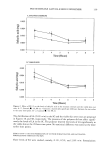
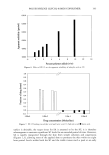
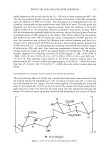
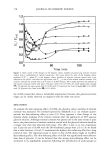
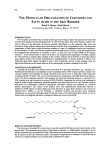
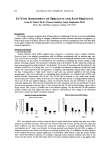
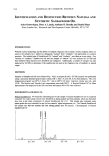
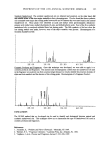
188 JOURNAL OF COSMETIC SCIENCE THE MOLECULAR ORGANIZATION OF CERAMIDES AND FATTY ACIDS IN THE SKIN BARRIER David J. Moore, Mark Rerek International Specialty Products, Wayne, NJ 0 74 70 INTRODUCTION: The skin plays an essential role in human physiology by providing a barrier that protects the body from external insult and prevents the unregulated loss of water from the body. This barrier function resides in the outer 10-20 gm of the epidermis, the stratum comeurn. Specifically, it is the ceramides, fatty acids, and cholesterol of the stratum corncure lipid matrix that provides the skin's permeability barrier. The molecular organization of these lipids within the stratum comeurn is a topic of considerable interest and importance. In our laboratory we have used Fourier transform infrared spectroscopy (FTIR) to study the intermolecular and intramolecular interactions of ceramides 2 and 5, on their own, and in lipid models of the stratum comeurn b4. In the current study we report on the inter- and intramolecular organization of human ceramide III. This molecule is commercially available to the cosmetic industry and is therefore of more than clinical and academic interest. Our results demonstrate two important points: 1) human ceramide 3 behaves very differently than either human ceramides 2 and 5, and of particular interest to this audience, there are significant differences in the phase behavior of the commercially available ceramide III and IIIB. MATERIALS AND METHODS: Ceramide III and IIIB were obtained from Cosmoferm B.V. through Centerchem, Inc., Stamford, CT. Perdeuterated hexadecanoic acid (palmitic acid) was purchased from CND Isotopes, Quebec, Canada. Pure ceramide samples were prepared by drying ceramides from solvent onto an horizontal ATR crystal then covering with pH 5.5 buffer. The crystal was then placed in a temperature controlled HATR unit (Specrta- Tech). The three component mixtures were prepared by dissolving equimolar amounts of ceramide III or IIIB, palmitic acid, and cholesterol in solvent (CHC13/CH3OH), evaporating the solvent, and hydrating the lipids in buffer at high temperature. Hydrated samples were placed between two AgC1 infrared windows and placed in a temperature controlled transmission cell holder. Spectra were acquired on a Mattson Infinity spectrometer. The nature of the detailed inter- and intramolecular information inherent in biophysical FTIR spectra of lipid samples has been discussed in great detail elsewhere and will not be repeated here s . Suffice to say the technique is extremely powerful and provides direct molecular information (i.e. no probe molecules) about the physical state of the lipid hydrocarbon chains as well as detailed data on headgroup ionization, hydrogen bonding and solvent accessibility. ceramide 171 '""' v v v v v T '"OH OH RESULTS AND DISCSUSSION: The structure of ceramide III is shown above, note that ceramide IIIB has an oleoyl chain in place of the stearyl chain. The intermolecular packing of lipid chains in bilayers i.e., orthorhombic, hexagonal or liquid and the intramolecular conformational order of the chains can be monitored directly, and simultaneously, in the IR spectra via the CH2 vibrational modes. The transition temperatures of ceramide III and IIIB from an ordered to a disordered bilayer are extremely high as illustrated in figure 1.

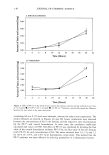
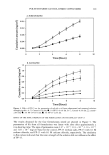
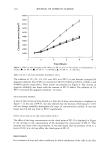
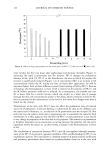
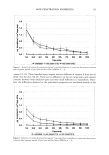
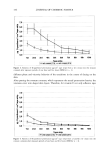
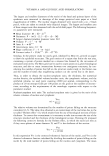
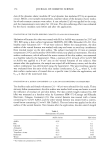
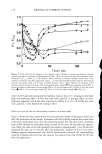
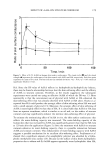
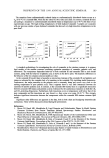
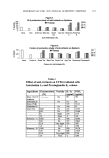
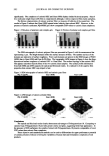
PREPRINTS OF THE 1999 ANNUAL SCIENTIFIC SEMINAR 189 The transition from conformationally ordered chains to conformationally disordered chains occurs at a Tm of 85 øC for ceramide IIIB, which has the oleoyl (C18:l) fatty acid chain. In contrast, ceramide III does not undergo a transition to conformationally disordered chains at temperatures up to 90 øC (the limit of our experimental set-up). The high melting temperatures of both hydrated ceramide 3 samples are consistent with our previous studies of pure hydrated ceramides that showed very high transition temperatures in the pure form 2. 2854 2008 2853 2852 2851 2850 2849 I • ceramide3 o palmitic acid 20 30 40 50 60 70 80 temperature [øC] 2854 2098 o • 2096 2853 _---, , 2094 I 2852 2092 • • 2851 2090 • • 2850 2088 2849 • ceramide 3B 0 palmitic acid 20 30 40 50 60 70 80 temperature FC] 2096 2094 2092 2090 2088 A standard methodology for investigating the role of ceramides in the stratum comeurn is to prepare lipid models of the stratum comeum containing equimolar quantities of ceramide, palmitic acid, and cholesterol. The temperature dependent behavior of both ceramide III and ceramide IIIB in such model systems, along with the behavior of palmitic acid, is shown in the above plots. The dramatic differences in the behavior of the two stratum comeurn models are clear. In the ceramide III model there is basically no interaction (mixing) of the ceramide III and palmitic acid chains as indicated by the complete lack of a transition in the ceramide CH2 stretching mode frequencies. Furthermore, the major transition in the palmitic acid is extremely sharp and occurs very close to the melting temperature of pure palmitic acid. Thus it appears there is very little interaction between the ceramide III and the palmitic acid. In contrast, in the ceramide IIIB model, there is a significant interaction between ceramide IIIB chains and palmitic acid as evidenced by the synchronous transition in both the CH2 and CD2 stretching frequencies. Furthermore, both transitions occur at temperatures well below that of the pure compounds and the transitions are very broad, i.e., they occur over some 20-30 øC. This strongly indicates significant interaction between the components within the ceramide IIIB stratum corneum lipid model. Significant other differences are apparent in the data, both in both chain and headgroup intermolecular interactions. These will be discussed in detail during the presentation. References: 1. Moore D J, Rcrek ME, Mcndclsohn R, Lipid Domains and Orthorhombic Phases In Model Stratum Comeurn: Evidence from Fourier Transform Infrared Spectroscopy Studies. Biochemical and Biophysical Research Communications, 231,797-801 (1997). 2. Moore D J, Rerek, ME, Mendelsohn R, FTIR Spectroscopy Studies of the Conformational Order and Phase Behavior of Ceramides. The Journal of Physical Chemistry, 101, 8933-8940 (1997). 3. Moore D J, Rerek ME, Mendelsohn R, Role of Ceramide II and IV in the Structure of the Stratum Comeurn Lipid Barrier. Proceedings of the 20th Congress of the IFSCC, 1, 30-50 (1998). 4. Moore DJ, Rerek ME, Mendelsohn R., Role of Ceramide 2 and 5 in the Structure of the Stratum Comeum Lipid Barrier. International Journal of Cosmetic Science, In Press (1999). 5. Mendelsohn R, Moore DJ, Vibrational Spectroscopic Studies of Lipid Domains in Biomembranes and Model Systems. Chemistry and Physics of Lipids, 86, 141-157 (1998).
Purchased for the exclusive use of nofirst nolast (unknown)
From: SCC Media Library & Resource Center (library.scconline.org)