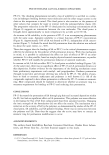
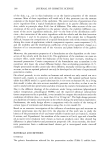
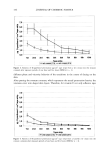
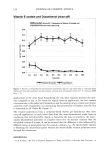
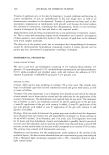
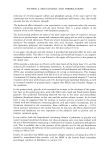
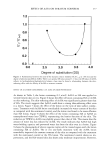
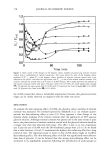
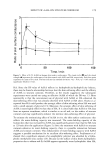
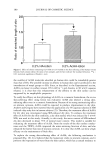
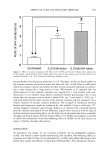
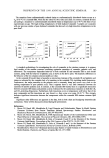
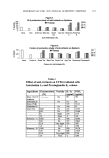
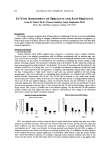
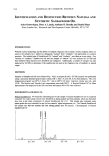
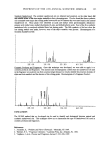
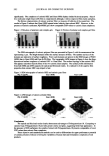
144 JOURNAL OF COSMETIC SCIENCE 50 45 40 35 30 25 20 15 10 5 0 0 0.1 0.2 4 6 8 10 12 Percent drug (w/w) Figure 8. Effect of drug concentration on the cloud point of PP-15. [•, Salicylic acid •, lactic acid. time (within the first two hours after application) and decrease thereafter (Figure 2), mirroring the rapid accumulation into the receptor. PP-15 changes the permeation kinetics of SA with 3% PP-15 in the formulation, the rate at which SA reaches the receptor is significantly reduced (Figures 1,4). A concomitant effect is an increase in SA concentrations within the SC during the first six hours after application. As will be discussed below, both of these differences result from binding of SA by PP-15. Because of binding, the thermodynamic activity of SA is reduced in the presence of PP-15, and the SC/vehicle partition coefficient is reduced. As a consequence, the transfer rate into SC is lower than for a control system, which also results in a lower rate of passage through the skin. SA concentrations persist in the donor, which continues to feed the SC, thus accounting for the maintenance of the level in this tissue for a longer time than is found for the control. Pretreatment of the skin with PP-15 does not affect the permeation rate of tritiated water (9). Furthermore, if silicone sheeting is substituted for skin in the diffusion cell, the same result is obtained, i.e., a reduction in SA penetration into the receptor (9). Not only that, but the relative reduction in penetration rate is essentially the same for both membranes. It is thus apparent that the effect of PP-15 on SA permeation is not related to any change in properties of the skin due to this polymer. The reduction in permeation is therefore dependent on an interaction occurring between the polymer and the active ingredient within the donor, or, in other words, a change in the thermodynamic activity of SA. The mechanism of interaction between PP-15 and SA was explored through measure- ment of the PP-15 cloud point, apparent solubility of SA, and SA binding by PP-15 (via equilibrium dialysis). The cloud point is a familiar property of many nonionic surfactants and polymers, particularly those based on a polyoxythelene chain (as is the case with

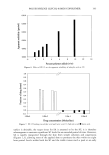
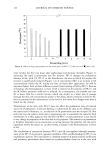
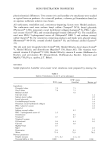
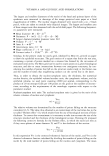
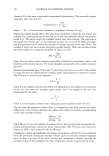
POLYETHYLENE GLYCOL-8/SMDI COPOLYMER 145 PP-15). The clouding phenomenon (actually a loss of solubility) is ascribed to a reduc- tion in hydrogen bonding between water molecules and the ether oxygen atoms in the chain as the temperature is raised. The cloud point is also sensitive to the presence of other solutes that compete for water or interact with the polyoxyethylene chains (10). The progressive reduction in the PP-15 cloud point by increasing concentrations of SA (Figure 8) suggests an interaction between the two molecules. The cloud point is brought down approximately to room temperature by as little as 0.15% SA. An increase in SA solubility in the presence of PP-15 is an accompanying phenomenon with the same cause. Apparent solubility is a linear function of PP-15 concentration (Figure 6). Approximately 50% of SA was bound to PP-15, independent of SA concen- tration (Figure 7). It should be noted that SA permeation from the solution was reduced by about the same extent, i.e., 50%. These data suggest that the binding of SA to PP-15 is the critical phenomenon respon- sible for the alteration by the polymer of SA permeation kinetics. With this mechanism in mind, it is possible to understand the effect (or lack of effect) of PP-15 on other permeants. It is also possible, based on simple physicochemical measurements, to predict whether PP-15 will modify the permeation behavior of untested molecules. In contrast to SA, LA did not affect PP-15's cloud point or exhibit binding (Figures 7,8). At the same time, there was no significant effect of PP-15 on LA permeation kinetics or skin deposition. Further evidence for the importance of the binding mechanism comes from preliminary experiments with methyl- and propylparaben. Parabens permeation through excised skin and silicone sheeting was reduced by PP-15. The ability of para- bens to bind to nonionic surfactants and polymers is well known (11). All of the compounds explored to date whose permeation is affected by PP-15 contain an aromatic ring. More compounds should be explored to determine whether an aromatic ring is a necessary requirement for binding to PP-15 and reducing skin penetration. CONCLUSIONS PP-15 decreased the permeation of SA through pig skin and increased deposition within the SC, but had no significant effect on LA permeation. This polymer was more effective in decreasing the flux of SA from subsaturated than from saturated systems. Changing the ionic strength of the formulation did not affect the results. The mechanism was a reduction in the activity of SA by the polymer, as demonstrated by studies of the PP-15 cloud point, SA solubility, and SA-polymer binding. There was no interaction between the polymer and LA. Data thus far suggest that the active may have to contain an aromatic ring for permeation modification to occur. ACKNOWLEDGMENTS The authors thank SmithKline Beecham Consumer Healthcare, Charles River Labora- tories, and Perme Gear Inc., for their financial support to this study. REFERENCES (1) P. C. Chen-Chow and S. G. Frank, Comparison of lidocaine release froln pluronic F-127 gels and other formulations, Acta Pharma. Suec., 18, 239-244 (1981).
Purchased for the exclusive use of nofirst nolast (unknown)
From: SCC Media Library & Resource Center (library.scconline.org)