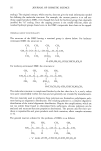
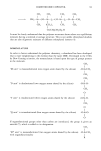
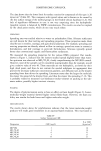
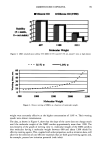
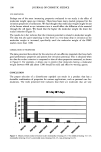
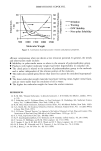
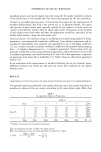
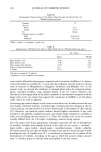
DIMETHICONE COPOLYOL 95 The maximum spreading area was measured on a polyester surface (overhead slide film). The films were inspected for cleanliness prior to use. These were not used if they showed any signs of fingerprints or debris on the surface. Ten microliters of a 0.1%w sample, prepared with distilled water, were placed on the film using a micropipette and its diameter measured after 45 seconds using a Vernier caliper. Longer times sometimes led to sample evaporation. Experiments were conducted at room temperature (23 ø + iøC, 65 + 3% relative humidity) in replicate and averaged. The relative area reported is the area of the sample drop divided by that of distilled water. Nonylphenol ethoxylate, 9 mole ethylene oxide (EO), NP-9EO, was used as a control. Surface tension and cmc were measured at room temperature using a Krtiss K-12 automated tensiometer equipped with a Wilhelmy plate. The cmc's were calculated automatically by the K122 program of the tensiometer. Solubilities were measured by mixing the sample into the solvent at a given concentration and observing its homo- geneity after 24 hours. The solubility was defined as: soluble (S), clear homogeneous phase dispersed (D), translucent or cloudy but homogeneous phase and insoluble (I), not homogeneous. Draize primary ocular irritation was conducted by an independent laboratory. Emulsification was measured by mixing in a shaker at high speed for five minutes. Each emulsion consisted of 5 % w/w DMC and 95 % w/w of two of the following phases at 1:1 at ratio (w -- water, O = mineral oil, Si = silicone oil 350 viscosity). Stability was determined after one hour standing undisturbed. Stability was defined as: 5 -- stable/homogeneous milky 4 = appearance of milky layer(s), with the volume of one layer drastically reduced (mostly emulsified) 3 = appearance of milky layer(s), with the volume of each layer shifted to some degree (some dispersion) 2 = appearance of translucent layer(s), with the volume of each layer shifted to some degree (some dispersion) 1 = appearance of translucent layer(s), with the volume of each layer being approximately the same as originally added to the mixture (slightest degree of dispersion) 0 -- no mixing: two distinct clear layers. RESULTS AND DISCUSSION CLOUD POINT DMC compounds, like many hydrocarbon-based non-ionic surfactants, exhibit cloud points in aqueous solution. As a 1% w solution of the DMC is heated, a temperature is encountered at which the material is no longer soluble. This is referred to as the high cloud point. The high-cloud-point phenomenon is related to how the polyoxyalkylene portion (i.e., ethylene oxide, EO) of the hydrogen molecule bonds with water molecules. At higher temperatures the hydrogen bonding with water is lost as the polyoxyalkylene groups in the tail of the molecule rotate and alehydrate, resulting in lower solubility. Upon cooling, the dimethicone copolyol rehydrates and becomes soluble again. Our results showed there were no significant differences among the cloud points of the materials studied (Table II). This is in agreement with and can be explained by the pioneering work of Dr. Steven Vick (6). He found that the cloud point is related to the amount of polyoxyethylene group in the molecule and was rather independent from

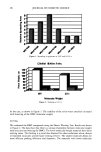
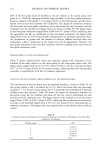
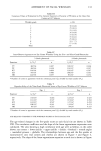
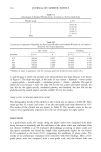
96 JOURNAL OF COSMETIC SCIENCE Table II Cloud Points of 1% w Solutions Designation % EO Cloud point (øC) MD*M 74 58 MD*DM 67 57 MD2*/D2M 76 58 MD3*DsM 74 58 MD3*D7M 75 58 MD4*DsM 75 57 the silicone portion of the molecule. Dr. Vick concluded, "A statistical analysis of the cloud point data suggests that fully 98.7% of the data variability is accounted for by the length of the ethylene oxide chains." Our materials vary in molecular weight but not in the amount of polyoxyethylene group. SOLUBILITY The solubility of the DMC materials was measured in polar and non-polar solvents (Table III). The solubility was defined as: soluble (S), clear homogeneous phase dis- persed (D), translucent or cloudy but homogeneous phase insoluble (I), not homoge- neous. All products were soluble in water. As mentioned above in the cloud point discussions, the solubility is related to the amount of polyoxyethylene group. This behavior is similar to that found in ethoxylated alcohols. The average amount of poly- oxyethylene group for all the products studied was similar, about 74%, which makes them soluble in water. All products also showed good solubility in methanol, ethanol, i-propanol, and propylene glycol. Products with higher molecular weight dispersed best in non-polar oils. The larger molecular weight, or longer hydrophobe, seems to contribute to the enhanced nonpolar media solubilization. The large-molecular-weight products will be preferred when for- mulating using an oil base. SURFACE TENSION AND CRITICAL MICELLE CONCENTRATION We also studied cmc (critical micelie concentration) and the surface tension ($) at cmc. Table III Solubility in Various Solvents at 24øC (1% w/5% w) Designation MD*M MD2*D2M MD3*D7M Methanol Soluble/Soluble Soluble/Soluble Soluble/Soluble Ethanol Soluble/Soluble Soluble/Soluble Soluble/Soluble i-Propanol Soluble/Soluble Soluble/Soluble Soluble/Soluble Propylene glycol Soluble/Soluble Soluble/Soluble Soluble/Soluble Water Soluble/Soluble Soluble/Soluble Soluble/Soluble Mineral oil Insoluble/Insoluble Dispersible/Dispersible Dispersible/Dispersible Mineral spirits Insoluble/Insoluble Dispersible/Dispersible Dispersible/Dispersible Silicone oil, 350 cps Insoluble/Insoluble Insoluble/Insoluble Dispersible/Dispersible
Purchased for the exclusive use of nofirst nolast (unknown)
From: SCC Media Library & Resource Center (library.scconline.org)