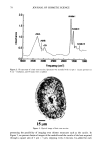
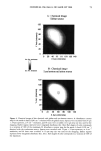
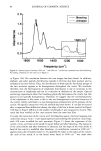
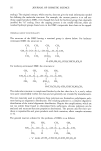
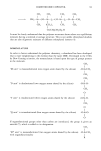
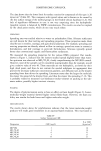
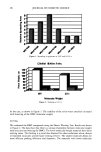
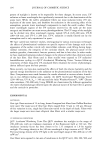
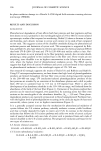
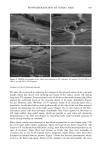
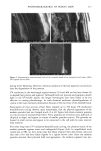
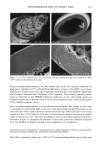
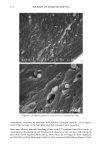
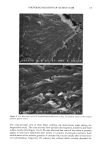
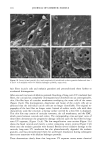
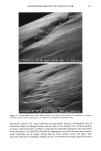
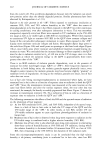
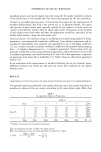
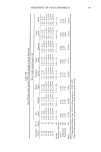
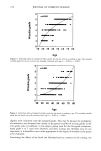
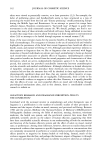
118 JOURNAL OF COSMETIC SCIENCE 006020 5. 0 RV xG00 50. O•,mtl. doGo 1 kV x 5 ß B. Figure 12. Longitudinal (a,b) and cross-sectional (c,d) views of long-term UV-irradiated hair fibers after subsequent 15-rnin treatment with 6% alkaline hydrogen peroxide. this extreme cuticular disintegration during chemical oxidation of UV-exposed fibers. Long-term UV irradiation causes extensive oxidative degradation of the proteins of the cuticula as manifested in an Allw6rden-like reaction during subsequent chemical oxi- dation of UV-exposed hair fibers (Figure 14a-f). After only seconds of alkaline peroxide treatment (Figure 14b,c), small bubbles develop along the hair surface. These small bubbles or half domes resemble the famous Allw6rden sacs formed by the Allw6rden reaction. Allw6rden first detected these sacs at the surface of wool fibers during treat- ment with chlorine water. He thus also discovered the epicuticle surrounding the cuticle cell. The epicuticle is a semipermeable, partly proteinaceous membrane, -25 A in thickness, which allows small molecules (water) to diffuse into the cell, rapidly swelling degraded, hydrophilic, low-molecular-weight peptide fractions. The highly hydrophilic molecules are not capable of diffusing out and remain trapped inside the cell. In Allw6rden's reaction, the hydrophilic molecules continue to attract water from the outside solution, and thus these sacs are formed by the resulting osmotic pressure. In our study concerning long-term UV exposure of human hair, the bubbles resembling Allw6rden sacs are formed by diffusion of peroxide, ammonium hydroxide, and water through the epicuticle into the cuticle cell, where the already photolytically degraded proteins are now further degraded by the peroxide and swollen by water. The hydrophilic protein fractions are still too bulky to diffuse out through the semipermeable epicuticle. They remain trapped within the cuticle cell, attracting water and forming the sac-like

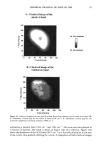
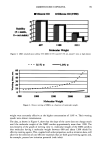
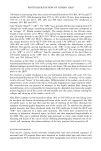
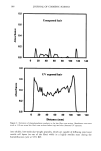
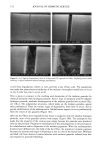
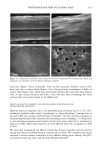
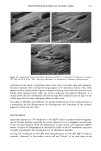
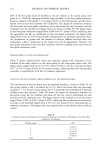
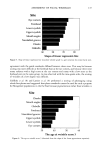
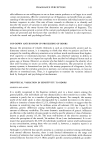
PHOTODEGRADATION OF HUMAN HAIR 1 I9 J. B0•011 5.0 kV Figure 13. Longitudinal (a,b) and cross-sectional (c,d) views of long-term UV-irradiated hair fibers and subsequent 2-h treatment with 6% alkaline hydrogen peroxide. structures (Figure 14b,c). Eventually, these sac-like structures (swollen cuticle cells) burst and their contents drain (Figure 14d), leaving behind membranes or shells of cuticle cells (Figure 14e), which may detach from the hair fiber and drift away (Figure 14f), or may remain attached and form a thin film-like layer enveloping the outer cortical cells, as has been shown in the SEM study. EFFECTS OF RELATIVE HUMIDITY AND SPECTRAL ENERGY DISTRIBUTION ON PHOTOCHEMICAL OXIDATION Moisture plays an important role in the photobleaching of human hair (3,11,12). Pho- tochemical oxidation (also termed "weathering" or "photo-bleaching") damages hair at any given RH and increases with duration of exposure. The wet mechanical properties of photo-bleached hair fibers decrease with increasing extent of damage (11). Reduction in wet mechanical properties was found to be the most severe when hair is weathered at high or low RH. These fiber properties are least affected when hair is exposed at a RH of 30%. We have also investigated the effects of both the relative humidity and the spectral energy distribution on photochemical oxidation of hair fibers. We compared the results obtained at various relative humidities in two different fading units, namely, the QUV accelerated weathering tester and the Atlas Weather-Ometer ©.
Purchased for the exclusive use of nofirst nolast (unknown)
From: SCC Media Library & Resource Center (library.scconline.org)