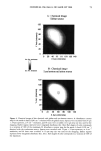
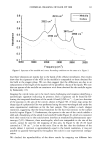
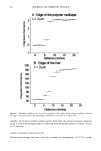
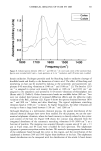
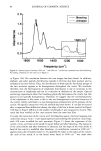
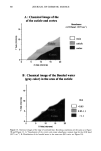
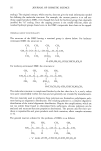
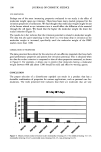
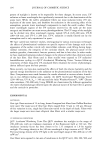
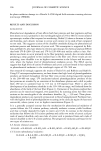
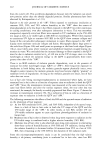
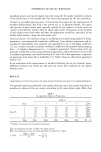
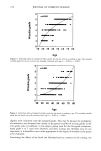
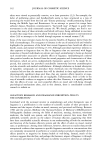
144 JOURNAL OF COSMETIC SCIENCE ¸ Female • Male 90 1 0 80 95 70 60 90 •, 50 •A• •ROS, TE• N?N•t 85 •AMYL AC•ETt,, 40 i i i • I I I [J'] 1 2 3 4 5 6 7 8 9 10 80 1 2 3 4 5 6 7 8 9 10 O 90 80 • 50 • 100 r,• 95 • 90 GALAXOL IDE 12345678910 oo 95 90 85 80 EUGENOL 1 2 3 4 5 6 7 8 9 10 85 M ERCAP TANS 1 2 3 4 5 6 7 8 9 10 ROSE 1 2 3 4 5 6 7 8 9 10 DECADE OF lIFE Figure 1. Variation in olfactory function across the lifespan, as measured by odor identification ability for six odorants from the National Geographic Smell Survey. After C.J. Wysocki and A. N. Gilbert (14).

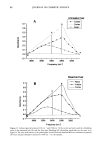
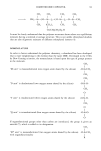
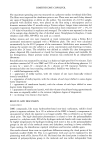
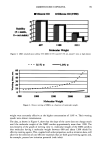
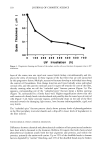
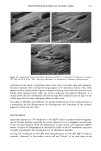
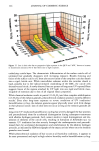
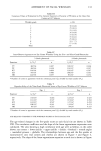
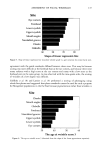
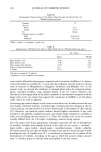
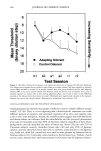
FRAGRANCE PERCEPTION 145 titled, because the majority of real-world odor experiences rarely involve smelling a single odorant. Nonetheless, an individual's specific anosmia has the potential to influ- ence the perception of fragranced products because the inability to smell one or more fragrances can greatly alter the overall intensity and quality of a complex fragrance (18). EXPOSURE HISTORY AND THE PERCEPTION OF FRAGRANCE Manufacturers of fragranced products such as lotions, perfumes, and air fresheners fre- quently hear complaints that the perception of the fragrance in their product fades in a remarkably short time. Although the consumer may suspect that the product fragrance is less long-lasting than the manufacturer claims, the simple truth is that continued or repeated exposure to any odor stimulus will result in a decrease in the perceived intensity and detectability of that odor--a normal sensory process known as "olfactory adaptation" (and sometimes referred to as "odor fatigue"). Odor adaptation is a common occurrence in natural environments when individuals who work or live in odorous contexts cease to smell odors that are readily perceived by new visitors. This decrease in odor perception does not appear to be due simply to a decrease in the amount of attention paid to a familiar fragrance (although that may certainly play a role), but appears to reflect specific, often persistent, changes in sensitivity and re- sponse to the odorant that may be occurring both at the level of the olfactory receptors as well as in higher cortical structures in the brain. Studies of individuals who are occupationally exposed to a chemical have shown that workers exposed to acetone or styrene have significantly higher detection thresholds for those chemicals, respectively, than do non-exposed controls but show no difference in their sensitivity to another chemical to which neither group is exposed (19,20). Consistent with anecdotal observations, long-term adaptation has also been documented following exposure to "air-freshener" type odors in the home. Participants whose bed- rooms were continuously odorized with either isobornyl acetate or citralva for a two- week period showed a marked decrease in sensitivity to this odor, but an increased sensitivity to a control odor (see Figure 2). These results suggest that individuals who regularly use the same scented products can experience long-lasting changes in the perception of those fragrances that can alter both their olfactory experience and use of the product. Of course, individuals such as perfumers or fragrance evaluators whose profes- sions require them to maintain sensitivity to fragrances even as they sniff and sample them regularly often limit their exposure duration in order to minimize the effect of adaptation on their sensory systems. Paradoxically, brief, repetitive exposures can also increase sensitivity to an odorant, as is often experienced by individuals like perfumers or flavorists who find themselves able to detect ever-lower concentrations of volatiles with continued experience. Although the phenomenon of sensitization has been less well-studied than its counterpart, adaptation, there is experimental evidence of increased sensitivity following certain types of odor exposure. For example, some individuals who were anosmic to the volatile steroid androstenone could be induced to smell androstenone following repeated exposure to its odor (21,22). And among individuals who were already able to smell an odorant, repeated testing at threshold frequently led to a lowering of the olfactory threshold for the target odorant (23,24).
Purchased for the exclusive use of nofirst nolast (unknown)
From: SCC Media Library & Resource Center (library.scconline.org)