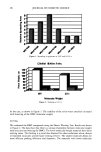
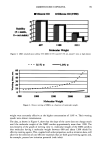
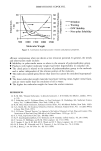
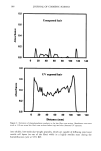
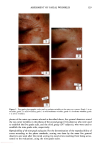
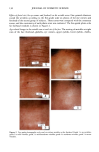
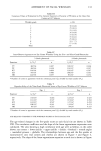
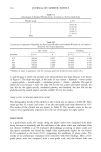
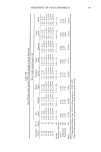
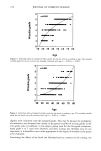
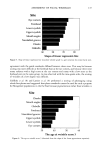
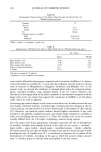
ASSESSMENT OF FACIAL WRINKLES 139 We evaluated an agent for wrinkle improvement using a photo scale and obtained good results and found that an evaluation of pre- and post-treatment wrinkles was possible using a wrinkle photo scale, suggesting the validity and usefulness of this method. REFERENCES (11) (12) (13) (14) (15) (1) R.B. Armstrong, J. Lesiewicz, G. Harvey, L. F. Lee, K.T. Spoehr, and M. Zultak, Clinical panel assessment of photodamaged skin treated with isotretinoin using photographs, Arch. Deramtol., 128, 352-356 (1992). (2) M.J. Stiller, J. Bartolone, R. Stern, S. Smith, N. Kollias, R. Gillies, and L. A. Drake, Topical 8% glycolic acid and 8% I-lactic acid creams for the treatment of photodamaged skin, Arch. Dermatol., 132, 631-636 (1996). (3) J. S. Weiss, C. N. Ellis, J. T. Headington, T. Tincoff, T. A. Hamilton, and J. J. Voorhees, Topical tretinoin improves photoaged skin, JAMA, 259, 527-532 (1988). (4) J.J. Leyden, G. L. Grove, M.J. Grove, E. G. Thorne, and L. Lufrano, Treatment of photodamaged facial skin with topical tretinoin, J. Am. Acad. Dermatol., 21,638-644 (1989). (5) L. Lever, P. Kumar, and R. Marks, Topical retinoic acid for treatment of solar damage, Br.J. Dermatol., 122, 91-98 (1990). (6) G.L. Grove, M.J. Grove, J.J. Leyden, L. Lufrano, B. Schwab, B. H. Perry, and E. G. Thorne, Skin replica analysis of photodamaged skin after therapy with tretinoin emollient cream, J. Am. Acad. Dermatol., 25,231-237 (1991). (7) C. E. M. Griffiths, S. Kang, C. N. Ellis, K. J. Kim, L. J. Finkel, L. C. Ortiz-Ferrer, G. M. White, T. A. Hamilton, and J.J. Voorhees, Two concentrations of topical tretinoin (retinoic acid) cause similar improvement of photoaging but different degrees of irritation, Arch. Dermatol., 131, 1037-1044 (1995). (8) C. E. M. Griffiths, T. S. Wang, T. A. Hamilton, J. J. Voorhees, and C. N. Ellis, A photonumeric scale for the assessment of cutaneous photodamage, Arch. Dermatol., 128, 347-351 (1992). (9) C. Larnier, J.P. Ortonne, A. Venot, B. Faivre, J. C. Beani, P. Thomas, T. Brown, and E. Sendagorta, Evaluation of cutaneous photodamage using a photographic scale, Br. J. Dermatol., 130, 167-173 (1994). (10) Y. Takema, Y. Yorimoto, and M. Kawai, The relationship between age-related changes in the physical properties and development of wrinkles in human facial skin, J. Soc. Cosmet. Chem., 46, 163-173 (1995). J. Cohen, A coefficient of agreement for nominal scales, Educ. Physiol. Measurement, 20, 37-46 (1960). J. D. Fleiss and J. Cohen, Large sample standard errors of kappa and weighted kappa, Psychol. Bull., 72, 323-327 (1969). J. R. Landis and G. G. Koch, The measurement of observer agreement for categorical data, Biometrics, 33, 159-174 (1977). S.H. Goh, The treatment of visible signs of senescence: The Asian experience, Br. J. Dermatol., 122(Suppl. 35), 105-109 (1990). Y. Takema, K. Tsukahara, T. Fujimura, and M. Hattori, Age-related changes of 3-dimensional morphological changes in the human facial skin, Skin Res. Tech., 3, 95-100 (1997).

j. Cosmet. Sci., 51,141-151 (March/April 2000) Fragrance perception: From the nose to the brain PAMELA DALTON, Monell Chemical Senses Center, 3500 Market Street, Philadelphia, PA 19104. Accepted for publication February 15, 2000. Presented to the New York Chapter of the Society of Cosmetic Chemists, November 4, 1998. Synopsis Fragrance is a major component in many personal products, influencing their acceptability and, in some cases, their perceived efficacy. Despite claims that certain fragrances can relax or energize, there is surpris- ingly little scientific evidence in support of direct, physiological effects of fragrances. Rather, recent research suggests that psychological factors, such as personal experience, expectations, and the surrounding context may be among the most important factors that determine how a fragrance is perceived. INTRODUCTION Among humans, the ability to perceive volatile chemicals through our sense of smell is often considered to be far less important than perception via other sensory modalities such as sight or sound. In stark contrast to this view, considerable scientific, anthropo- logic, and economic evidence exists to suggest that stimulation of olfaction through the perception of environmental volatiles, fragrance materials, or scented products is of paramount importance to humans. Odor perception provides information that guides our responses to the environments in which we live (1) and the individuals we encounter. At a commercial level, the significance of our response to olfactory stimulation is illustrated by the fact that the fragrance industry is a multibillion dollar industry that supplies products to scent shampoo, deodorants, tissues, soaps of all types, hand creams, leather products, toys, air fresheners, cleaning products, and many other commodities. In many commercial contexts, the addition of fragrance can serve a primary or secondary purpose. For example, in some applications, such as air fresheners or perfumes, the delivery of a pleasing scent (and the masking of an unpleasant one) is often the primary function of fragrance. In other products, such as shampoos, lotions or soap, both the immediate and lingering scent provides a secondary dimension that, in addition to its hedonic impact, can also serve to reinforce perception of the product's purpose and efficacy. From an anthropological perspective, the meaning and significance of odors in everyday human experience has historically been quite varied. Prior to the discovery of germ theory, for example, unpleasant odors were deemed to be carriers of disease and good 141
Purchased for the exclusive use of nofirst nolast (unknown)
From: SCC Media Library & Resource Center (library.scconline.org)