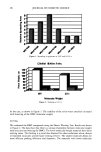
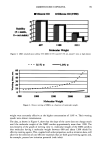
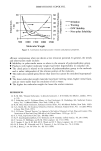
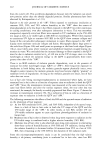
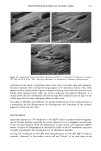
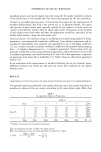
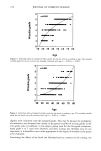
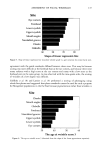
DIMETHICONE COPOLYOL 99 •Mineral Oil K]Si!lcone Oil (F350) Stability (5 = stable, 0 = not stable) 4' 3' 2' 1' 0 607 ß ! ß 1108 2111 Molecular Weight Figure 3. DMC emulsification ability (5% DMC/47.5% water/47.5% oil, mixed 5 rain at high shear). 60 50 ½ 40 "• 30 zo lO o 500 - - - 0.1%w 1.0%w _ ß mm .m mm .m mm .m ,, mm mm mm mm m mm ßmm mm• 1000 1500 2000 Molecular Weight Figure 4. Draves wetting ooe DMCs as a oeunction ooe molecular weight. 2500 weight were extremely effective at the higher concentration of 1.0% w. Their wetting speeds were almost instantaneous. The data, as shown in Figure 4, show that the slope of the curve does not change much until the molecular weight of the DMC reaches approximately more than 1200. The non-linearity of the graph of wetting time vs. molecular weight of the DMC predicts that molecules having a molecular weight between 600 and about 1200 should be effective wetting agents. This, coupled with other properties, such as irritation data, will allow for the selection of cost-effective materials that are both good wetting agents and, for example, possess low irritation potential (vide infra).

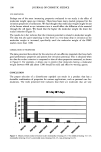
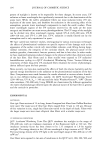
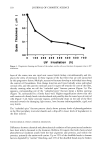
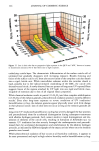
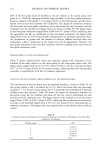
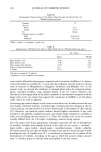
100 JOURNAL OF COSMETIC SCIENCE EYE IRRITATION Perhaps one of the most interesting properties evaluated in our study is the effect of molecular weight upon eye irritation. There have been many models proposed for the irritation properties of surfactants. We had thought that molecular weight might be one of the factors related to eye irritation since it would affect the diffusion of the material through the cell layers. We found that the higher the molecular weight the lower the ocular irritation (Figure 5). The results do in fact indicate that the irritation potential is related to molecular weight. The data was also quite surprising in that there is a very sharp drop in irritation as the molecular weight is increased, specifically until the molecular weight of the DMC reaches more than 1108. CORRELATION OF PROPERTIES The data presented here allows for the selection of cost-effective materials that have both good performance properties and possess low irritation potential. This is obtained when the data for ocular irritation is compared to that of other properties measured, as shown in Figure 6. For example, it allows one to predict that molecules having a molecular weight between 600 and about 1200 should be mild and effective wetting agents. CONCLUSION The proper selection of a dimethicone copolyol can result in a product that has a desirable combination of properties for various applications, such as personal care for- mulations. The work presented here indicates that there are molecules that are very [] 1 day 17 days 3O 25-- .•. 'r. 10-- 0 Figure 5. Draize primary ocular irritation (scale: moderately irritating 25.1-50 mildly minimally irritating 2.$-15, practically non-irritating 0.$-2.5, non-irritating 0-0.5).
Purchased for the exclusive use of nofirst nolast (unknown)
From: SCC Media Library & Resource Center (library.scconline.org)