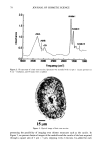
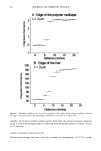
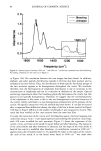
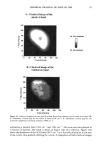
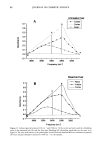
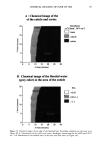
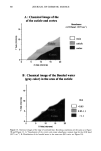
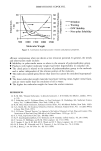
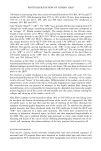
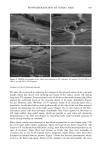
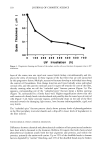
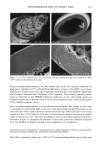
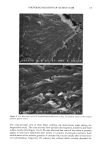
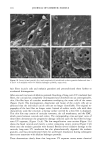
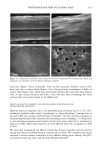
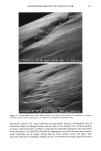
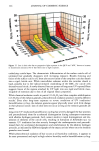
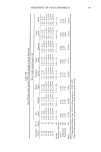
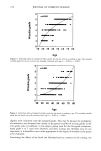
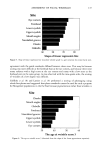
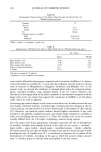
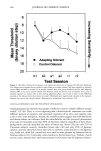
122 JOURNAL OF COSMETIC SCIENCE from the cuticle cell. This accelerates degradation because now the radiation can attack new proteins rather than the already degraded proteins. Similar phenomena have been observed by Ratnapandian et al, (11). Exposure to the so/at spectrum in the "AW." Fibers exposed to continuous irradiation at constant 20%, 50%, and 70% relative humidity in the "AW" show the extent of photodegradation to be less than in hair fibers exposed in the QUV (to either continuous or cycling conditions), even after subsequent immersion in water. This was somewhat unexpected, especially since hair fibers were exposed to UV irradiation in the 250-400 nm range as well as to visible light at 400-800 nm wavelengths. While fibers exposed to continuous UV light at constant 10% RH in the QUV show extreme collapse and fusion of the cuticula after subsequent immersion in water, fibers exposed in the "AW" display more moderate cuticular collapse and fusion. Micrographs depict large pores in the scale faces (Figure 16b) and small pores or openings at the fused scale edges (Figure 16b,c), most likely areas where moisture and solubilized materials escaped during im- mersion in water. We concluded that the increased damage to fibers exposed in the QUV must be due to radiation emitted at }tm of 340 nm in the UV-A range, since it is that wavelength at which the radiation energy in the QUV is approximately three times greater than that of the "AW." There is no SEM evidence of melanin granule degradation, even in the presence of moisture for either wavelength range, (QUV or "AW"). After long-term exposure to irradiation in both fading units, the melanin granules appear physically intact, even though in some instances the melanin granules may have become slightly "grainier" at moderate levels of degradation. As long as the melanin granules are intact, loss of hair color does not occur. Loss of hair co/or. Using microspectrophotometry in transmitted white light, we have measured loss in hair color as a function of exposure time to radiation in both the QUV and "AW." Since the transmission intensity was measured at the same location on the same hair fibers before and after the various exposure times, the true color loss was monitored, for example, for heavily or weakly pigmented hair fibers. Figure 17 shows the increases in transmission intensity (TIt-TIo), indicative of loss in color as a function of exposure time to radiation in both the QUV and "AW." The following summarizes the effects of both the RH and the spectral nature of radiation on the photolysis of hair pigment: (a) At low RH conditions (10%, 20%, and 50% RH), independent of the spectral range, there is a lack of loss in hair color in both the UV range of the QUV and the UV/visible range of the "AW." In other words, at low RH, neither UV nor UV/visible radiation appear to cause significant photodegradation of melanin in brown hair. (b) Moderate loss of hair color is observed when long-term exposure to radiation in the UV/visible range is combined with a higher relative humidity (70% RH). (c) Moderate loss of hair color is also observed upon long-term exposure to alternating three-hour cycles of humidification at 95% RH and UV radiation, during which the relative humidity is decreased within 30 minutes from 95% to a low of 10% RH, then remaining at the 10% RH for the duration of the radiation cycle. From this microspectrophotometric study it can be concluded that the high relative h•midity is the primary contributing factor to accelerated loss in hair color, since low RH

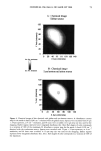
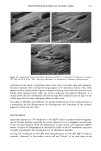
PHOTODEGRADATION OF HUMAN HAIR 123 Figure 16. Longitudinal views of hair fibers exposed to (a) 300 h of continuous UV radiation at constant 20% RH and 50øC in the "AW," and (b,c) subsequent 1-h immersion in lukewarm deionized water. conditions do not result in significant loss in hair color, even after long-term exposure. Increased exposure time and spectral range appear to be secondary factors. Also, there appears to be an initial period of great resistance to fading, since color loss does not occur during short exposure times under any of the conditions investigated. However, it is clearly shown that the combination of both the high RH conditions and the light in the visible range has the most damaging effects on hair color. According to Wolfram and Albrecht (2), partial solubilization of the melanoproteins is a prerequisite for the decolorization by disintegration and dispersion of the melanin pigments within the hair fiber. CONCLUSIONS Long-term exposure to UV irradiation in the QUV results in photo-oxidative degrada- tion of the hair proteins, especially of cystine, which occurs at its highest concentration in the cuticular domains where the degradation is most severe. UV irradiation (QUV) results in amino acid degradation as indicated by shifts in the UV absorbance spectrum to higher wavelengths and development of an absorbance shoulder. Cycling UV irradiation at 10% RH with humidification at 95% RH (QUV) leads to extensive "thinning" of the surface cuticle cell and "fusion" of its scale edge to the
Purchased for the exclusive use of nofirst nolast (unknown)
From: SCC Media Library & Resource Center (library.scconline.org)