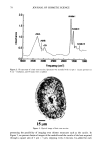
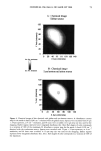
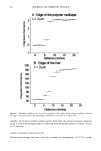
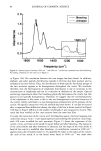
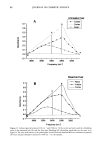
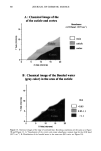
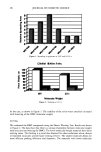
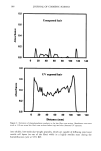
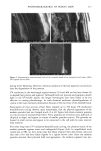
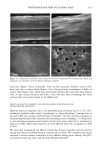
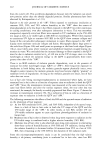
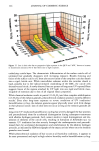
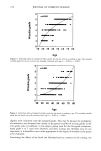
108 JOURNAL OF COSMETIC SCIENCE 0.8 o.4 0.2 0.0 0 20 40 60 80 1 O0 120 140 0.8 0.6 0.4 O.2 0.0 UV exposed hair 0 20 40 60 80 100 120 140 Distance (mm) Figure 2. Formation of photodegradation products in the hair fiber cross section. Absorbance scans were made at 330 nm across hair fiber cross sections before (top) and after (bottom) UV exposure. into soluble, low-molecular-weight peptides, which are capable of diffusing into lower cuticle cell layers (or out of the fiber) while in a highly swollen state during the humidification cycle at 95% RH.

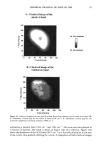
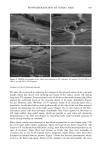
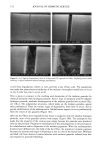
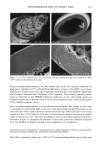
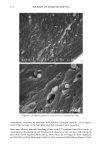
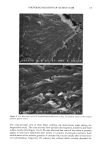
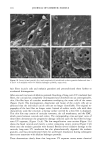
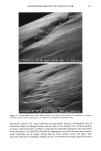
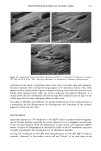
PHOTODEGRADATION OF HUMAN HAIR 109 Figure 3. FESEM micrographs of hair fibers after exposure to UV radiation. (a) control, 0 h (b) 100 h (c) 300 h and (d) 700 h UV exposure. FUSION OF THE CUTICULAR SHEATH We were also interested in exploring the changes in the physical nature of the cuticular sheath, which had shown such thinning and fusion of the surface cuticle cell during long-term UV exposure. Cross-sectional views of the freeze-fractured untreated hair fiber showed the individual layers of the cuticular sheath to be easily identifiable (Figure 5al,a2). However, after 300 hours of UV exposure, fusion of all cuticular layers into a monolithic, brittle unit had occurred preferentially on the side of the hair fiber oriented towards the damaging rays of the light source (Figure 5b). In that region of the fiber, individual cuticle cells were no longer identifiable. Also, fibers exposed to 300 hours of UV light exhibit deep radial cracks, which are parallel to each other and absolutely perpendicular to the fiber axis (Figure 6), fracturing easily under minimal amounts of stress during bending or extension. More drastic results were observed in hair fibers exposed for an even longer time (700 h) to UV light under similar conditions. Upon extension of hair fibers exposed for 700 hours to UV irradiation/humidification cycling, most fibers failed instantaneously at the start of extension. These fibers had become so brittle that they were incapable of extension due to loss of all original elastic properties. Upon failure, these hair fibers displayed an unusual fracture pattern. Figure 7 shows this fracture phenomenon, which occurs as the fibers snap apart. Fusion of the complete cuticula and possibly the outer
Purchased for the exclusive use of nofirst nolast (unknown)
From: SCC Media Library & Resource Center (library.scconline.org)