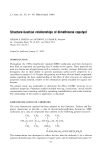
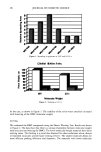
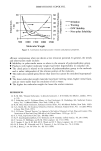
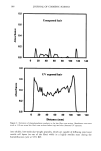
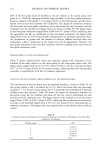
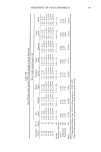
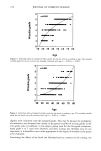
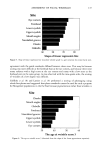
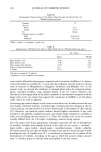
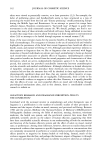
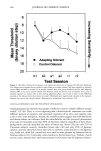
FRAGRANCE PERCEPTION 143 able influence on our willingness to use or shun certain products or to linger in or avoid certain environments, effective commercial use of fragrances can benefit from an under- standing of the myriad factors that contribute to or determine individual sensitivity and hedonic responses to odor. One aim of basic research in olfaction is to identify and describe the sources of variation in odor perception, which can lead to a more complete understanding of the many factors that determine our perception of fragrance. The following sections provide a review of the current psychological perspectives on the way odors are processed and the factors that contribute to the variation in odor experience, at both the neural and psychological levels. TOP-DOWN AND BOTTOM-UP PROCESSING OF ODORS Because the perception of volatile chemicals is such an evolutionarily ancient and ru- dimentary sensory system, it is tempting to think that what we perceive and how we interpret the resulting olfactory sensation occur without much involvement from higher- level cognitive or emotional processes. Similarly, any observed variation in ability to perceive an odor or in its impact has typically been ascribed to biological factors such as genes, age, or disease. However, as anyone who has failed to recognize the identity of an odor until locating its source can attest, olfactory perception, like perception in other sensory systems, is determined not just by the sensory properties of a fragrance, but by information that the stimulus activates in memory, our current expectations, or even our affective or emotional state. Thus, it is appropriate to examine the variation induced both by biological and psychological mechanisms. INDIVIDUAL VARIATION IN SENSITIVITY TO ODORS GENETICS AND AGING It is widely recognized in the fragrance industry and, to a lesser extent, among the general public, that individuals can vary dramatically in their sensitivity to odors. This variation is partly due to a number of predisposing factors. For example, the sensory world of the older adult is often distinguished by a marked decrement in the detect- ability or intensity of many odors (12,13), although there is evidence to suggest that the decrease in sensitivity may not be uniform across all odorants (14) (see Figure 1). In addition, genetic differences among individuals appear to account for a significant amount of olfactory variability. The most dramatic manifestation of genetic influences on olfaction is the inability of some people to smell a specific odorant or class of odorants, known as specific anosmia (15,16). The most well-known of the selective anosmias in- volves the perception of the steroid, 5ot-androst-16-en-3-one (androstenone). It is esti- mated that approximately 40-50% of individuals worldwide cannot smell androstenone at any concentration among those who can smell it, however, a majority report it as having a urinous, sweaty odor (15). Although it is believed that specific anosmia is a common occurrence among individuals with normal olfactory function, there is only limited information on the range and diversity of odorants that cannot be smelled by one or more individuals with otherwise normal olfactory function (16,17). Most people's specific anosmias probably go uniden-

144 JOURNAL OF COSMETIC SCIENCE ¸ Female • Male 90 1 0 80 95 70 60 90 •, 50 •A• •ROS, TE• N?N•t 85 •AMYL AC•ETt,, 40 i i i • I I I [J'] 1 2 3 4 5 6 7 8 9 10 80 1 2 3 4 5 6 7 8 9 10 O 90 80 • 50 • 100 r,• 95 • 90 GALAXOL IDE 12345678910 oo 95 90 85 80 EUGENOL 1 2 3 4 5 6 7 8 9 10 85 M ERCAP TANS 1 2 3 4 5 6 7 8 9 10 ROSE 1 2 3 4 5 6 7 8 9 10 DECADE OF lIFE Figure 1. Variation in olfactory function across the lifespan, as measured by odor identification ability for six odorants from the National Geographic Smell Survey. After C.J. Wysocki and A. N. Gilbert (14).
Purchased for the exclusive use of nofirst nolast (unknown)
From: SCC Media Library & Resource Center (library.scconline.org)