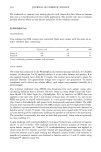
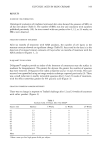
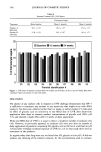
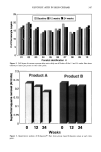
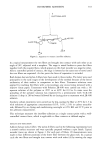
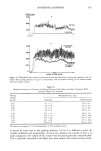
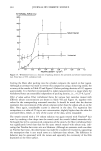
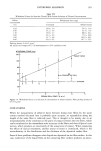
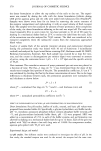
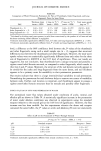
NAIL PERMEATION 369 Donor Compartment (Teflon) Receptor Compartment (Glass) .i Donor Formulation Applied Through Opening Nail Receptor Solution • Water In Water Out Stirrer Bar MagnetStirreSwitchStirrer Figure 1. Schematic of the diffusion cell used for in vitro permeation studies. them. Also, each part of the donor compartment was curved to accommodate the natural curvature of the nail, thus ensuring a good fit. The area of the cell available for perme- ation was 0.2749 cm 2. A circulating water bath maintained the temperature of the receptor compartment at 37øC. Magnetic stirrer bars were used to ensure receptor uniformity throughout an experiment. Donor formulations JCr water permeation studies. Aqueous gels were prepared with 1.5% HEC and spiked with a small quantity of 3H20 so as to obtain a ratio of hot:cold drug of 1:1000. The gels were agitated with a vortex mixer (Vortex Genie, Fisher Scientific, Springfield, NJ) and allowed to stand at room temperature for 24 hours to ensure homogenous distribution of the label. Prior to use, three 10-pl aliquots of the gel were analyzed by liquid scintillation counting (LSC) to validate uniformity of spiking. Permeation studies. To establish and validate a reproducible technique to study nail per- meation in vitro, water permeation studies were run with six replicates using excised, human toenails. The water permeation studies were repeated three times on the same nails to assess the reproducibility of the method. Hydrated, trimmed nails were clamped in the diffusion cells, and the receptor com- partment was filled with the receptor fluid (water containing 0.5% PEG-20-oleyl ether, a wetting agent to facilitate removal of air bubbles and not expected to affect the nail at such a low concentration). The cells were tilted and gently tapped to remove any entrapped air bubbles. A temperature of 37øC and constant stirring was maintained throughout the study. The cells were left uncovered for one hour prior to application of

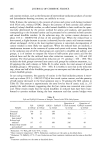
370 JOURNAL OF COSMETIC SCIENCE the donor formulation to allow the top surface of the nails to dry out. The experi- ment was started by dosing the cells with the donor formulation [infinite dosing (200 lad for aqueous gels], and the cells were sealed with laboratory film (Parafilm©). Samples were drawn every hour for six hours by removing the entire contents of the receptor compartment and replenishing it with an equal volume of fresh receptor fluid. The samples were then analyzed for amount of water permeated. After completion of the study, the donor formulation adhering to the nail was wiped off. The nails were rinsed repeatedly (five to seven times for two-hour periods) in 10 ml of DI water by shaking in a mechanical shaker bath at 25øC to extract the label from the nails. Each of the extractions was also analyzed for 3H20 content. The label was considered to be extracted completely when the radioactive counts from the extractions approached blank values. Analysis of samples. Each of the samples (receptor solution and extractions) obtained during the permeation study was mixed with 10 ml of Scintiverse I (scintillation cocktail) and analyzed by liquid scintillation counting (LSC, Beckman model LS 5000T, Beckman Instruments, Somerset, NJ). Each sample was counted for at least five min- utes, and the counts in disintegrations per minute (dpm) were converted to amount of active, using the conversion factor 1 laCi = 2.2 x 10 6 dpm and the specific activity of 3H20. Data treatment. The cumulative amount of water permeated per unit area was plotted as a function of time. The flux, J, (mg cm-2h -1) was determined from the slope of the steady-state (straight-line) portion of the plot. The permeability coefficient, P, (cm h-1) was calculated by dividing the flux by the donor concentration of water. Due to the large differences in thickness between nails, the permeation parameters were normalized for nail thickness as shown below: J* = J x h (1) where J* = normalized flux (mg cm-lh -1) and h = nail thickness (cm) and P* = P x h (2) where P* = normalized permeability coefficient (cm2h-1). EFFECT OF ENVIRONMENTAL FACTORS (pH AND TEMPERATURE) ON NAIL PERMEATION Donor formulations. For pH studies, buffers of acidic, neutral, and basic pH values were prepared from standard tables (8). Specifically, a glycine-hydrochloric acid buffer (acidic, pH -2), monobasic potassium phosphate-dibasic sodium phosphate buffer (neutral, pH -7), and glycine-sodium hydroxide buffer (basic, pH -12) were prepared. HEC was added in a concentration of 1.5% to each of the buffer systems, and gel formation was allowed by shaking on a mechanical shaker bath for up to 12 hours. Each of the gels was spiked with 3H20 to obtain a hot:cold drug ratio of 1:1000. For temperature studies, aqueous gels spiked with 3H20 were used. Experimental design and method (a) pH studies. Two different studies were conducted to investigate the effect of pH. In the first study, the standard receptor was used. In the second, the receptor had the same com-
Purchased for the exclusive use of nofirst nolast (unknown)
From: SCC Media Library & Resource Center (library.scconline.org)