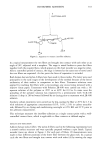
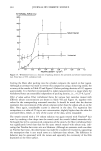
NAIL PERMEATION 371 position as the donor. In both studies, excised human toenails were used, and prior to the start of the study, a baseline water permeation profile for each toenail was established. A total of six nails were used, and these were assigned to two treatment groups (comprising three nails each) such that the mean normalized water flux for each group was approximately equal. In both studies, nails of both groups (n -- 6) were treated with the gel of pH 7. The method for the permeation studies and washout procedure was the same as that described above. The temperature was maintained at 37øC for all pH studies. Subsequently, nails of one group (n = 3) were treated with the gel of pH 2, and nails of the other group (n = 3) were treated with the gel of pH 12, also at 37øC. The permeation experiment and washout procedure was once again repeated. (b) Temperature studies. Three temperature settings were investigated: 37% 47 ø, and 57øC. As before, a total of six toenails were used, and these were again assigned to two treatment groups of varying temperature comprising three nails each. In order to achieve the different temperature settings, the diffusion cells were enclosed in an oven, and magnetic stirrer plates were placed below the cells to allow stirring. The oven temperature was monitored throughout the study (by placing thermometers in various parts of the oven) to ensure that it remained constant (+0.2øC). The donor gels and receptor solution were also equilibrated at the appropriate temperature before and during use. Initially, the water permeation studies were performed on all the nails at 37øC, followed by a washout period. After this, the permeation experiments were carried out on nails of one group (n = 3) at 47øC, and those of the other group (n = 3) at 57øC. A washout period followed once again. (c) Test for barrier integrity of nails after pH and temperature studies. In order to assess whether the barrier integrity of the toenails had been retained after pH and heat treatments, water permeation studies using aqueous gels spiked with 3H20 were performed on all the nails after pH/ternperature treatment and washout. The water permeation parameters so obtained were compared with the baseline parameters (which had been previously determined). Minimal changes in permeation parameters before and after pH/ternperature treatments indicated that the barrier integrity of the nails had been maintained. RESULTS AND DISCUSSION DEPENDENCE OF PERMEABILITY ON SOURCE OF NAILS Figure 2 depicts the permeation profiles for toenail pairs from different donors (desig- nated 1 and 2) different nails from the same donor are designated A and B. Profiles for nails of Pair 1 are illustrated by open symbols, while closed symbols are used for nails of Pair 2. Water permeation parameters for these two nail pairs (normalized for nail thickness) are shown in Table I. Repeated measurements on the same nail result in less than 5% variability in the data (as evidenced by the small error bars in Figure 2), indicating that the technique is highly reproducible. Figure 2 also shows that permeation patterns for two nails of the same pair are very similar however, these patterns differ considerably between pairs (water per- meation through nails of Pair 2 is much higher than that through nails of Pair 1). Thus,

372 JOURNAL OF COSMETIC SCIENCE 140.00 120.00 100.00 8o.oo 60.00 40.00 20.00 0.00 oNail 1A ANail lB ß Nail 2A ß Nail 2B ! i I i 0 4 5 6 7 Time (h) Figure 2. Permeation profile of two toenail pairs (nails A and B from donors 1 and 2). Bars represent SEM (n = 3). Table I Water Permeation Parameters: Normalization of Data for Toenail Thickness Mean + SD Relative standard Parameter (n = 4) deviation (%) Flux J (mg cm-2h -•) 13.58 _+ 5.66 41.68 Normalized flux J* (mg cm •h •) 1.67 _+ 0.35 20.96 Permeability coefficient P (x 102) (cm h -•) 1.37 + 0.57 41.61 Normalized permeability P* (x 10 3) (cm2h •) 1.67 + 0.35 20.96 coefficient nails of Pair 2 result in a statistically significantly higher flux and total water uptake than nails of Pair 1 (t-test, o• = 0.05). The reduced permeation through nails of Pair 1 is partially explained by the fact that this nail pair is thicker (mean thickness = 1.60 + 0.10 mm) than Pair 2 (mean thickness = 1.05 + 0.02 mm). Our results indicate that approximately 88% of the variability in flux is associated with changes in toenail thickness (estimated from the coefficient of determination, i.e., the square of the Pearson product moment correlation coefficient for flux and toenail thickness). This is consistent with reports from the literature wherein permeability coefficients of radiolabeled metha- nol and ethanol were nonlinearly dependent on the reciprocal of fingernail thickness (4). By normalization of the flux and permeability coefficient using equations 1 and 2, the standard deviation was reduced from approximately 42% of the mean value to 21% for both these permeation parameters (Table I). Thus, normalizing the data for nail thick- ness is an effective way to remove one source of interindividual variability between nails. Therefore, we normalized all our data for nail thickness in succeeding experiments.
Purchased for the exclusive use of nofirst nolast (unknown)
From: SCC Media Library & Resource Center (library.scconline.org)