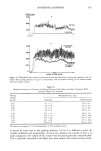
NAIL PERMEATION 373 The permeation parameters of great toenails and thumbnails are compared in Table II, which shows that these nails differ considerably in thickness, the great toenails being more than twofold thicker than the thumbnails. From the studies with great toenails (described above) it was seen that the thicker nails proved to be more resistant barriers to water permeation, resulting in lower fluxes than was observed with thinner nails. Thus, it was anticipated that the thinner thumbnails would have a higher flux than the thicker toenails. However, Table II shows that although the thumbnails were only about one half as thick as the great toenails, their flux values were not statistically significantly different from each other, and the resulting normalized flux values for thumbnails were statistically significantly lower than the J* values of the great toenails (t-test, tx = 0.05). The coefficient of determination for the correlation between flux and thumbnail thick- ness was 0.13. Our data suggest that toenails and thumbnails differ in structure, thus resulting in different J* values. The total water uptake calculated by dividing the total water extracted from the nails by the product of cell area and nail thickness (assuming lateral diffusion is negligible) is also shown in Table II. The total water uptake by thumbnails was statistically significantly higher than that by toenails (t-test, tx = 0.05). These results further suggest that there is an inherent difference in the structure of the keratin network that comprises the thumbnails and toenails. It appears that the thumb- nails have a tighter cross-linked keratin structure as compared to the great toenails, which results in their almost equal fluxes, smaller J* values, and higher total water uptake. To further elucidate nail permeability characteristics resulting from differences in nail location, we compared J, J*, and total uptake values for water from a pair of thumbnails with those from the index fingernails and long fingernails of the same donor. The results are shown in Table III. The thumbnails were about 1.3-fold thicker than the index or long fingernails, which were close in thickness. As was generally expected, the thicker thumbnails resulted in a statistically significantly (approximately twofold) lower flux (J) for water compared with the other fingernails at the 0.05 level of significance by ANOVA. The index and long fingernails had approximately equal fluxes, possibly due to their similar thickness (68% of the variability in flux was associated with changes in thickness for the other fingernails, as estimated from the coefficient of determination). When the flux values were normalized to account for variation in nail thickness (Table III), the resulting J* values for thumbnails were statistically significantly lower than the J* values for the other fingernails at the 0.1 level of significance by ANOVA. Although not statistically significantly different at the conventionally accepted 95% confidence Table II Comparison of Water Permeation Parameters of Great Toenails and Thumbnails Nail Thickness (mm) J (mg cm-2h -•) J* (mg cm-•h -•) Total water uptake (mean + SEM) (mean + SEM) (mean + SEM) (mg cm-3) c Great toenails (n = 4) a 1.33 + 0.16 13.58 + 2.83 1.67 + 0.18 143.09 + 14.88 Thumbnails (n = 6) b 0.51 + 0.02 13.21 + 1.85 0.66 + O.08t 315.92 + 28.96t a Flux and normalized flux values are the results of three repeated measurements on four great toenails. b Flux and normalized flux values are the results of two repeated measurements on six thumbnails. c Calculated by dividing total water present in nails (from extractions) by the product of cell area and nail thickness (assuming lateral diffusion is negligible). •- Indicates statistically significantly different from parameters for toenails (t-test, o• = 0.05).

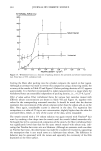
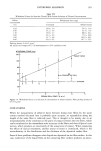
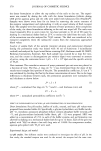
374 JOURNAL OF COSMETIC SCIENCE Table III Comparison of Water Permeation Parameters for Pairs of Thumbnails, Index Fingernails, and Long Fingernails From the Same Donor Nail Thickness (mm) J (mg cm-2h -•) J* (mg cm-•h -1) Total water uptake (mean + SEM) (mean _+ SEM) (mean _+ SEM) (mg cm-3) a Thumbnails (n = 2) 0.66 + 0.02 6.72 + 1.947 0.44 + 0.1277 242.01 + 8.90 Index fingernails (n = 2) 0.56 _+ 0.10 14.52 + 1.08 0.80 + 0.08 283.31 + 32.52 Long fingernails (n = 2) 0.52 _+ 0.06 15.48 * 2.35 0.79 -+ 0.03 361.88 _+ 71.06 a Calculated by dividing total water present in nails (from extractions) by the product of cell area and nail thickness (assuming lateral diffusion is negligible). t Indicates statistically significantly different fromJ of index and long fingernails (ANOVA, tx = 0.05). '•t Indicates statistically significantly different from J* of index and long fingernails (ANOVA, tx = 0.1). level, a difference at the 90% confidence level between the J* values of the thumbnails and other fingernails, using such a small sample size (n = 2), suggests that structural differences exist between the thumbnails and other fingernails. However, the total water uptake values were not statistically significantly different from each other for the three sets of fingernails by ANOVA at the 0.05 level of significance. Thus, our results are suggestive, but not conclusive, that thumbnails have a unique structure and possibly a tighter cross-linked keratin network, as compared to other fingernails, which results in their lowJ and J* values. Moreover, the structure of the nail keratin network appears to be similar for the index and long fingernails from the same donor, and nail thickness appears to be a primary cause for variability in their permeation parameters. Our results indicate that there is a large interindividual variability in nail permeation. Normalizing the parameters for nail thickness helps to remove one source of variability between nails. Further, nail location is important, and thumbnails appear to possess a tighter cross-linked keratin structure than do toenails and possibly other fingernails. EFFECT OF pH ON IN VITRO NAIL PERMEATION OF WATER The normalized water flux values obtained under conditions of acidic, neutral, and alkaline pH are shown in Table IV. A statistically significant increase in the permeation of water under alkaline conditions was observed in experiments using the standard receptor (relative to the neutral gel) at the 0.05 level of significance. However, the flux increase was less than twofold. For the experiments wherein the donor and receptor contained the same buffer, the J* values at acidic and alkaline pH were not statistically Table IV Effect of pH on the Permeation of Water Through Toenails j* (mg cm-•h -•) (mean + SEM, n = 3-6) pH Standard receptor Receptor = Donor 1.96 1.52 + 0.08 1.95 + 0.17 7.01 1.48 _+ 0.10 1.61 + 0.16 11.27 2.09 _+ 0.13• -- 11.69 -- 1.39 _+ 0.10 Indicates statistically significantly different from neutral conditions (t-test, tx = 0.05).
Purchased for the exclusive use of nofirst nolast (unknown)
From: SCC Media Library & Resource Center (library.scconline.org)