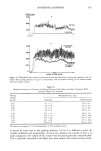
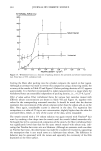
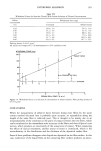
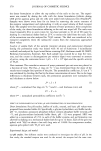
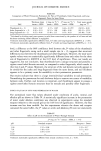
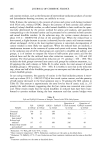
384 JOURNAL OF COSMETIC SCIENCE and cysteine residues, such as the formation of intermediate oxidation products of cystine and lysinoalanine-forming reactions, are unlikely to occur. Table II shows the variation in the contents of cystine and cysteic acid during treatment with TGA only, without DTDG. Despite the presence of both cysteine and carboxy- methyl-3-alanyl disulfide residue, so-called mixed disulfide in hair could not be quan- titatively determined by the present method for amino acid analysis, and quantities corresponding to the decreased cystine can be presumed to be converted to both cysteine and mixed disulfide residues. In the reduction step, the cystine content decreases to about 33% [= 100(89/270)] of that of the untreated hair. When the reduced hair is heat-treated, a slight decrease in cystine is observed, but the cysteic acid content remains almost unchanged. As far as the heat treatment process is concerned, decomposition of cystine residues is most likely not significant. When the reduced hairs are oxidized, a simultaneous increase in the contents of cystine and cysteic acid occurs. Assuming that in the oxidation step all of the thiol groups are converted to disulfide and sulfonic acid groups, it is of interest to compare the values of half-cystine plus cysteic acid for the reduced hairs and for the oxidized hairs after reduction treatment, i.e., 189 and 360 pmole/g. The thiol groups produced by reduction are 171 pmol/g (= 360 - 189). This includes the thiol groups converted into cysteic acid groups by oxidation treatment, i.e., 48 pmole/g (the sixth column in Table II). In other words, the total amount of mixed disulfide groups is 199 pmol/g (= 559 - 360). It is worthy to note that in the reduction step, about one half of the disulfide groups goes to mercaptan and the other half goes to mixed disulfide groups. In our curing treatment, the quantity of cystine in the final oxidation process is recov- ered up to about 91% [-- 100(245/270)] of the initial cystine content, and the quantity of half-cystine decreased in the final oxidation step is 50 pmol/g (the fifth column in Table II). This amount is approximately the same level as that of cysteic acid, i.e., 63 pmol/g (the sixth column), suggesting that the lost cystine was converted into cysteic acid. These results imply that the mixed disulfides in reduced hairs have been trans- formed to cysteine residues during the heat treatment and that cystine bridges were Table II CyS and CySO3H Contents of Samples Treated with TGA-Only System CyS CySO3H Samples (p mol/g) (p mol/g) Quantities of Quantities of 1/2CyS + CySO3H 1/2CyS decreased CySO•H increased (p mol/g) (p tool/g) (p mol/g) Untreated 270 19 559 -- -- Reduced • 89 12 189 362 -7 Reduced and heat-treated 2 78 18 174 384 - 1 Reduced and oxidized • 147 67 360 246 48 Reduced heat-treated and oxidized 4 245 82 571 50 63 • Reduction: 7% TGA, pH 9.20 45øC, 15 min. 2 Heat treatment temperature: 180øC. Reduction conditions are the same as described above. 3 Oxidation: 7% NaBrO3 35øC, 15 min. Reduction and heat treatment conditions are the same as described above. 4 Treatment conditions are the same as described above.

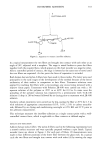
METHOD FOR PERMANENT HAIR STRAIGHTENING 385 reformed in the subsequent oxidation step. Major chemical reactions occurring in each step of the present treatment are represented by the following equations, equations 3-10. Reduction step: KSSK + RSH k• KSH + KSSR KSSR + RSH k• KSH + RSSR (3) (4) where K is the keratin chain, KSSK is the cystine disulfide linkage in keratin, RSH is the reducing agent, KSH is the cysteine residue, and KSSR is the mixed disulfide. The reaction of equation 3 seems to predominate in this reducing system, since, as discussed above, about one half of the cystine disulfides is transformed into mixed disulfides. The occurrence of equation 4 may be dependent on the concentration of reducing agent in the proximity of the mixed disulfide group. In a solid-state reaction, the rate of the reaction of equation 4 can be expected to decrease as a result of the ionic repulsion between carboxylate ion fixed on the keratin chain and thioglycolate ions. Heat treatment step: KSSR + KSH -• KSSK + RSH (5) KSSR + RSH -• KSH + RSSR (6) Equation 5 is the reverse reaction of equation 3, and the reaction may proceed at a lower concentration of reducing agent (RSH), producing cystine linkages. However, the ana- lytical results suggest that no production of cystine residues is involved (the second column in Table II), and therefore, equation 5 may be ruled out. Equation 6, which is essentially the irreversible reaction of equation 4, is considered as the predominant reaction that leads to production of cysteine residues by the reaction of mixed disulfide with the reducing agent remaining in the fibers even after washing with water before heat treatment. In this respect, further study is needed to demonstrate the amount of reducing agent remaining in the fibers. It is important to note that to obtain a high yield of cystine linkages, the mixed disulfide groups must have been converted into cysteine residues before oxidation. Oxidation step: 2KSH --- KSSK (7) KSH --- KSO3H (8) KSSK --- 2KSO3H (9) KSSR --- KSO3H + RSO3H. (10) The reactions expressed by equations 7 and 8 predominate in the oxidation step, as clearly indicated by the previous discussion. Equations 9 and 10 are likely to be com- paratively minor reactions for the case of sodium bromate as a milder oxidizing agent (9). Table III shows the variation of cystine and cysteic acid contents at different heat treatment temperatures. The hair sample used in this experiment contains a higher amount of cystine than the sample shown in Table II. It is emphasized that an almost perfect recovery of cystine linkages is achieved through the oxidation reaction after heat treatment at the higher temperature of 220øC. On the contrary, the recovery level is considerably lower at the heat treatment condition of 180øC, although this makes possible a perfect reformation of disulfide linkages in the fiber with a much lower cystine
Purchased for the exclusive use of nofirst nolast (unknown)
From: SCC Media Library & Resource Center (library.scconline.org)