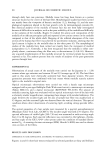
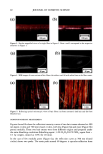
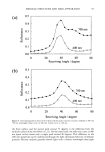
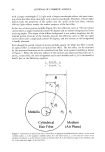
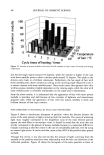
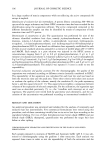
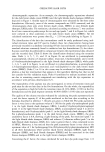
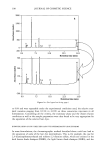
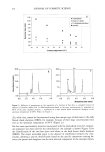
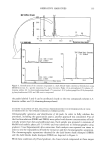
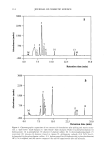
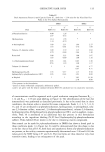
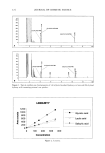
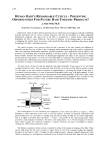
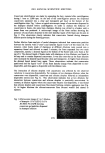
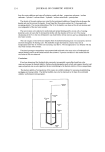
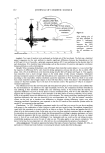
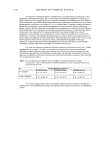
94 JOURNAL OF COSMETIC SCIENCE with a longer wavelength (13), light with a longer wavelength reflects the inner struc- ture of the hair fiber more than light with a shorter wavelength. Therefore, 700-nm light reflects both the properties of the surface and the inside of the hair fiber, whereas 400-nm light reflects mainly the surface property of the hair fiber. In the case of more porous medulla (Figure 6b), the reflection curve at 700 nm (closed circles) shows a single broad peak around 40 degrees and an intense background at lower receiving angles. The origin of the diffuse background is not surface roughness but the internal porous structure of the medulla, because the reflection curve at 400 nm (open circles) shows also a single peak around 40 degrees, and the increase in the background is hardly observed. Even though the partial content of porous medulla against the whole hair fiber is small, its optical effect is enhanced by an optical lens effect. The lens effect can be estimated by the structural formation of the cylindrical hair fiber with centered medulla as shown in Figure 7. When the refractive indexes of the medium (air phase) and hair fiber are n• and n 2, respectively, the ratio of apparent and actual medulla radii (ra/r) is calculated by Snell's law, as the following equation: ra R sin 0• •2 r R sin 02 n I i i ! / • I/"/ I Medium Hai (Air Phase) Figure 7. Estimation of optical lens effect of hair fiber on apparent medulla thickness, where r is the actual medulla radius, r a is the apparent medulla radius, R is the fiber radius, n• is the refractive index in the medium (air phase),/'/2 is the refractive index in the hair fiber, 0• is the refraction angle in the medium, and 02 is the refraction angle in the hair fiber.

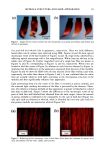
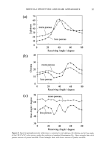
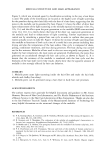
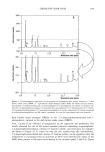
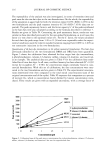
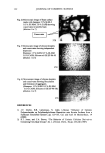
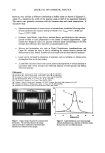
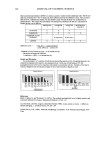
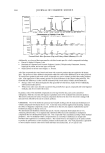
MEDULLA STRUCTURE AND HAIR APPEARANCE 95 (a) (b) 70 60 • 50 • 30 20 10 0 0 40 30 20 l0 20 40 60 80 Receiving Angle / degree more porous • less porous I I I 0 20 40 60 80 Receiving Angle / degree (C) 70 • 60 e• 50 m 40 more porous\ 0 I I I 0 20 40 60 80 Receiving Angle / degree Figure 8. Spectral goniophotometric reflectance is converted to (a) lightness, (b) chroma, and (c) hue angle of the CIE L*a*b* color system, under the condition of standard illumination D65. Open triangle: hair with greater amount of porous medulla. Closed triangle: hair with lesser amount of porous medulla.
Purchased for the exclusive use of nofirst nolast (unknown)
From: SCC Media Library & Resource Center (library.scconline.org)