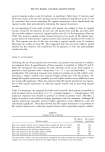
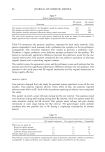
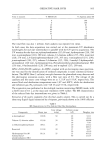
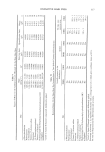
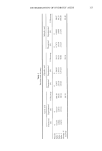
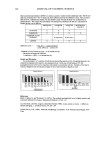
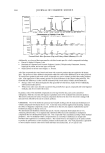
118 JOURNAL OF COSMETIC SCIENCE 2 giving confidence limits of 95% (Re + 2s), following the recommendations included in the Eurachem guide (8). It comes out that in all cases, whether the target hair dye has been spiked or not, the recovery is comprised between 92% and 110% except for 2,4-dat in the blond shade (130%). As shown in Table VI, the recoveries obtained, as well as the expanded uncer- tainties, are considered to be very good. Therefore, this whole procedure appears to be suitable for a complete identification and quantification of these hair dye intermediates. CONCLUSION The optimization and the validation of the analytical procedure for the determination of commonly used oxidative hair dyes by RP-HPLC coupled with DAD detection after a liquid-liquid extraction has been performed on commercial formulations. Five formu- lations, each containing five or six hair dyes, have been analyzed, two of these formu- lations having also been spiked. In each formulation, all the hair dyes could be clearly identified, using both their individual retention times and UV spectra and, in some cases, their mass spectral characteristics. The analysis also showed a very good repeat- ability in terms of retention times and peak areas for all thirteen hair dyes in the five formulations. From a quantitative point of view, calibration lines were performed for nine hair dyes, and in all cases excellent linearity was obtained for concentration ranges commonly found in commercial formulations with very low detection limits. The concentrations of each hair dye in the two formulations tested could be determined with an excellent percentage of recovery in each formulation, in most cases comprised between 92% and 110%. As a whole, the validated procedure thus appears to be highly appropriate for the identification and the quantification of oxidative hair dyes in real commercial permanent hair dyeing formulations. In a next step, the method will be proposed for an intercom- parison between European laboratories in order for it to be fully validated and proposed as a candidate reference method for the European Commission. ACKNOWLEDGMENTS We thank COLIPA and L'Oreal for providing raw materials and information. We also thank F. Cordeiro Raposo for his great help in performing the statistical calculations and Dr. G. Van Vyncht for his great help in performing the mass spectrometry. This work was carried out in the frame of support to DG "Enterprise" of the European Commission. REFERENCES (1) European Union Cosmetic Directives 76/768/ECC, OJ, L262, 169-200 (September 1976) 95/17/EC, OJ, L140, 26-29 (June 1995). (2) J. Wenninger and G. N. McEwan, Eds., International Cosmetic Ingredient Dictionary and Handbook, 7th ed, (Cosmetic, Toiletry, and Fragrance Association, Washington, DC, 1997), Vols. 1-3. (3) COLIPA: Personal communication (1994). (4) L'Or6al: Personal communication (2000).

OXIDATIVE HAIR DYES 119 (5) (6) (7) (8) (9) (10) E. Pel, G. Bordin, and A. R. Rodrfguez, HPLC candidate reference method for oxidative hair dye analysis. I. Separation and stability testing,,/. Liq. Chrom. Re/. Techno/., 21,883-901 (1998). U. Vincent, G. Bordin, and A. R. Rodroeguez, Influence of matrix compounds on the analysis of oxidative hair dyes by HPLC, J. Cosmet. Sci., 50, 231-248 (1999). U. Vincent, G. Bordin, and A. R. Rodroeguez, Validation of an analytical procedure for the determi- nation of oxidative hair dyes in cosmetic formulations,,/. Cosmet. Sci., 53, 43-58 (2002). S. L. Ellison, M. Rosslein, and A. Williams, Eds., Q•antifying Uncertainty in Analytical Meas•rement (Eurachem/CITAC Guide, 2000), pp. 1-120. U. Vincent, Practical Aspects of the Determination of Oxidative Hair Dyes by RP-HPLC--Development of a Database (Annual Report, GE/R/ACH/04/99, 1999), pp. 1-24. L. R. Snyder, J.J. Kirkland, and J. L. Glajch, Practical HPLC Method Demlopment, 2nd ed. (Wiley- Interscience, New York 1997), pp. 24, 29, 208-210.
Purchased for the exclusive use of nofirst nolast (unknown)
From: SCC Media Library & Resource Center (library.scconline.org)