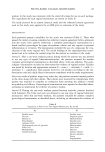
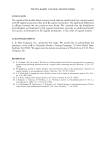
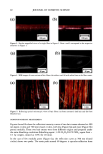
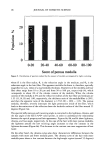
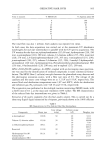
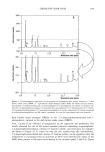
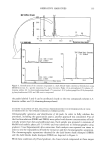
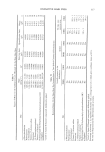
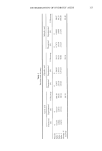
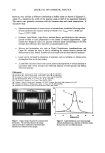
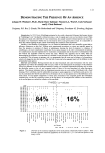
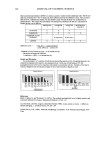
2001 ANNUAL SCIENTIFIC MEETING 141 DEMONSTRATING PmSENC OF AN Johann W. Wiechers l, Ph.D., Marie-Clare Taelman 2, Vincent A.L. Wortel l, Cock Verboom • and J. Chris DederenL Uniqema, PO. Box 2, Gouda, The Netherlands and •Uniqema, Everslaan 45, Everberg, Belgium Introduction: In 1935, Erwin Schr6dinger preõented to the world a theoretical dilemma that became known as "Schr6dinger's cat". He placed a radioactive atom, a vial of cyanide and a cat in a box that he closed. When the radioactive atom with a half-life of I hour would decay, the cyanide would be released and the cat would die. He asked if we would know whether the cat was dead or alive at any given point in time. It is impossible to know this without opening the box, which would change the conditions of the experiment. Similarly to the dilemma of Schr6dinger's cat, we wanted to demonstrate that a new emulsifier system had no influence whatsoever on skin feel. Whereas most experimental procedures in science are typically geared to show the presence or existence of objects or phenomena, showing the lack of presence, i.e. absence, of something is a lot more complicated, in particular if you cannot measure it. In order to demonstrate the absence of a contribution to skin feel implied that we would have to demonstrate that the skin feel of a formulation with and without the emulsifier would be exactly the same. Whereas this approach can be easily taken for demonstrating the influence of an emollient or a thickener on the perception of skin feel, this cannot be done for an emulsifier. This is because its primary role is to permanently mix the water and oil phases of a formulation, which will change the skin feel anyway. The skin feel of water and oil as separate layers will be different to that of emulsified water and oil. Materials and methods: Having assessed that the ideal benchmark (the same formulation with the same ingredients but without the emulsifier) did not exist, could we still demonstrate the presence of this absence? Using four different oils and six different emulsifier systems, we compared formulations differing only in either the emulsifier system or the oil, and compared some of those to the non-formulated oil using descriptive analysis. This sensory technique relies on obtaining an accurate score on a set number of attributes with a fixed meaning. The 31 attributes could be subdivided into groups to assess appearance (3 attributes), pick-up (4), rub- out (8), immediate after-feel (8) and after-feel at 20 minutes (8). As we anticipated some of the differences to be really small, we used paired comparisons in which every formulation was compared against the formulation containing the 'no skin fell' emulsifier system. In the first phase, we investigated the influence of the emulsifier, in the second phase we studied the influence of the emollient. PHASE! I p-values COMP • B4 MS 64 B3 qS D3 • • • = • ß 83 VS 63 * • * B2 VS F2 = • • B2 VS EZ • • B2 VS D2 • B2 VS C2 • BI VS FI • , A2 VB B2 • X H S k S • • K I I I I f • X X S K E E 2 2 2 • • • R D i S S 0 0 0 E I U S N•F 0 S Ct F 0 0 , attr •butes dot: •)0. OS •e•wiew of the stan•tical sign•cance I•el of all paired comparisons made in ph•e 1. Blue asteris• re•resent statistical sigm•cance at the I•el O. OI p 0.0• and red squares at the l•el • O. OI. Figure 1:

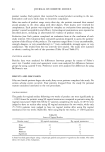
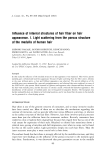
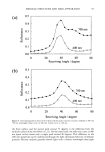
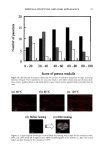
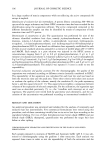
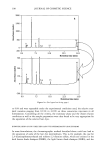
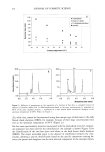
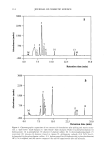
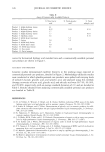
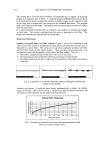
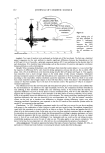
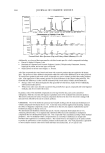
142 JOURNAL OF COSMETIC SCIENCE o- -o 2 - PC1 0 0 1 0 2 0 3 0'4 0•5 0'6 -0 2 -0 1 APR+AF-olI, X-expl 59%,19% Figure 2: PCA loading plot of the data obtained in phase 2, indicating that emulsifiers separate the APR attributes on PC1 and emollients separate the AF attributes on PC2. Analysis: Two types of analyses were performed on the data sets of the two phases. The first was a statistical paired comparison test for each attribute to identify significant differences between the formulations at the p=0.05 and 0.01 level. Secondly, a principal component analysis (PCA) was performed on the absolute data for each formulation. PCA identifies linear relationships such as the existence of a positive and negative correlation between attributes as well as formulations. Results: When comparing formulations only differing in their emulsifier system (phase 1), it was noticed that the majority of differences (84%) were observed during appearance, pick-up and rob-out, the so-called APR- phase. Only 16% of all differences were observed during the after feel (AF) phase (see Figure 1). This suggests that emulsifiers have a much stronger impact on the initial phase of skin sensory evaluation. Subsequent principal component analysis revealed that formulations were separated on the first principal component (PC1) according to their emulsifiers, whereas emollients caused the separation on PC2. However, while it was noted that certain emulsifiers had a bigger impact on skin feel than others, results from phase 1 did substantiate the concept of 'skin feel neutrality' due to the lack of the relevant control. The question of "what is no impact?" remained unanswered. The differences between the non-formulated and formulated oils (phase 2) were immense and confirmed that the non-formulated oil was indeed not the right benchmark. However, the comparisons between formulations only differing in their emollients yielded some very interesting results. It was noticed that the majority of significant differences was now in the AF phase of sensory evaluation (59%), with 41% in the APR-phase. This suggests that the impact of emollients is more dominant in the later phases of sensory evaluation, but not solely. Some of the carefully chosen oils differed only in a few attributes. The various emulsifiers introduced all kind of significant differences that were not observed for the non-formulated oils. The "skin feel neutral" emulsifier system was the only not to introduce new differences or eliminate existing differences. Again, even when comparing emollients, formulations were separated on the first PC based on their emulsifier systems while the second PC was separated on the emollients. Conclusions: In 1935, Schr6dinger experiment taught the world that you can not be sure about anything with respect to the combination of exact location in space and exact point in time. Nevertheless, humans have coped with that uncertainty on a macro-scale for as long as we know. We have diaries and agendas that tell us where to be at what moment in time. In the same way as we now from practical experience that we can agree to be somewhere at a given point in time, despite this being impossible according to quantum mechanics, we know from practical experience that the new emulsifier system does not contribute to skin feel. However, we cannot prove it. Even if you would make Schr6dinger's box transparent and you could see the cat licking its paws, scientifically speaking you can not be sure of what you see. The same applies to our sensory evaluations. You know it to be true, but you cannot prove it. After all, how do you demonstrate the presence of an absence? Acknowledgements: The authors appreciate the help of the team at Sensory Spectrum, Chatham, NJ, USA, in particular Lee Christie and Lynn Carlone, in executing the sensory studies described in this paper.
Purchased for the exclusive use of nofirst nolast (unknown)
From: SCC Media Library & Resource Center (library.scconline.org)