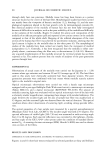
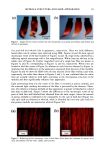
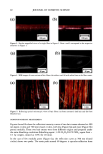
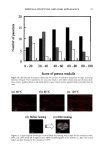
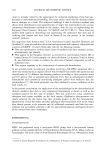
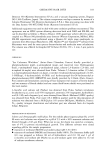
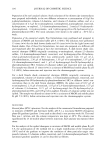
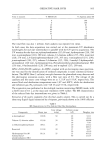
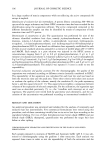
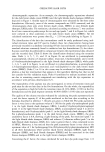
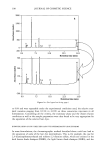
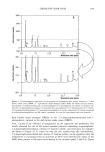
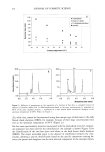
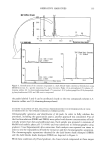
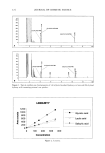
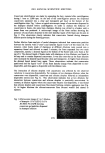
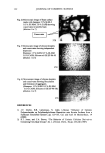
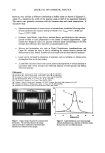
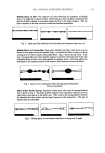
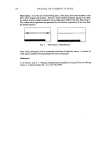
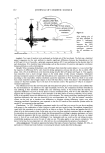
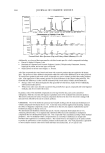
2001 ANNUAL SCIENTIFIC MEETING 139 Holding Spray on Hair: The sequence of events following the deposition of holding spray on a single hair is shown in Fig.4. Film break up to form droplets is extremely fast and the droplets coalesce by movement along the fiber to for larger droplets. This can lead to deposits on the fiber which are visine and therefore undesirable. Fig. 4 Light spray film break-up to form droplets and subsequent spray dry-out. Holding Spray on Crossing Hair: Since a hair assembly has fibers which cross over one another at low angles along with parallel fibers, we studied the effect of sprays on fibers crossing at 8 ø as well as loosely held parallel fibers. Figs. $ shows the end result. In the case of crossing fibers the spray droplets migrate to the fiber intersection and in the case of parallel fibers the fibers are pulled together by capillary forces. Both these effects are dominated by the Laplace pressure of the concave liquid meniscus between the fibers. Fig. 5 Spray on two crossing hair fibers showing liquid being drawn into the intersection. Effect of Hair Surface Energy: Interaction of hair spray with a pair of crossing bleached hair is shown in Fig. 6. The spray droplets migrate to the intersection forming a bow tie rather than a neat bead as in the earlier case. This is due to the strong adhesion between the bleached hair fiber surface and the liquid meniscus at the intersection. This type of deposits may be undesirable. Fig. 6 Holding spray on two bleached hair fibers crossing at an 8 ø angle.

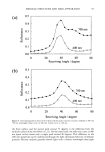
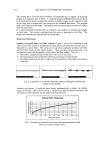
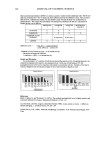
140 JOURNAL OF COSMETIC SCIENCE Shine Spray: As in the case of the holding spray, shine spray also forms droplets on the fiber, which migrate and coalesce. However, these droplets ultimately spread on the fiber by surface tension gradient generated forces (Marangoni Effect) into thin films (Fig.7). The surface tension gradients are generated by the selective evaporation of solvents from the droplet meniscii. Fig. 7 Shine spray on bleached hair. Most of the information will be presented in the form of real time videos. A number of other aspects related to this phenomena will also be discussed. References K. G. Kornev, and A. V. Neimark, Hydrodynamic Instability of Liquid Films on Moving Fibers, J. Colloid Interface Sci., 215, 381-396 (1999).
Purchased for the exclusive use of nofirst nolast (unknown)
From: SCC Media Library & Resource Center (library.scconline.org)