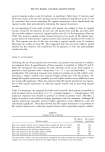
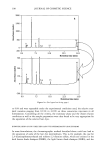
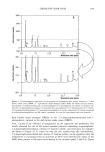
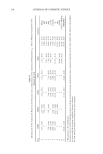
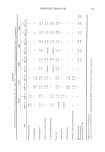
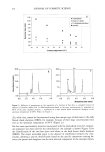
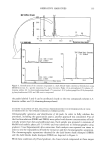
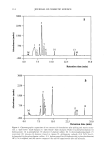
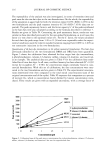
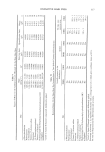
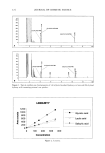
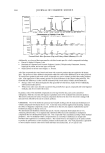
104 JOURNAL OF COSMETIC SCIENCE Preparation of the stock standard solutions. Stock solutions of the thirteen dye intermediates were prepared individually in the two different solvents at a concentration of 10g/l for p-phenylenediamine, toluene-2,4-diamine, and toluene-2,5-diamine sulfate, and at a concentration of 2.5 g/l for m-aminophenol, 0-aminophenol, p-aminophenol, resorcinol, hydroquinone, tx-naphtol, 2,4-diaminophenoxyethanol, 2-methyl-5-hydroxyeth- ylaminophenol, 6-hydroxyindole, and hydroxypropyl-bis-(N-hydroxyethyl-p- phenylenediamine) HCI. The stock solutions were shown to be stable at -30øC for a week. Preparation of the commercial samples. Five formulations were purchased and prepared in mixtures of MeOH and Soerensen buffer pH 8.1 (40%). The dilutions were performed 15 times (w/w) for the dark brown shades and 10 times (w/w) for the light brown and blonde shades. Out of these five formulations, two were also prepared at a different pH and reanalyzed after the spiking of hair dye intermediates. A dark brown shade com- mercial shampoo (DBRS) originally containing m-aminophenol, toluene-2,5-diamine sulfate, 2,4-diaminophenoxyethanol, resorcinol, and hydroxypropyl-bis-(N-hydroxy- ethyl-p-phenylenediamine) HC1 was additionally spiked with 10 g/1 of p- phenylenediamine, 2.50 g/l of hydroquinone, 1.95 g/l of m-aminophenol, 1.97 g/l of 2,4-diaminophenoxyethanol, and 1 g/l of hydroxypropyl-bis-(N-hydroxyethyl-p- phenylenediamine) HCI. Toluene-2,5-diamine sulfate and resorcinol were not spiked. The sample was diluted 25 times (w/w) in a mixture of MeOH and mobile phase B, pH 5.9 (40%), before extraction and injection into the chromatographic system. For a dark blonde shade commercial shampoo (DBLS) originally containing m- aminophenol, toluene-2,5-diamine sulfate, 2,4-diaminophenoxyethanol, resorcinol, and hydroxypropyl-bis-(N-hydroxyethyl-p-phenylenediamine) HC1 at different initial con- centrations than in the dark brown shampoo (DBRS), the spikes were of 0.67 g/l of m-aminophenol, 2.33 g/l of resorcinol, 1.10 g/1 of 2,4-diaminophenoxyethanol, 5.27 g/l of toluene-2,4-diamine, 0.21 g/l of hydroxypropyl-bis-(N-hydroxyethyl-p- phenylenediamine) HCI, and 0.96 g/1 of o•-naphtol. Toluene-2,5-diamine sulfate was not spiked. The sample was diluted ten times (w/w) in a mixture of MeOH and mobile phase B, pH 5.9 (40%), before extraction and injection into the chromatographic system. PROCEDURES Reversed-phase HPLC separations. For the analysis of the commercial formulations prepared in mixtures of MeOH and Soerensen buffer, pH 8.1, a non-linear MeOH (A)/aqueous phase (B) gradient (gradient 1) was used as described in our previous work (6). The total flow was 1 ml/min, and the column temperature was kept at 48øC. The column was equilibrated by 25 ml mobile phase between injections. Each analysis was repeated three times. For the analysis of the spiked shampoos in mixtures of MeOH and mobile phase B, pH 5.9, the optimization of the method led to a slight modification of the temperature (50øC) and of the gradient to improve the resolution of three particular target com- pounds (toluene-2,5-diamine sulfate, resorcinol, and 2,4-diaminophenoxyethanol). This optimized gradient (gradient 2) can be described as follows:

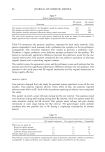
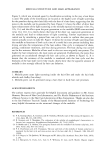
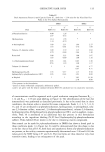
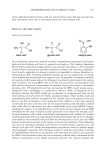
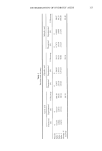
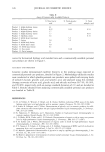
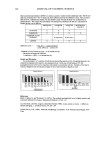
OXIDATIVE HAIR DYES 105 Time in minutes % MeOH (A) % Aqueous phase (B) 0 0 100 1 0 100 2O 19 81 30 80 20 35 8O 2O 40 95 5 5O 95 5 53 0 100 74 0 100 The total flow was also 1 ml/min. Each analysis was repeated ten times. In both cases the data acquisition was carried out at the maximum UV absorbance wavelengths for each dye intermediate in parallel with the UV spectra acquisition. The UV maxima for the dyes are p-phenylenediamine (235,90 nm), hydroquinone (220, 290 nm), m-aminophenol (230, 280 nm), toluene-2,5-diamine sulfate (235,290), resorcinol (220, 270 nm), 2,4-diaminophenoxyethanol (235,295 nm), 0-aminophenol (235,290), p-aminophenol (220, 297), toluene-2,4-diamine (235, 290), 2-methyl-5-hydroxyethyl- aminophenol (240 nm), hydroxypropyl-bis-(N-hydroxyethyl-p-phenylenediamine) HC1 (256 nm), 6-hydroxyindole (220, 290 nm), and o•-naphtol (235, 290 nm). HPLC-DAD-ESI/MS conditions. An HPLC coupled with an electrospray mass spectrom- eter was used for the identification of coeluted compounds in some commercial formu- lations. The HPLC flow (1 ml/min) was split between the photodiode array detector and the electrospray ionization source, with a flow rate ratio of 9/1. The voltage of the capillary and the source cone voltage were set at 3.2 kV and 15 kV, respectively. The source block and desolvation temperatures were 130 ø and 400øC, while the desolvation and nebulizer gas (NQ pressures were 548 1/h and 53 l/h, respectively. The acquisition was performed in the multiple reaction monitoring (MRM) mode, with a dwell time of 0.1 s, at the mass unit resolution (10% valley). The MS characteristics of the selected hair dye intermediates are given in Table I. Extraction of the matrix components from the final analyte solution. This is carried out by a three-step liquid-liquid extraction by n-heptane, previously shown to be 100% efficient Table I MS Characteristics for Five Selected Hair Dye Intermediates Cone voltage Collision energy Compounds Parent ions (volts) (eV) Daughter ions m-Aminophenol 110.06 30 20 93.11 2O 65.13 Toluene-2,5-diamine sulfate 123.09 30 20 108.08 30 77.01 2,4-Diaminophenoxyethanol 169.11 25 20 124.12 20 108.13 Resorcinol 111.04 30 15 93.17 2O 65.19 Hydroxypropyl-bis-(N- 361.31 25 25 165.22 hydroxyethyl-p- 40 121.15 phenylenediamine) HC1
Purchased for the exclusive use of nofirst nolast (unknown)
From: SCC Media Library & Resource Center (library.scconline.org)