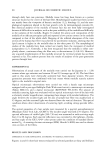
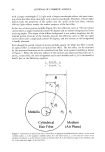
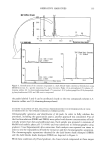
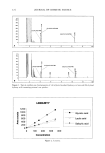
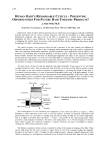
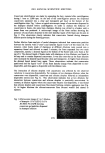
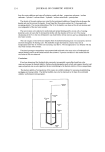
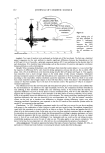
2001 ANNUAL SCIENTIFIC MEETING 129 varies as the fourth power of the hair's diameter (1). Furthermore, in a fibre of diameter 70 gm, an outer shell of the same thickness as that of the cuticle would contribute almost 50% of the bending resistance. The elastic moduli of various components of the hair have recently been determined. Using this information in the simplistic model one f'mds that the exocuticle could be contributing as much as 66% to the total bending stiffness and the endocuticle only a matter of 8% (2). The model, however, is NOT a good one because it fails to take account of the geometric arrangement of the cuticle cells in the fibre. Neither does it take account of the transfer of stress between the different parts of the structure as the fibre is bent the latter being something highlighted by Feughelman (3) in relation to setting processes involving the cortex. On the other hand the model's simplistic outcome provides a goal to be striven for and highlights the opportunities that might be presented by modifying the behaviour of the cuticle to cosmetic advantage. Hair outer surface Angle I ...... •'•-• , ,, •_•,, ,•o :,'' • ,,, Figure 2. Schematic of the :Y'•'••'' '•••' ', '-"• • through the cuticle. . •/•,,-., ,',, - •'•,, •. 3._• • • ,,,• ',,/• • •,,,r• .......... ..... ..•' A_layer • ufi-•ele //to fibre Cell membrane oe long axis complex Exoeu tiele A better model for predicting the influence of the cuticle upon bending processes in hair is to consider longitudinal bending about a section of the cuticle as shown in figure 2 where we now take account of the geometry of the layers, their internal chemistry and physical properties. A key event is of shear between the different layers. Bending stress in the stiffer outer layers (exocuticle + A-layer) will be transferred in the assembly to the softer endocuticle, leading its distortion. Such shear distortion of the endocuticle will occur particularly in the wet state and under extreme stress it will fail mechanically, as indeed has been frequently seen in the scanning electron microscope (4). The outcome predictably is for the cuticle to make little contribution to the hair's overall bending stiffness, On the other hand cosmetic processes aimed at increasing the shear strength of the endocuticle (and it is very accessible to reagents penetrating from the fibre surface!) ought to significantly increase the cuticle's influence upon hair bending stiffness. Such potential processes will be discussed both in terms of increasing the hair's apparent thickness and in terms of setting processes. References (1) J. A, Swift. Internat. ,/. Costnet. Sci. 17, 245-253 (1995) (2) J. A. Swift, J. Costnet. Sci. 51, 37-38 (2000) (3) M. Feughelman, J. Soc. Cosmet. Chern. 42, 129-131 (1991) (4) M. Gamez-Garcia, J. Cosmet. Sci. 49,213-222 (1998)

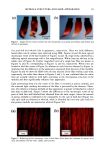
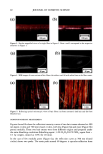
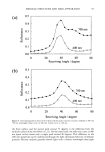
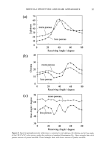
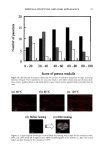
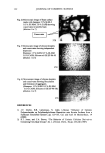
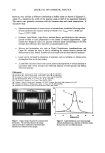
130 JOURNAL OF COSMETIC SCIENCE FOAM PROPERTIES OF SHAMPOOS AND THEIR EFFECTS ON SOIL REMOVAL AND INSOLUBLE ACTIVE DEPOSITION Manuel Gamez-Garcia, Ph.D. Amerchol Technical Center, 136 Talmadge Road, Edison, NJ INTRODUCTION Understanding the process of soil removal and insoluble active delivery from anionic detergent compositions is crucial in formulating efficient shampoos. The dynamics and complexity involved in a shampooing process makes, however, difficult the accomplishment of this task. It is well known that during hair washing a shampoo undergoes various phase transformations. For instance, at the point of application the shampoo is a colloidal liquid that may contain coacervates or precipitates because of its primary dilution. Then, during the lathering step this colloidal liquid is converted into foam. Finally, during the rinsing step the foam is transformed into a complex mixture of foam and gas emulsion. These phase changes during the shampooing process do not occur in definite steps, but rather in a gradual manner with the phases tending to overlap in time. For instance during shampoo application, the initial shampoo composition is simultaneously diluted and sheared to produce foam. Subsequently, during rinsing only a portion of the foam reaches dilution conditions the rest of the foam remains undiluted while a great portion of it is removed mechanically by the water stream. This paper presents data which shows that coacervates formed during the foaming process persist and partition within the foam between the lainella walls ("crust") and the lamella liquid ("core") of the foam. Coacervate dispersability in the foam "core" of model shampoos was found to change with water dilution ratio. As the foam dilution ratio increased the coacervates in the "core" were seen to change from dispersible, to non-dispersible, and then to dispersible again at high dilutions. It was also found that depending on the polycation molecular weight, these changes in coacervate behavior, produced either insoluble droplet stabilization or hetero-flocculation. Droplet stabilization by coacervates was found to inhibit insoluble deposition on hair surfaces, while droplet hetero-flocculation by coacervates enhanced insoluble deposition. METHODOLOGY Deposition of silicon on hair was carried out by X-Ray Fluorescence using the method of Gruber et al (1). Identification and quantification of coacervates was carried out by Optical Microscopy and Centrifugation. Measurements of polymer substantivity to hair were performed using the quantitative dye technique described by Jones et al (2). Hair tresses, 2 inches wide and 8 inches long with 2.5 grams constructed using European Medium Brown hair from IHI (Valhalla, NY) were used in the quantitative analysis. RESULTS When 10 grams of two model shampoos with composition SLES-2/JR-30M/CAPB and SLES-2/JR-30M/DCDAC, respectively, were diluted in a 1-7 ratio they gave rise to the formation of hazy solutions indicating phase separation and formation of coacervates.
Purchased for the exclusive use of nofirst nolast (unknown)
From: SCC Media Library & Resource Center (library.scconline.org)