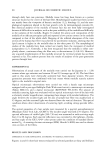
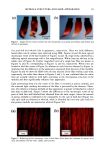
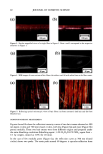
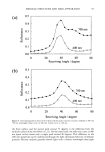
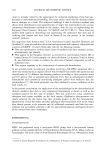
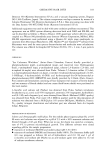
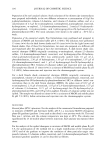
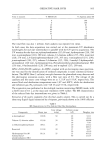
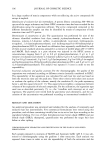
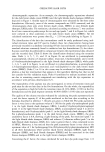
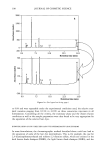
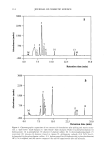
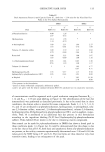
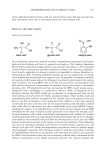
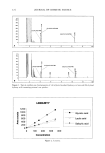
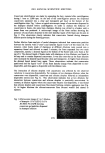
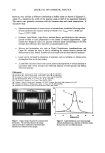
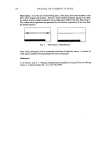
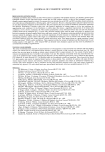
DETERMINATION OF HYDROXY ACIDS 123 of the silylated standard mixture each was injected three times. Routine external stan- dard calculations were used to determine percent for each hydroxy acid. RESULTS AND DISCUSSION METHOD DEVELOPMENT OH H 0%C / OH , CH3--C --C I NOH --CNoH H H lactic acid glycolic acid salicylic acid In our laboratory, there was a need for a simple, straightforward procedure to determine alpha and beta hydroxy acid levels in personal care products. The Cosmetic Ingredient Review Safety Assessment of alpha hydroxy acids and their salts (June 6, 1997) contained a brief overview of previously published analytical methods, but none were straightfor- ward, directly applicable to consumer products, or amenable to routine laboratory in- strumentation. After reviewing published methods, we saw the opportunity to develop a new method that would require less operator time, be amenable to automated analysis, and provide reliable quantitation. Our laboratory was already experienced in the routine assay of salicylic acid using HPLC with a UV detector since lactic acid and glycolic and their salts do not possess a chromophore (an aromatic ring) as does salicylic acid/sodium salicylate, their UV absorptivities are low, and analysis by HPLC would require using a nonspecific lower wavelength or a conductivity detector. HPLC investigations in our laboratory showed that HPLC would not be adequate to simultaneously assay for the three hydroxy acids of interest for reliable automated analysis. These hydroxy acids and corresponding salts could not be assayed by GC directly, due to the polarity of the acid form or the lack of volatility of the neutralized form. However, if the salts could be transformed into their acid form, then all the original hydroxy acids and newly acidified salts could then be derivatized into their trimethylsilyl esters using BSTFA reagent, enabling GC analysis. To accomplish this, our previously invented reagent of acid-DMF (developed for the assay of sodium lauroyl sarcosinate) was utilized for one-step acidi- ficadon/dissolution, after which trimethylsilyl derivatization and capillary GC analysis could be performed. Previous experimentation had demonstrated that salts of carboxylic acids needed to be converted to the acid form for derivatization to occur the acid-DMF reagent would convert all salts of the hydroxy acids into the acid forms. This technology was tried on individual standards and mixtures of sodium lactate, glycolic acid, and salicylic acid, and a GC column and temperature program was chosen to produce proper chromatographic resolution. This technique worked so well that early plans to develop test methodology only for lactic and glycolic acids (and assay the salicylic acid separately by HPLC) were discarded so that this new technology could be used to determine all the analytes sz'm•/tameo•s/y in one sample preparation and GC run. Typical capillary GC

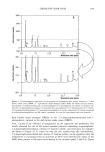
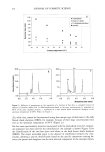
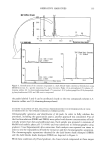
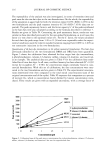
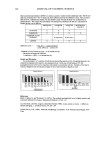
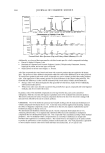
124 JOURNAL OF COSMETIC SCIENCE 600 • • 500 • GLYCOLIC ACID-TMS 400 • LACTIC ACID-TMS •' 300 J SALICYLIC ACID-TMS • 20O • A i i • I• 1•o 112 ' ' mi• pA 160 _ 140 - 120 • • 4004 • GLYCOLIC ACID-TMS 80 - LACTIC ACID-TM, • J SALICYLIC ACID-TMS 60_ ' •/ • 40- • m •. ß • o- ' • • ..... B i • • • 1• 1•2 ' mir Figure 1. Typical capillary gas chromatograms of: (A) silylated standard hydroxy acid mix and (B) silylated hydroxy acid-containing personal care product. UNEARITY 1200 1000 800 •00 400 200 0 ' 0 100 200 300 Concentration 400 Glycolic acid Lactic acid Salicylic acid Figure 2. Linearity.
Purchased for the exclusive use of nofirst nolast (unknown)
From: SCC Media Library & Resource Center (library.scconline.org)