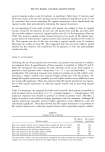
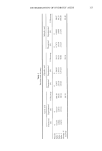
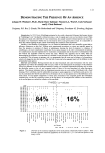
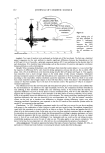
PECTIN-BASED VAGINAL MOISTURIZER 85 received vaginal residue scores of moderate to significant. After those 47 patients used SE for two weeks, only two (4%) patients received moderate-to-significant scores. It can be concluded that pectin-containing SE vaginal moisturizer leaves significantly less vaginal residue than polycarbophil-containing Rp vaginal moisturizer. At the beginning of each study interval, each patient was judged to have no vaginal residue, except for two patients. In each case, the patient first used Rp, and then, after the one-week washout, received a vaginal residue score of 2 at the beginning of her use of SE. One patient's vaginal residue cleared during her two weeks on SE vaginal mois- turizer while the other patient's vaginal residue score increased during her two weeks on SE. This patient was one of the two receiving a vaginal residue score of moderate following two weeks of using SE. This suggested that the one-week washout period allowed for the crossover was insufficient for all patients to clear the polycarbophil residue from Rp. PRODUCT ACCEPTABiLiTY Following the use of each product for two weeks, each patient was required to complete an evaluation form. A quantification of their responses is included in Tables IV and V. Table IV summarizes the responses for both intervals of the study. Each patient re- sponded to each question with a rating from 1 to 7 (1 = very uncomfortable 7 -- very comfortable). The numerical responses were totaled to generate an overall comfort score. Therefore, a higher comfort score indicated higher satisfaction with the product. Al- though SE vaginal moisturizer generally received higher comfort scores, differences were not statistically significant. These data indicated that SE vaginal moisturizer was equiva- lent to Rp vaginal moisturizer in relieving vaginal dryness and in providing vaginal comfort. Table V summarizes the responses for both study intervals. Each patient responded to each statement with a rating from 1 to 7 (1 = strongly disagree 7 = strongly agree). The numerical responses were totaled to generate an overall acceptance score. Therefore, a higher acceptance score indicates stronger agreement with the statement. Although SE vaginal moisturizer generally received higher agreement scores, differences were not statistically significant. These data showed that SE vaginal moisturizer is equivalent to Rp vaginal moisturizer in relieving vaginal dryness and in providing vaginal comfort. Table IV Comfort Scores of Patients SE vaginal Rp vaginal Panelist ratings moisturizer moisturizer Rate your vaginal comfort due to vaginal dryness during the past two weeks 296 278 Rate your vaginal lubrication during intercourse during the past two weeks 293 292 Rate this moisturizer for relieving vaginal dryness 299 295 Rate this moisturizer for providing vaginal comfort 297 294 Rate this moisturizer for overall performance 295 284 The sums of the comfort scores for each patient completing the study are shown for each product. A higher comfort score was considered indicative of a higher degree of satisfaction with the product.

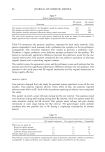
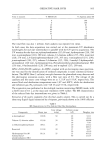
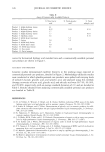
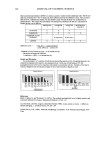
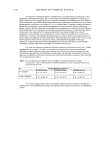
86 JOURNAL OF COSMETIC SCIENCE Table V Patient Agreement Scores SE vaginal Rp vaginal Statement moisturizer moisturizer This product provided relief for the discomfort caused by vaginal dryness 287 277 This product provided relief for vaginal dryness 284 286 This product provided adequate lubrication during sexual intercourse 293 290 The sums of the agreement scores for each patient completing the study are shown for each product. A higher agreement score indicates a higher degree of agreement with the statement. Table VI summarizes the patients' preference responses for both study intervals. Each patient responded to each question with a preference for a product or for no preference (comparable). The numerical responses were totaled to generate a preference score. Therefore, a higher preference score indicates stronger preference for the product. We found no statistically significant differences between the preference scores for the two vaginal moisturizers. Our patients considered the two products equivalent in relieving vaginal dryness and in providing vaginal comfort. The comfort scores, the agreement scores, and the preference scores each indicate that the patients perceived no significant performance differences between the two products. The patients in this study perceived SE vaginal moisturizer and Rp vaginal moisturizer as being equally effective. PRODUCT SAFETY Four patients dropped from the study for personal reasons unrelated to use of the test product. Four patients reported adverse events while on Rp two patients reported adverse events while on SE. Each of the six patients reporting an adverse event completed the study. One patient incurred a yeast infection during her Rp test interval. Two patients noted very transient itching and burning during their Rp interval, while one patient noted the same sensation during her SE interval. One patient noted itching and pain during intercourse at some stage during her Rp interval. The gynecologist noted uniform erythema that was possibly due to SE during a colposcopy examination of another patient. Table VI Patient Preference Scores SE vaginal moisturizer Rp vaginal moisturizer Comparable Which do you prefer for Relief of vaginal dryness? Relief of vaginal discomfort? Lubricant during sexual intercourse? Overall, which do you prefer? 12 13 22 13 13 21 12 14 21 19 19 9 The preference scores for each patient completing the study are shown for each product and for no preference (comparable). A higher preference score indicates a higher degree of preference for the product.
Purchased for the exclusive use of nofirst nolast (unknown)
From: SCC Media Library & Resource Center (library.scconline.org)