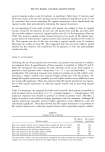
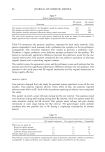
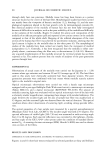
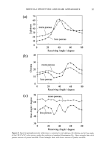
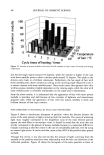
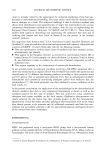
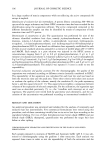
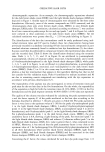
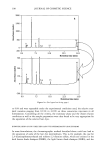
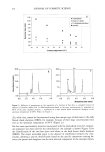
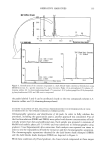
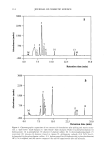
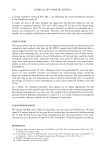
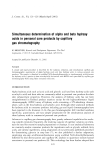
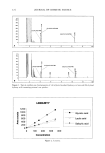
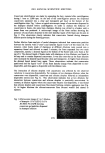
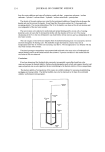
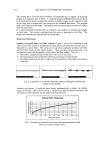
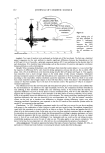
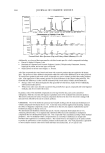
112 JOURNAL OF COSMETIC SCIENCE i , 20 25 30 a • m-am•phenol ß toluene-2,5-diamine ß 2,4- diaminophenoxyethanol t• resorcinol 35 40 45 50 55 60 65 Column temperature (øC) 30.0 30.0 b •_, 22.5- '• 15.0- g 7 7.5 -3.0 0.0 2.0 4.0 6.0 9.0 22.5 - 15.0 - 7.5- -3.0 0.0 5-6 M 7 I I I 2.0 4.0 6.0 8.0 Retention time (min) Figure 2. Influence of temperature on the separation of a mixture of hair dyes. a: standard mixture of toluene-2,5-diamine sulfate and 2,4-diaminophenoxyethanol at the same concentration. b: separation at 60øC of the same standard mixture. c: separation of a dark blonde shade commercial shampoo at the optimum temperature of 60øC. Peaks: see Figure 1. 2b), while they cannot be discriminated using that unique type of detection in the dark blonde shade shampoo (DBLS), for example, because of their large concentration ratio even at the optimum temperature of 60øC (Figure 2c). On-line mass spectrometry detection (associated with the photodiode array for compari- son purposes) was then used for the identification. An example is shown (Figure 3) for the identification of the two hair dyes cited above in the dark brown shade shampoo (DBRS). The major noticeable point is the absence of interference between the com- pounds, allowing a precise identification based on the specific transitions existing be- tween the parent and daughter ions for each selected compound. In the example shown,

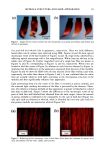
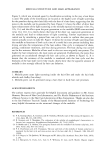
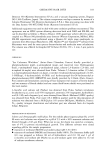
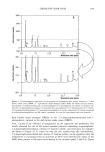
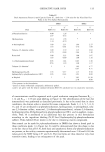
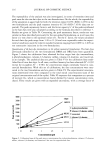
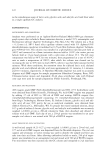
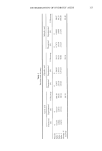
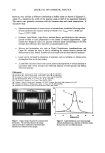
OXIDATIVE HAIR DYES 113 00- V• 7 RP-HPLC/DAD M .0 7.5 15.0 22.5 l•t•tio• tim, (m• '0 1 ! (Total Ionic Curre 100 $.i.:
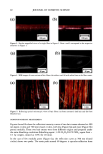
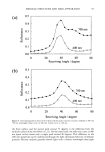
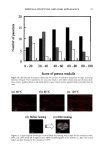
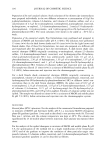
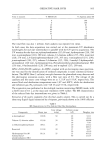
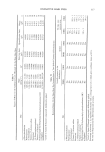
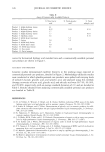
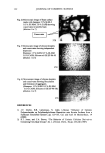
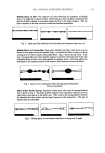
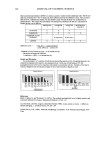
TIC 2.64e6 •[ ø'4øl tl $.t.: 169.1 124.1 It. ]l $.i.: 2.81e3 5 S.t.: 123.1 108.1 S i ....... .-e,..-m.. x-...-va. ........ Tim e .... •.=• .•_.. 2.09e6 ............................. - -' .... Time (ram) 0.0 7.5 15.0 0.0 7,• 1•.0 Figure 3. Identification of the coeluted compounds in a dark blonde shade commercial formulation using MS/MS detection. S.t.: specific transition. S.i.: signal intensity. Peaks: (4)m-aminophenol (5) toluene-2,5- diamine sulfate (6) 2,4-diaminophenoxyethanol (7) resorcinol (13) hydroxypropyl-bis-(N-hydroxyethyl- p-phenylenediamine) HC1 and (M) matrix compound. the peaks labeled 5 and 6 can be attributed clearly to the two compounds toluene-2,5- diamine sulfate and 2,4-diaminophenoxyethanol. IN-HOUSE VALIDATION OF THE ANALYTICAL PROCEDURE FOR THE DETERMINATION OF NINE INTERMEDIATES IN TWO SPIKED COMMERCIAL FORMULATIONS Chromatographic separation and identification of the peaks. In order to fully validate the procedure, including the quantitation aspect, another approach was considered. Two of the five formulations (DBRS and DBLS) were spiked with known concentrations of both initially present hair dyes and additional ones. Each sample was prepared in mixtures of MeOH and mobile phase pH 5.9 (40%) and was submitted to chromatography using gradient 2 (see Experimental) after extraction. Each analysis was repeated ten times in order to test the repeatability of both the extraction and the chromatographic separation. The chromatographic separations obtained for the dark brown shade shampoo (DBRS) and the dark blonde shade shampoo (DBLS) are depicted in Figure 4. With these conditions of pH and gradient, the closest eluted compounds in these ranges
Purchased for the exclusive use of nofirst nolast (unknown)
From: SCC Media Library & Resource Center (library.scconline.org)