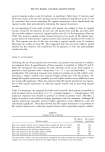
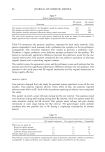
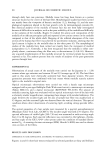
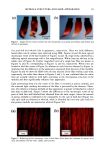
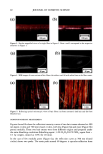
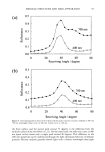
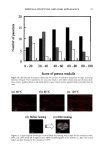
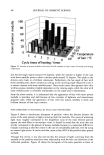
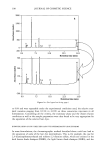
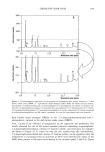
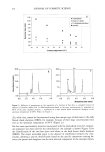
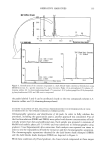
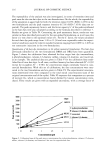
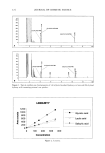
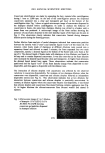
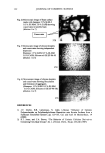
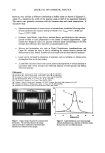
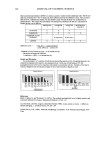
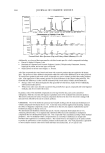
MEDULLA STRUCTURE AND HAIR APPEARANCE 99 Figure 9, which was reviewed again by classification according to the way a hair dryer is used. The peaks of the distribution are located at the higher score of light scattering for the panelists drying their hair fully with the heat of a hair dryer, suggesting that the pores in the medulla can be generated by heat. Figure 11 shows the effect of dryer heat upon enhancement of the light scattering at the medulla (optical microscopic views 11 a, 1 lb, 1 l c) and the effect upon the pore generation at the medulla (SEM cross-sectional views 1 ld, 1 le). It is clearly shown that heat of the dryer can cause pore generation in the medulla and lead to enhancement of light scattering. Further experiments were carried out by simulating a general hair care cycle in order to confirm that pore gen- eration actually occurs in daily life. Figure 12 shows the increase of light scattering from the medulla as functions of both cycle time of a model hair care process including heat drying and also the temperature of the hair surface. One cycle is composed of sham- pooing, conditioner treatment, and heat drying processes. The heat drying was carried out for five minutes. Medullae of hair used in this test were originally non-porous. The higher the hair temperature, the more pores are generated. Furthermore, the pores thus generated are accumulated through the hair care cycles, as shown in Figure 12. It is known that the existence of the medulla is correlated with the hair cycle and the thickness of the hair shaft (4,16). Our results clearly show that the apparent amount of medulla is also strongly affected by hair care behavior. SUMMARY 1. Medulla pores cause light scattering inside the hair fiber and make the hair look whitish and chalky (less shiny). 2. Medulla pores can be generated using a hair dryer in daily hair care processes. ACKNOWLEDGMENTS The authors express their gratitude for helpful discussions and guidance to Mr. Itomi Homma, Director of Hair Care Laboratories, and Dr. Koichi Nakamura of the Institute of Beauty Science in the Hair Care Laboratories of Kao Corporation. Thanks are also due to the late Professor Toyoichi Tanaka of the Massachusetts Institute of Technology for many helpful discussions on the structural changes of the medulla. REFERENCES (1) P. K. Chattopadhyay, K. Gonmori, and N. Yoshioka, Medulla types of hair among the Japanese, Act. Crim. Japon, 60, 142-148 (1994). (2) R. Iwamoto and E. Munakata, The evaluation of the validity of morphological characteristics in forensic hair comparison, Kagakukeisatsu Kenkyuhoukoku, 45, 75-83 (1992). (3) G. Mahrle and C. E. Orfanos, The spongious keratin and the medulla of the human scalp hair, Arch. Derre. Forsch. 241, 305-316 (1971). (4) P.E. Hutchinson and J. R. Thompson, The size and form of the medulla of human scalp hair is regulated by the hair cycle and cross-section size of the hair shaft, Br. J. Dermatol., 140, 438-445 (1999). (5) G. E. Rogers, in The Epidermis, W. Montagna and W. Lobitz, Eds. (Academic Press, New York, 1964), p. 202. (6) J.-L. Bantignies, G. Fuchs, G.L. Carr, G.P. Williams, D. Lutz, and S. Marull, Organic reagent

100 JOURNAL OF COSMETIC SCIENCE interaction with hair spatially characterized by infrared microspectroscopy using synchrotron radiation (Paper No. 33, 20th IFSCC Congress, Cannes, 1998). (7) J. L. Clement, A. LePareux, and P.F. Ceccaldi, The specificity of the ultrastructure of human hair medulla, J. Forensic Sci. Soc., 22, 396-398 (1982). (8) T. Yasuda, T. Sutoh, and N. Seta, Mouhatsu Kagaku Zusetsu 7th, Nihon Mouhatsu Kagaku Kyoukai (1996). (9) C. R. Robbins, Chemical and Physical Behavior of Human Hair, Third Edition, (1994). (10) Vlabo Valkovic, Human Hair (CRC Press, Boca Raton, FL, 1988), Vol. 1. (11) R.F. Stamm, M. L. Garcia, and J.J. Fuchs, The optical properties of human hair. I. Fundamental consideration and goniophotometer curves, J. Soc. Cosmet. Chem., 28, 571-599 (1977). (12) R. F. Stamm, M. L. Garcia, andJ. J. Fuchs, The optical properties of human hair. II. The luster of hair fiber, J. Soc. Cosmet. Chem., 28, 601-609 0977). (13) L.J. Wolfram and L. Albrecht, Chemical- and photo-bleaching of brown and red hair, J. Soc. Cosmet. Chem., 82, 179-191 (1987). (14) A. R. Haly and O. A. Swanepoel, The nature of birefringence, Textile Res. J., 31,966-972 (1961). (15) F. Wakui, Z. Shinjo, T. Ikeuchi, and N. Uchino, Study concerning the luster of human hair, J. Soc. Cosmet. Chem. Japan, 21, 156-161 (1987). (16) M. Glass, The diameter dependence of fiber medulladon and the medulladon weighting function. Textile Res. J., 70, 611-614 (2000).
Purchased for the exclusive use of nofirst nolast (unknown)
From: SCC Media Library & Resource Center (library.scconline.org)