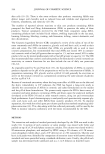
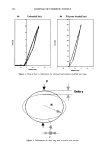
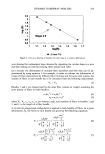
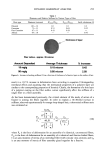
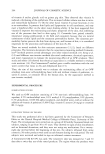
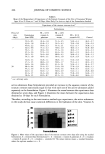
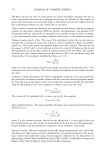
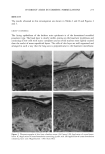
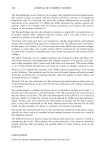
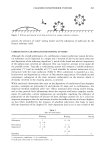
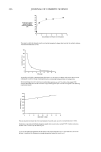
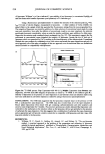
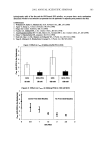
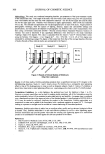
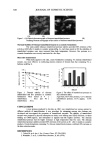
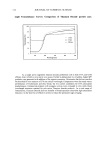
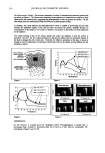
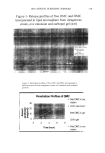
254 JOURNAL OF COSMETIC SCIENCE Thus, the ratio of the force of deformation of fiber bundles with the same fiber volume and different radii, r• and r2, is given by P2 - (8) We have verified equation 8 experimentally by measuring the stiffness of three types of hair with different diameters. The results are presented in Figure 5 and Table I. Figure 5 shows the variation in fiber stiffness for hair tresses with the same volume but differing in fiber diameter. The data demonstrate a decrease in stiffness for thinner fibers. Table I presents a comparison of experimental and theoretically calculated stiffness (according to equation 8) values normalized to the stiffness obtained for Oriental hair, Porient/P. It also includes diameters of the investigated hair measured by using an optical microscope. The values of (Porient/P)th .... and (Pori•nt/P)•xp. are in reasonably good agreement, with experimental ratios being a little smaller than those estimated from the theoretical model. The table also presents the results of Swift's calculations (2), which were per- formed assuming the elliptical nature of Caucasian hair. The effect of fiber ellipticity might explain the lower experimental values of (Potions/P) than those predicted theoret- ically assuming circular cross sections of hair. To analyze the stiffness of hair tresses treated with fixatives we have to consider the total force of deformation of a fiber bundle consisting of n identical fibers with a cross section radius r. Such a force should be a superposition of forces acting on each individual fiber: n•yEI /',, = (9) -- -- For a fiber assembly treated with a fixative, one has to consider the fact that the average thickness of a polymer layer is small as compared to the fiber dimensions as shown in Figure 6. For the amount deposited of 90 mg/g, an increase in radius of 2.58% could 25 20 20.6•1.8 1.4 12.5•1.6 Oriental Caucasian Fine Caucasian Figure 5. Bending stiffness of various types of hair.

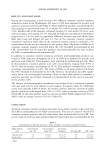
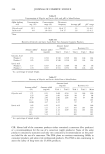
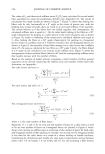
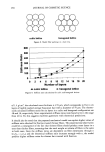
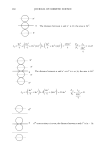
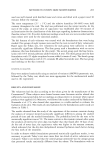
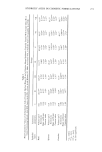
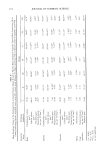
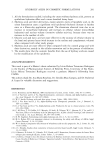
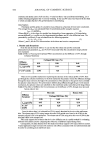
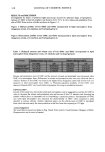
DYNAMIC HAIRSPRAY ANALYSIS 2 5 5 Table I Diameters and Relative Stiffness for Various Types of Hair Hair type Diameter (microns) (Porie,•t/P)•,,p_ Pori•,•t/P)theo•. Swift calculation (2) Oriental 101 + 14 1.0 1.0 1.0 Caucasian 72 + 11 0.51 0.63 0.35 Fine Caucasian 67 + II 0.43 0.59 -- African 64 + 10 -- 0.76 fiber radius - approx. 35 micron Amount Deposited Average Thickness thickness of layer % Increase 15 mglg 0.15 micron 0.42 90 mglg 0.90 micron 2.58 Figure 6. Increase in bending stiffness (%) as a function of thickness of a fixative layer on the surface of hair. result in a 10.7% increase in deformation force according to equation 9 (disregarding interfacial effects and assuming that the mechanical properties of a polymer layer are similar to the corresponding properties of keratin). Clearly, the formation of a thin layer of a polymer coating on the fiber surface cannot significantly affect the stiffness of a single fiber or a fiber assembly. As has been demonstrated previously, the critical element of the mode of action of a fixative is joining the fibers together. In order to explain a 10-30-fold increase in stiffness, observed experimentally for omega-loop-shaped hair, a theoretical stiffness ratio was estimated as: •yEI,l -) P,,1 R3 'rr 1 -- P. - nSyEI I nl I nl (lO) where Pn is the force of deformation for an assembly of n identical, unconnected fibers, Pnl is the force of deformation for an assembly of n identical and fixative-linked fibers, I is an area moment of inertia of an individual fiber (with circular cross section), and Inl is an area moment of inertia of fiber assembly glued together by a fixative.
Purchased for the exclusive use of nofirst nolast (unknown)
From: SCC Media Library & Resource Center (library.scconline.org)